Golf Digest senior writer Alex Myers is on a one-year mission to see how good he can get at golf through daily training, practice and playing. Read more from his “Late Scratch?” series here.
My first foray into caddying earlier this year was both a fun and eye-opening experience. By the end of that day at Rockaway Hunt Club, I thought I had somewhat gotten the hang of it. But that wasn’t truly confirmed until Quaker Ridge head pro Mario Guerra asked to have me back on the bag a couple months later for the 2026 Met PGA Championship.
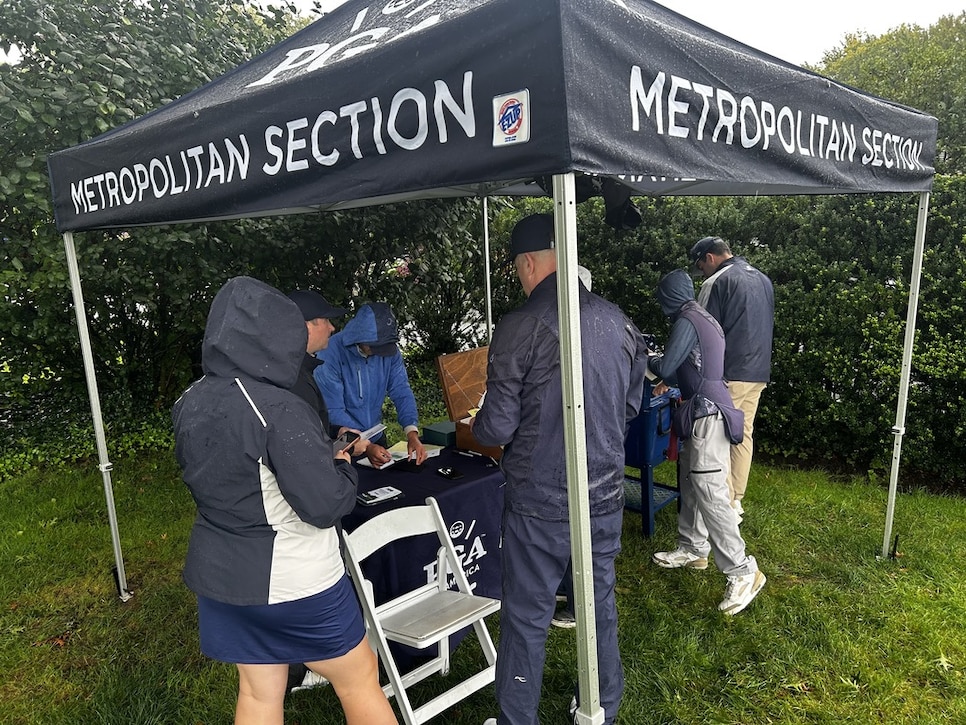
This time, it was a multiple-day event. At Winged Foot. And it was awesome. Well, other than the torrential rain on Day 1 that wound up resulting in those 4-plus soggy holes being wiped away. I learned very quickly that caddying in the rain is extremely tough.
But like at Rockaway Hunting Club, over the course of this event, I also learned a lot of other things from watching this Golf Digest Best In State teacher play up close that, hopefully, can help my golf game—and yours.
Make practice feel real
After hitting some balls, Mario only used one when hitting a few putts to get used to Winged Foot’s famed fast greens. For him this simulated what he’d be feeling when the round started more than if you drop two or three balls and putt from the same spot. Instead, he worked his way around with one ball, picking a target and then playing out that ball into the hole. This matches up with something Jacob Bridgeman, the PGA Tour’s best putter in 2026, recently said.

“I tend to kind of go away from gadgets and drills and everything,” Bridgeman said. “I try and do all my practice in like real life scenarios instead of just getting on the putting green and hitting a bunch of the same short putts over and over and working on my stroke. I try to do real life putts and go through a full routine and keep it simple.”
Stay patient
After an opening bogey on Winged Foot’s East Course on Day 1, Guerra hit a great drive on the par-5 second. He was in position to take a crack at the green in two, but opted to hit an iron to avoid a bunker down the left side and a severe fall-off to the right by the green.
“I don’t want to force anything,” Guerra said. “There will be other opportunities.”
I was impressed by his discipline of not doing everything he could to get that stroke lost on the first hole right back. And the strategy wound up paying off as after a perfect layup, he hit a good wedge and drained a 15-footer for birdie.
Take your medicine
A pulled drive on another par 5 put Mario in a pretty deep fairway bunker. But instead of trying to make up for his poor tee shot, Mario quickly pulled a wedge from his bag and popped one back into the middle of the fairway. It left him with a long third shot, but it took away the possibility of him compounding his first error and making a big number.
RELATED: 9 things I learned caddying in a pro qualifier
Mario has been preaching that kind of course management to me over the past year, but it really hits home when you see it in person. That discipline paid off as Mario wound up finishing T-56 out of the 131 area pros (Congrats to Meadow Brook Club’s Matt Dobyns for winning!) who started the tournament. And while there’s no leaderboard for looping, at one point he said, “You’re going to be a tour caddie by the time this is over.” So, I’ll gladly take that compliment along with the lessons this experiences came with.
But take advantage of opportunities
On Day 2 at the West Course, Mario hit a great drive on the par-5 fifth hole. This time he decided to play aggressively. Why? Because if you’ve played the West Course—or watched any of the U.S. Opens played there—you know that there aren’t many scoring chances, so you need to capitalize on the few that present themselves.
Mario didn’t quite do that in this case, failing to get up and down after a great 3-wood put him up by the green. Still, a stress-free par sometimes feels like a birdie. And on the next hole, the short par-4 sixth, another great drive allowed Mario to take on a tucked pin with a lob wedge and he hit one to just about kick-in range for a birdie. Tournament golf is a lot of playing defense, but when you get a chance to go on offense, you need to be ready.
Make more pro misses
I’ve had a longstanding joke with my golf buddies that if you miss a putt on the high side—AKA the pro side—that it should count as if you made it. Conversely, if you miss on the low side, you get docked an extra stroke. It’s a silly thing my friends do, but after a couple of days watching Mario and other pros, I realized it’s something they take seriously.
RELATED: How to flush more putts (Yes, putts)
One spot where this stood out was the difficult par-3 third hole at Winged Foot’s West Course, which was playing even more difficult than usual with a back-right pin. Mario hit a good tee shot to the left fringe, but a flubbed chip left him with a tough two-putt. Coming up short could have meant the ball coming all the way back to his feet so he erred long and then made the five-footer for bogey. Obviously, Mario wasn’t happy with bogey, but he had avoided disaster. And if you do that a few times a round, those saved strokes really add up—especially at a place like Winged Foot.
Don’t make yourself another opponent
As we played the back nine on Day 2, Mario mentioned he’d been watching “Break Point,” the tennis documentary on Netflix. He recommended the show, but also a philosophy he took from it in that you shouldn’t “play against yourself.” The thinking is that you already have an opponent, so why create another by battling yourself with negative comments?

Of course, this translates to golf, where in addition to actual opponents, you are taking on the golf course as well. And on this day, it was about as difficult of a golf course as they come. But while Mario had begun the day with three consecutive bogeys, his positive demeanor never changed. He kept saying he felt great—and, eventually, he started playing great, going one under over his next eight holes.
RELATED: 7 mistakes I learned playing tournament golf (and how to avoid them)
“If you’ve learned anything from me over the past year, I want it to be that you should never get down on yourself,” Guerra said. “That’s taking the easy route.”
At this point, I’d also like to point out just how hard golf is. Mario played so freaking well that day and he shot 78. Meanwhile a Winged Foot assistant shot 90. On days when I’m really struggling, I’ll definitely keep that in mind and try to cut myself more slack.
Be grateful
But this is actually the lesson I’ll take most from my time working with Mario. No matter how he was playing, no matter how bad the conditions got, no matter how I caddied, he was always happy and appreciative to be out there. Multiple times during the event, he’d just stop, look around, and say something like, “How cool is this? I’m playing a tournament at Winged Foot.”

And he was right. It was cool. So was caddying there for him at the storied course two decades after covering the famed 2006 U.S. Open there. And I was grateful to be back there and for my time spent getting to know and learn from Mario. As the old saying goes, a bad day on the golf course is better than a good day at work. And lucky for Mario and I, those two activities are always intertwined.
RELATED: The mental exercise you should do after every round