Why clubhouses are embracing a new generation with American whiskey.
There was a time when ordering bourbon in the clubhouse felt like making a statement. Now, increasingly, it feels like making a choice.
After a decade of explosive growth, American whiskey has entered a more interesting phase in 2026. The frenzy around hard-to-find bottles and inflated secondary-market prices is cooling, while drinkers are becoming more interested in what is in the glass. Provenance, age, maturation, proof, craftsmanship and, increasingly, value are carrying more weight than simply owning the bottle nobody else can find.
That makes bourbon rather well suited to the modern golf club and the new crowds they house. Like golf, it is a world where tradition matters but connoisseurship is personal. The best bottle is not necessarily the oldest or most expensive; it is the one that rewards attention. And after 18 holes, there are few rituals more satisfying than settling into the clubhouse with a good bourbon, neat or over a single large cube, and replaying the day’s best – and worst – swings.
There is also a welcome shift away from bourbon as a collector’s sport and towards bourbon as something to actually drink. Consumers are splitting into two camps: those seeking approachable, lower-proof expressions for easy sipping and cocktails, and enthusiasts chasing barrel-proof bottlings that deliver intensity and complexity. In between, the old idea that 90-100 proof is the only safe middle ground is beginning to disappear.
“For me, bourbon has always been about enjoyment opening a bottle, sharing a whiskey and discovering what you like,” says Gee David, trade advocacy manager – North American Whiskey, Sazerac AUNZ. “And that’s one of the things I love about Buffalo Trace bourbon. With more than 250 years of whiskey-making behind the distillery, there’s incredible depth to explore, but you don’t need to be an expert to enjoy it. That breadth allows us to respect tradition while responding to how people drink today, offering something for every palate, occasion and pocket.”
Consumers are becoming more considered in what they drink. Quality, provenance, age and craftsmanship are increasingly influencing the decision. Research from NIQ found that 67 percent of spirits drinkers say they are willing to pay more for higher-quality drinks, with many preferring two premium serves to four standard ones.
“At Buffalo Trace Distillery, premium has always meant quality over quantity and craftsmanship beyond price,” David adds. “Like a great round of golf, a great bourbon isn’t about brute force, it’s about balance, precision and character. Quality always wins when every element works together.”
Perhaps that is why bourbon is having its moment now. The hype is settling. The whiskey is getting better. And, much like golf, the more you learn, the less interested you become in simply showing off and the more committed you become to finding something good.
OUR PICKS
Buffalo Trace
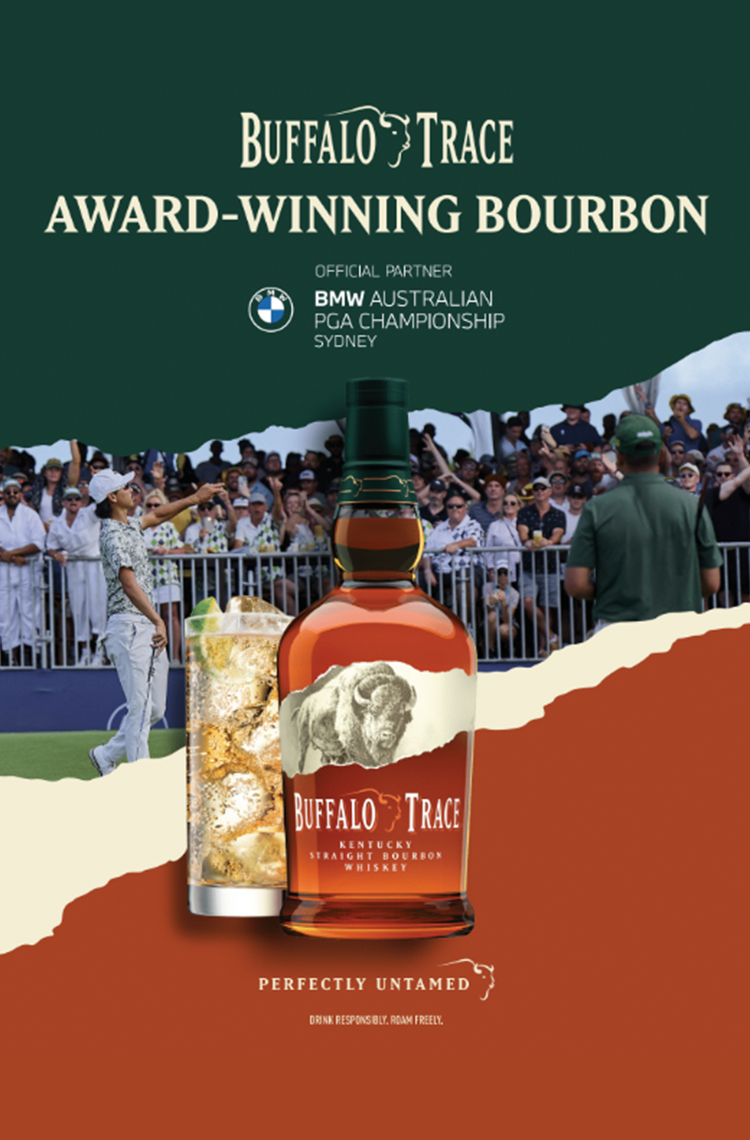
With more than two centuries of bourbon-making heritage, Buffalo Trace has weathered Prohibition, two world wars and generations of changing tastes to become one of Kentucky’s most celebrated whiskeys. Its distillery has been named ‘Distillery of the Year’ seven times, while Buffalo Trace has earned more than 100 awards and honours in the past two decades, including multiple gold and double-gold medals from top international spirits competitions. In the glass, expect inviting aromas of vanilla, mint and molasses, followed by layers of brown sugar and warming spice on the palate. A long, dry finish completes a beautifully balanced bourbon – the kind of whiskey that deserves a comfortable seat in the 19th hole and a little time to savour. Serving suggestion: Buffalo Trace Bourbon makes a perfect club soda highball – delicious, refreshing, and elegantly simple. Or try a Buffalo Trace Bourbon and cola or dry.
W.L. Weller Special Reserve
Named for the whiskey merchant and distiller William Larue Weller, who pioneered this use of wheat in his whiskey’s mash bill for a more subtle flavour, W.L. Weller Special Reserve is a sophisticated and sweet bourbon that we can’t praise highly enough. W.L. Weller uses wheat rather than rye as its secondary grain, resulting in a softer, smoother bourbon flavour – a refined choice for settling in after 18 holes.
Eagle Rare Aged 10 Years
For the golfer looking to explore bourbon a little further, Eagle Rare is a natural next step. Aged for a minimum of 10 years and selected for its distinctive character, it brings greater depth and complexity while remaining beautifully balanced and approachable. Expect notes of toffee, orange peel, oak and cocoa, followed by a long, dry finish.
It’s the kind of bourbon worth taking your time over once the scorecard has been put away.
Photograph by istock/igoriss