On the phone, Dr Lawrence Rocks speaks a language I’m not all that familiar with. The language of science, which waved goodbye to me in my sophomore year of high school. Our conversation was supposed to be about a new type of golf glove he invented, yet afterwards I was typing things like “Avogadro’s number” and “antiviral compounds” into my Google search bar.
RELATED: The real reason you rip your golf gloves isn’t what you think. How to stop it
The thing is, golf and science have been the two constants in Dr Rocks’ entire life (he got his start in the game by caddieing during World War II), so it makes sense that he can’t talk about one of those interests without mentioning the other. An intense curiosity into both led Rocks, who helped in the creation of the US Department of Energy in the 1970s, to create a new type of golf glove that could prove the ultimate cure to every weekend hacker’s mortal enemy: the slice.
There is no name for the glove, yet. “A name too close to your own puts a target on you,” says Rocks, who has never been one for the limelight. But there is both a patent as well as an equipment standards decision notification from the USGA stating that it has been examined and that the design does “not appear contrary to the Rules of Golf”. However, a final determination cannot be made to the product’s conformance until there is a finished sample.
For now, it’s being referred to as “The Torsion Recoil Glove”. It features two elastomer strips on the palm and along the index finger to the base of the thumb, designed to prevent the clubhead from twisting at impact.
Chris Crenshaw, the head golf professional at St George’s Golf & Country Club in East Setauket, New York (the Long Island club where Dr Rocks and his son Burton have been members for six years), teamed up with the family on marketing and development after Rocks approached him with the idea a few years ago.
“He said I have a theory that with the elasticity on a glove that it provides some kind of rebound effect,” said Crenshaw, who is the nephew of two-time Masters champion Ben Crenshaw. “And it reduces twist of the face. We made up some prototypes and then hit some shots.”
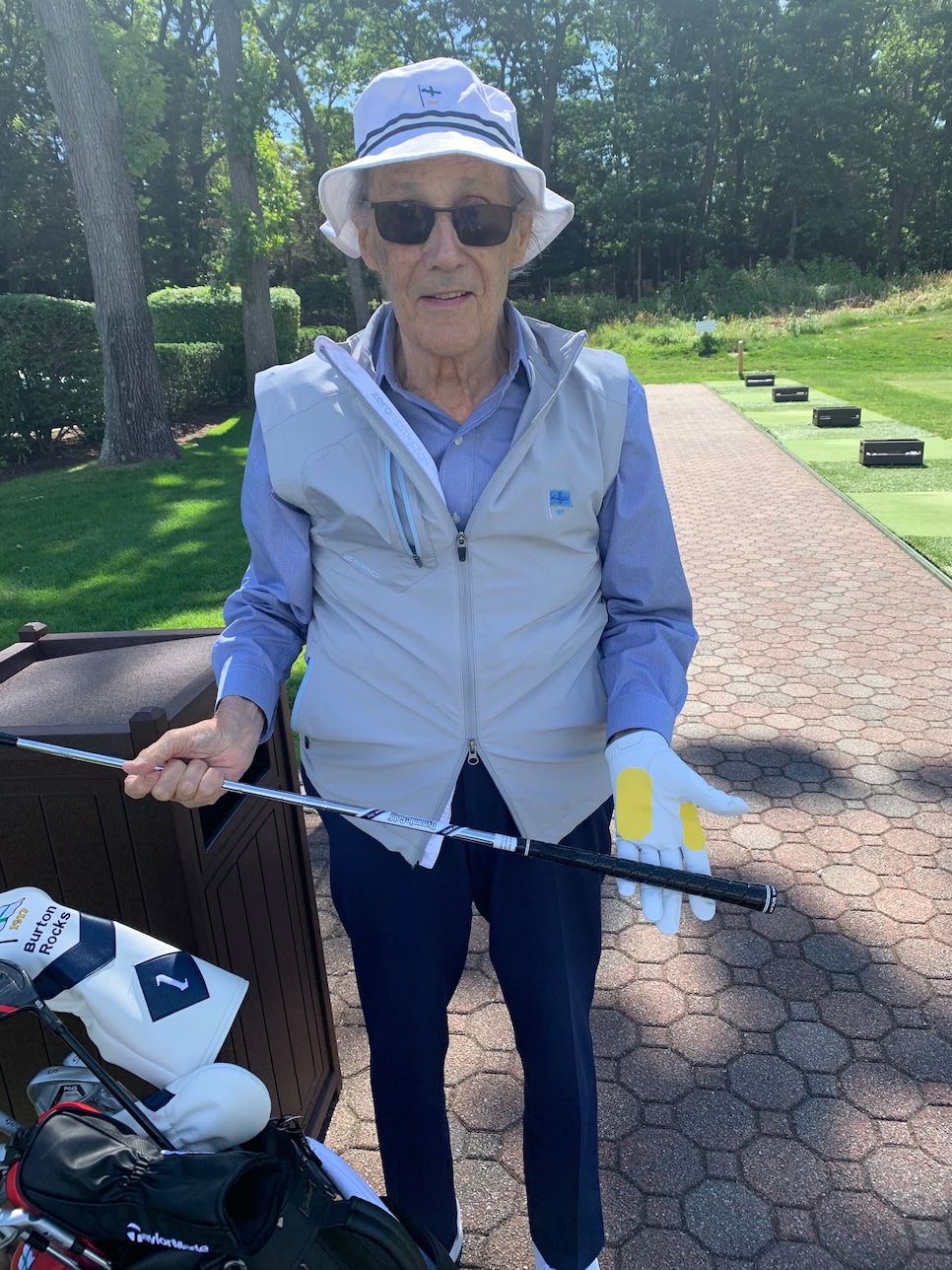
Dr Rocks modelling the glove at the range.
While Crenshaw says they don’t have the equipment to do the proper robot testing at the club, it’s hard to prove just how effective the glove is. But after using it himself, he said he believes everyday golfers would find less twist to the clubface, more online hits and more velocity of the golf ball rebound should they get their hands on one.
The challenge, from the USGA conformance standpoint, has been making the rubber portion of the glove thin enough. Getting someone to manufacture it has proved difficult, too. Crenshaw reached out to a number of OEMs, including TaylorMade, Callaway and Titleist. He did not receive a response from the first two and Titleist officials informed him that because he’s a golf professional and has an account with Titleist, they do not solicit ideas from their own account holders.
Being told no – or being ignored entirely – has never stopped Dr Rocks before, though. In the early 1970s, his manuscript, titled “The Energy Crisis”, was turned down by publishers.
“They said there is no such thing,” Dr Rocks said. “Energy is never going to interest the public. One publisher said that they sent [the manuscript] to the physics department at Harvard and said the same. It’s too complicated.”
Two years later, a different publisher picked it up (the book published in 1972), and the Harvard Club invited Dr Rocks to speak to a local group about energy. He later found out that in all the years the Harvard Club existed, he was one of the few invited to speak who was not a professor at the university.
“It was a full-cycle thing,” he said. The book coincided with the 1973 Oil Crisis and influenced the government to create the Department of Energy in 1977.
The invention of a golf glove that could cure your slice pales in comparison, but the process has been similarly long and arduous. It was just after COVID when Dr Rocks first came up with the idea for the glove, noticing something while looking at slow-motion photography of the golf swing.
“Everybody notices that you sometimes slice the ball, or hook it,” he said. “The reason for that is a lot of times the clubface is set at an angle when you’re trying to hit the ball in one direction and the face of the club is actually in another direction.
“I thought, The golfer hits the ball and the ball pushes on the face of the club and it makes it twist. People say a golf glove will correct that, but it doesn’t, because skin does not respond quickly to being stretched. So it’s that torsion and recoil phenomenon. This glove incorporates rubber that responds quickly.”
In 2022, the USGA sent its equipment standards decision notification to Crenshaw of the glove’s likely conformance.
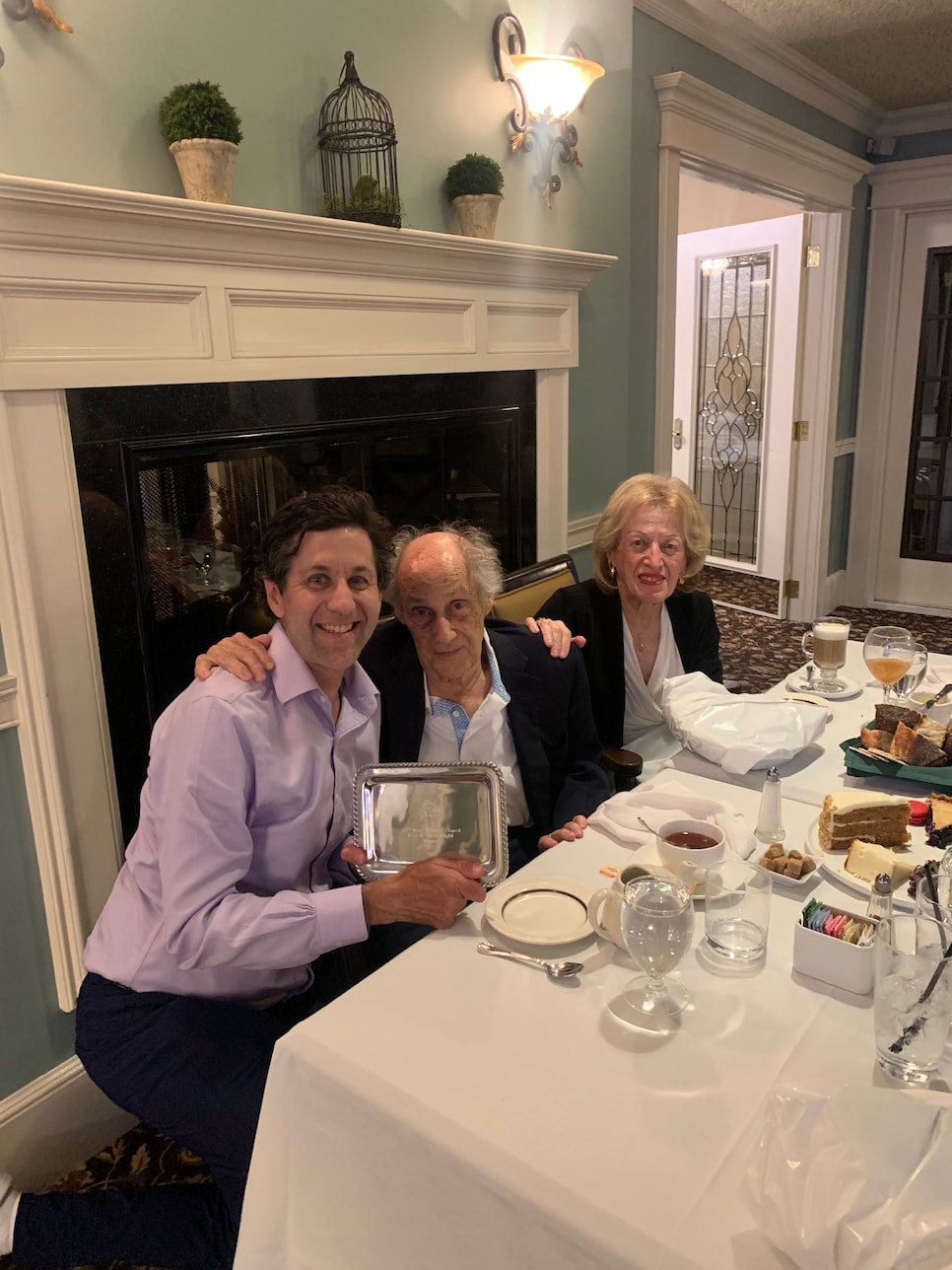
Dr Rocks with his son Burton and wife Marlene, who executive-produced the “Larry the Caddie” short film.
The manufacturing and marketing portion of the process is where things have mostly stalled. At 92, Dr Rocks doesn’t have much time for either. He had major heart surgery in February, and while recovery has taken longer than expected, he’s back riding in the golf cart with his son Burton at St George’s. He’s been unable to take swings for more than a year now, though he did play golf on his 91st birthday.
If Dr Rocks has learned anything in his life, it’s that his ideas are worth fighting for, even if “everything nowadays takes forever”, as he says. He hopes to find a company, perhaps one that’s not in the golf-glove business, that might take a chance on his prototype. If it truly is a cure for a slice (or a hook), he is sitting on a potential gold mine, something he’d never tout.
“I’m a chemist,” he said. “What do I know about these matters?”
To learn more about Dr Rocks and the glove, check out the short cartoon film “Larry the Caddie”, which was directed by his son Burton and executive-produced by his wife of 58 years, Marlene, who just passed away on June 29.