
If you’re struggling to repeatedly make solid contact with the golf ball, there are plenty of possible reasons, but the most typical is improper sequencing in the downswing, says Jeff Ritter, one of Golf Digest’s Best Teachers in Oregon. The typical higher-handicap player relies too heavily on the torso and arms to get back to the ball and isn’t initiating the downswing with his or her legs.
Interestingly, a key reason for this common fault is technology. Yep, the advancements in golf-club design almost tempt you to make a poor swing. The reason? Golf clubs are so light, your brain knows it doesn’t have to recruit a lot of muscle power to swing them.
Credit your on-board computer for being efficient, but that doesn’t help the issue of good sequencing and the proper role of the lower body in the golf swing. You know what does?
Medicine balls.
When you attempt to mimic a golf swing by throwing a medicine ball, particularly one that feels just a little bit heavy, your brain automatically activates your lower body and core muscles to provide the power and stability to launch it. You have no choice because without that muscle power, your throw would likely be feeble at best.
“I’ve had great success with my golf clients when I give them a med ball,” says Jennifer Fleischer, a Golf Digest Certified Fitness Trainer who trains golfers in the San Francisco Bay area. “It can help with power, speed and definitely better sequencing.”
Another Golf Digest Certified Trainer, Justin Barr, says med balls help train the lower-body muscles of the legs, glutes and pelvis, and they also help improve dissociation between the lower body and upper body. When the lower body begins the downswing ahead of the upper body, it creates a lot of snap-like power through the hitting area. It also lets the club move on the correct in-to-out path in relation to the target line and provides more time to square the face in relation to that target. In other words, a lot of good stuff happens.
“They are great to help train the lower body to use the ground to initiate power,” says Barr, who trains players at Golfnasium in Jupiter, Fla.
As a bonus, the trainers say, med-ball training actually is a great way to get a cardio boost while breaking up the monotony of traditional training like running, cycling, etc.
There are several med-ball exercises that make sense for golfers, but here are two to get you started. Fleischer is demonstrating med-ball slams in the saggital plane while Barr shows you how to do med-ball throws in the saggital and transverse planes. Just from viewing the images, you can see how active the lower-body and core need to be engaged to do them correctly.
The trainers recommend using a med ball just heavy enough to challenge you and to do several reps and a couple of sets in a short amount of time to get the cardio benefit. Go all out on the slam/throw and only rest as needed.

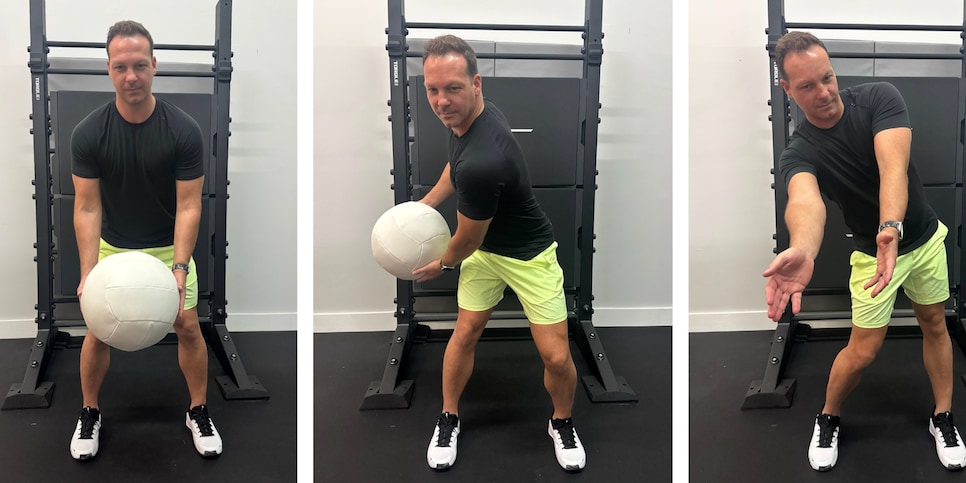
“It all gets back to this idea that if I asked you to throw a light ball 10 yards, you’d probably do it with little or no activity beyond your arm,” Ritter says. “But try the same thing with a heavy object and all of a sudden, there’s going to be a lot of big-muscle recruitment.”
As if all of this wasn’t enough, they also are a great way to get some frustration out if you just had an on-course meltdown.
Click on this link if you’re interested in becoming a Golf Digest Certified Fitness Trainer.
This article was originally published on golfdigest.com