Golf Digest senior writer Alex Myers is on a one-year mission to see how good he can get at golf through daily training, practice and playing. Read more from his “Late Scratch?” series here.
Throughout this experiment, I’ve enjoyed sharing things I’ve learned about my own game, many of which have come from Quaker Ridge head pro Mario Guerra. But the next step involved me observing Mario playing his game as his caddie.
I wanted to do this playing lesson in reverse to better understand how a high-level golfer approaches a round of golf, specifically, in competition. Plus, I owed Mario for him looping for me at a qualifier the month prior.
Mario entrusted me to carry his clubs at a Met Open qualifier at Rockaway Hunting Club and I’m so glad he did. (Hopefully, he is too!) Here’s what I took away from a fun, but pressure-packed day.
Caddying is harder than it looks
I’ve played plenty of rounds with caddies, so I should have known this already. But until you’re actually carrying that bag, and that yardage book, and that pin sheet, and that range finder, and, well, you get the point, it’s a lot to keep track of. Add in things like raking bunkers, getting the flag, keeping the clubs clean, it’s a lot. All while being mindful to not get in the way of other golfers (I was asked to move once on the fourth green and I was even more careful after that). Thankfully, the rain that was forecasted never came because that would have made everything a lot trickier. And I wasn’t even reading greens for Mario, one of Golf Digest’s Best In State teachers, who has been helping me with my game since last year.

Plus, when you’re caddying in a tournament, you are fully invested in how your player does. It’s stressful! Anyway, it was nice having with us one of Rockaway’s caddies, Fred, who was looping for Shinnecock Hills head pro Sean Quinlivan, to show me the ropes. After, he said, “Your guy played well,” and I took that as a compliment. Am I officially a caddie now?
Tournament golf is harder than it looks
I was aware of this already after my two attempts at playing in qualifiers earlier in the year. But seeing golfers who are much better than me struggle out there only reinforced the point. Mario played great golf, especially given windy conditions that Fred said were as tough as he’d seen on this historic seaside links course.
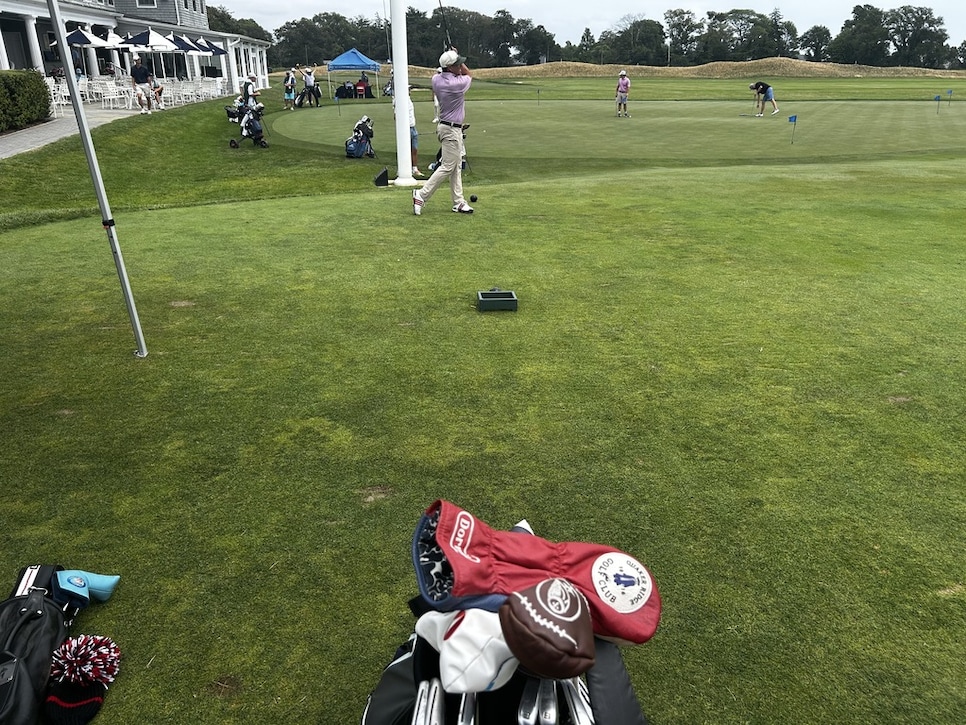
But Mario missed some short putts, hit a couple approach shots fat, and he blasted his final approach way too long when we—I’m a big player-caddie “we” guy now—thought he needed birdie to qualify. He wasn’t perfect, but he still managed to keep his round together as he tried to qualify for the Met section’s premier event, in large part to a career-best +2.9 strokes gained around the green, according to his Arccos Golf app. It was like having a front-row seat to a Matt Fitzpatrick short-game clinic, minus the cross-handed chipping. And it was an up-close masterclass in grinding out a good score. I was both impressed and proud by his effort.
Take your time on tap-ins
Early in the round, a golfer in our group missed a short par putt, walked around the hole and casually tapped his golf ball . . . and missed again. Mario turned to me and said, “You NEVER do that.” And he never did. Mario didn’t make every putt, but he gave every putt the attention it deserved.
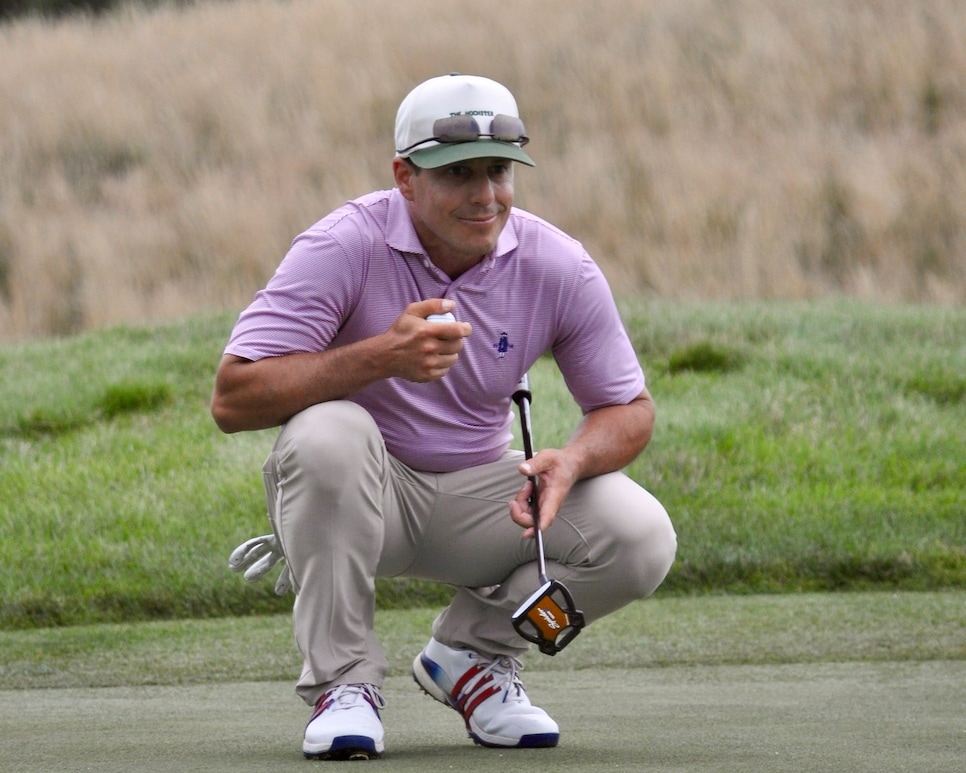
If there was any doubt about stepping on someone else’s line, he marked. When he missed a nasty short par attempt on 13, he marked and reset for the next one before making it. Every stroke counts the same and every stroke matters. Unfortunately, we were reminded of the latter after finishing the round.
Pace off your putts
Speaking of putting, I noticed how Mario, who previously shared with me why putting with proper speed is so important, would pace off longer putts before attempting them. This seems like an obvious thing to do, yet how many of us take the extra few seconds to calibrate how long of a putt we have?

And it’s not even necessarily a few extra seconds. Mario sometimes did this while other golfers were going through their pre-putt routine or you can do it on your way to grabbing the flag. Regardless, I like to estimate the length of my putts before figuring out how big of a stroke I need to take, but actually confirming that distance takes out some of the guesswork.
Do a pre-round speed check
To that end of collecting more info, Mario brought out his Stack radar at the end of his pre-round range session. He only took a few swings doing this with a driver and a 6-iron just to make sure he was swinging his normal speed. That confirmed he could expect to hit the ball his normal carry distances on the course. I’ve gotten used to taking my Stack radar to the range for speed training, but I’ve never thought to use it like this.
RELATED: The 7-iron speed rule you’re probably not following
Treat each hole separately
After a pair of solid opening pars, Mario said something that stuck out to me as we walked to the third tee. “Every hole is its own tournament,” he said. “Each round is like 18 mini-tournaments. Those two are done.” And he displayed this mentality after that short miss on No. 13 when he hit a brilliant 4-iron over water and into a howling, hurting crosswind to about 15 feet on the par-3 14th. That was as good as it gets.

Anyway, this mindset was something we’d talked about before, comparing this to the “Zero-zero” mindset the New York Knicks used throughout their run to the NBA title in which they treated every game like it was Game 1, no matter the score of the series. So it’s a way to stay focused on the task at hand. But it’s also a reminder that a round of golf is a marathon, and that there will be 18 opportunities to record some good scores. Which leads to the next point . . .
Conserve your energy
When Mario caddied for me, his biggest critique was that I wasted too much energy—especially mental energy. And watching him handle himself throughout 18 holes made that even clearer. Whether he missed a short putt or chipped in like he did on No. 10, he stayed very even-keeled. He didn’t dwell on results, good or bad, even during a hole, conserving his mental energy for what mattered.

Like when he got a tough break on an approach shot spinning off the front of the green, he immediately started focusing on reading the putt. Or on another hole when we couldn’t tell if his tee shot reached a fairway bunker.
RELATED: How different is tournament golf? I found out the hard way
“We’ll deal with it when we get there,” he said calmly. “When I hit the tee shot, I was in control. After that, I’m not in control. And it doesn’t do me any good to think about it while I walk 250 yards to the ball.” Good point.
Hit the driver when in doubt
Most golfers are well aware that opting for extra yardage is usually the best play in terms of strokes gained, but it can also be the smartest choice when you’re under pressure. Mario didn’t need to hit driver on the par-4 18th with it playing dead downwind, but he believed he needed a birdie and that it gave him the best chance given the nerves he was feeling. “I went with the bigger clubface,” he said with a laugh. “That’s my easiest club to hit.”

And hit it he did. Mario said he actually hit his drive off the toe, but the result couldn’t have been better as his golf ball wound up about 40 yards from the green. I have a tendency to get scared to hit the driver under pressure, but hopefully using this philosophy will change that.
Be more positive
I’ve heard having an optimistic outlook is an essential part of golf—particularly, tournament golf—from many people, including Mario when he caddied for me. And I’ve pledged to do better with this. But seeing Mario actually play like this really hit home. Early in the round, he said, “We chose to be here and we look forward to the challenge.” Later, he mentioned how lucky we were to be out here playing and to have found careers in golf. And at one point, he described tournament golf as “punishment, but fun.” Heck, the guy even walks with positive posture and a Rory McIlroy-esque bounce in his step:

Mario has told me before that tournament golf is like a drug and once you get a taste, you want more of it. I’m definitely not to that stage, but I understood what he meant as he—I mean, WE—tried to qualify. And given the tough conditions, I was happy to be watching.
RELATED: 9 things I wish I knew before caddying in a big event
Although, I felt sick when Mario found the back bunker on 18 after that great drive and wound up making bogey to finish with 75. And I felt even worse after learning 74 wound up being the number, spending my entire drive home wondering if there was something else I could have done. Golfers always focus on where they lost shots out on the course, but now as a caddie I was doing the same. But Mario took the close call in stride.
“The only option for me is to keep getting better,” Mario said.
Same here. Both with hitting—and carrying—clubs.
RELATED: Four bad habits tournament golf exposed within my game
This article was originally published on golfdigest.com