We reflect on four decades as Australia’s most influential course ranking and the role it’s played in promoting this nation’s most admired golf architecture.
It’s no easy task to identify and rank the Top 100 golf courses from more than 1,600 layouts across this Sunburnt Country. In many ways it’s a bit like comparing apples with oranges. Coastal seaside courses differ greatly from inland parkland layouts.
So it’s with great pride that Australian Golf Digest has reached its 40th anniversary of the inaugural Top 100. Almost 275 judges have submitted their feedback from course inspections over the past two years. Special mention must be given to managing editor Steve Keipert who has painstakingly collated the results and compiled what is our most comprehensive ranking to date.
Golf-course rankings are subjective. Hence, they attract criticism. And so they should. But even the most ardent critics – such as course architects – concede begrudgingly that rankings serve a purpose. Veteran architect Bob Harrison challenges the methodology before making a telling statement: “Who is going to be doing the ranking? Is this a personal opinion? The fact that they might be a good golfer doesn’t necessarily mean they’ll have an appropriate view of good golf courses. So they’re obviously flawed… But they’re interesting. And the fact that they’re interesting means they’re valuable.”
With that in mind, here’s a snapshot of the evolution of Australia’s Top 100 Golf Courses along with some interesting observations over the past four decades.
1986-1996
The Norman Era
The inaugural publication of Australia’s Top 100 Golf Courses coincided with Greg Norman’s rise to become the world’s No.1-ranked golfer. In 1986, Norman captured the so-called ‘Saturday Slam’ when he led all four men’s major championships into the final round, winning the Open Championship at Turnberry. Norman was the Pied Piper of Australian golf, drawing new fans to tournaments and driving club membership applications across the country.
Under the stewardship of former manager editor, the late Phil Tresidder, the inaugural Top 100 ranking was very different to what it is today. It was literally a three-part compilation process. ‘Tres’ would assemble a handful of judges in each of the six states to adjudicate the best courses in their domain. From there he would ask a dozen or so ‘authorities’ – administrators, elite amateurs and tour professionals – to use these assessments to form their own contribution. These submissions would then form to a final compilation of Australia’s Top 100.
Remember, this was prior to the widespread adoption of email. So it was a cumbersome process for Tres to manually tabulate the submissions. It was a sight to behold. Sheets of paper would stretch across his desktop and the editorial team used to breathe a sigh of relief once the final ranking came to fruition.
Resort golf boom
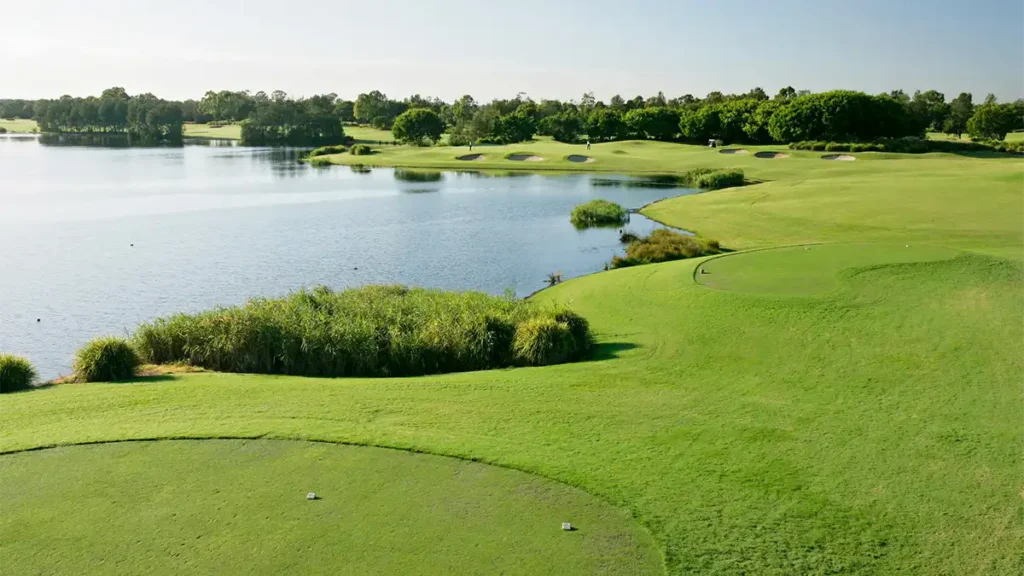
The 1980s and 1990s triggered a flurry of course construction when Asian investment, especially Japanese money, was responsible for the ‘gift’ of lavish resort-style layouts in Queensland and Western Australia. The benchmark of this era were Perth’s Joondalup Resort (Robert Trent Jones Jnr, 1985) and Sanctuary Cove’s Pines (Arnold Palmer/Ed Seay, 1989), the latter of which gained popularity from Frank Sinatra’s appearance at a gala opening and hosting the Australian Skins matches.
Nevertheless, the opening of Hope Island in 1993 was a revelation. Those old enough to remember may recall the Gold Coast layout once ranked as high as No.8 in the Top 100. That may come as a surprise as it has since settled in the 40-60 bracket. The Thomson/Wolveridge/Perrett layout piqued curiosity for its unique design features given South-East Queensland’s humid subtropical climate. Rounded pot bunkers plus sand traps placed in the middle of fairways were a topic of conversation by club members across the nation. So, too, the lavish condominiums and exquisite waterways around which the course was routed. In 1997, Hope Island hosted the Johnnie Walker Classic that attracted a world-class field. South Africa’s Ernie Els won by a shot from Peter Lonard and Kiwi Michael Long, who called a one-stroke penalty on himself after his ball moved at address on the 15th green in the final round. The incident generated worldwide attention for Long’s sportsmanship as Hope Island acquired an iconic reputation.
1996-2006
Links golf renaissance
The arrival of The Dunes Golf Links on Victoria’s Mornington Peninsula in 1997 marked the start of a significant era for the Top 100. Tony Cashmore’s transformation of a non-descript country track into a rural masterpiece was the catalyst for a links golf renaissance. Links courses spread elsewhere on the Mornington and further afield on Victoria’s Bellarine Peninsula, Western Australia and Tasmania.
Undoubtedly, the success of Australians at golf’s oldest men’s major played a role in this links golf renaissance. We witnessed a golden era when Australians contended and captured the claret jug three times in eight years: Norman in 1986 at Turnberry; Ian Baker-Finch in 1991 at Royal Birkdale; Norman again in 1993 at Royal St George’s. (At the Women’s British Open, Karrie Webb won two of the four triumphs by Australian women from 1988-1997.) Their success appears to have validated the pursuit of links golf in the minds of course architects and developers with deep pockets who funded their construction.
Some 23 courses in the current Top 100 are considered a genuine links or known for ascribing to links-like characteristics: Cape Wickham, Barnbougle Dunes, Barnbougle Lost Farm, 7 Mile Beach, The National (Moonah), The National (Gunnamatta), Ocean Dunes, The Dunes, St Andrews Beach, Magenta Shores, 13th Beach (Beach), Links Kennedy Bay, Lonsdale Links, The Cut, Moonah Links (Legends), Moonah Links (Open), Links Hope Island, Sandy Links, Bougle Run, Links Lady Bay, Curlewis, 13th Beach (Creek), Warrnambool.
Residential golf phenomenon
The residential-golf phenomenon that’s come to be known as Living On The Fairway spawned the construction of more Top 100 courses. Housing around golf courses tends to be regarded like an unwanted party guest. But when constructed tastefully, these communities offer a beautiful ambience as an accompaniment to a round of golf.
While the residential-golf phenomenon can be traced to America, its growth in Australia coincided with Norman’s semi-retirement as a touring professional in the late 1990s. His Great White Enterprises formed a joint venture with Macquarie Bank that built a number of these residential communities under the Medallist banner. Norman and long-time design partner Bob Harrison penned courses as part of Sanctuary Lakes (2000), Pelican Waters (2000), Glades (2000), Brookwater (2002), The Vintage (2003), Settlers Run (2007) and Stonecutters Ridge (2012).
Some 27 courses on this year’s ranking form part of a residential-golf community: Magenta Shores (the highest at No.34), 13th Beach (Beach and Creek), Links Kennedy Bay, The Cut, Brookwater, Sanctuary Cove (Pines & Palms), Links Hope Island, The Vintage, Links Lady Bay, The Heritage (Henley & St John), Meadow Springs, Palmer Resort Coolum, Pelican Waters, Mount Compass, Sanctuary Lakes , Glades, Lakelands, Black Bull, Pacific Harbour, Stonecutters Ridge, Settlers Run, Noosa Springs, Eastern (South).

Ellerston: To rank or not to rank?
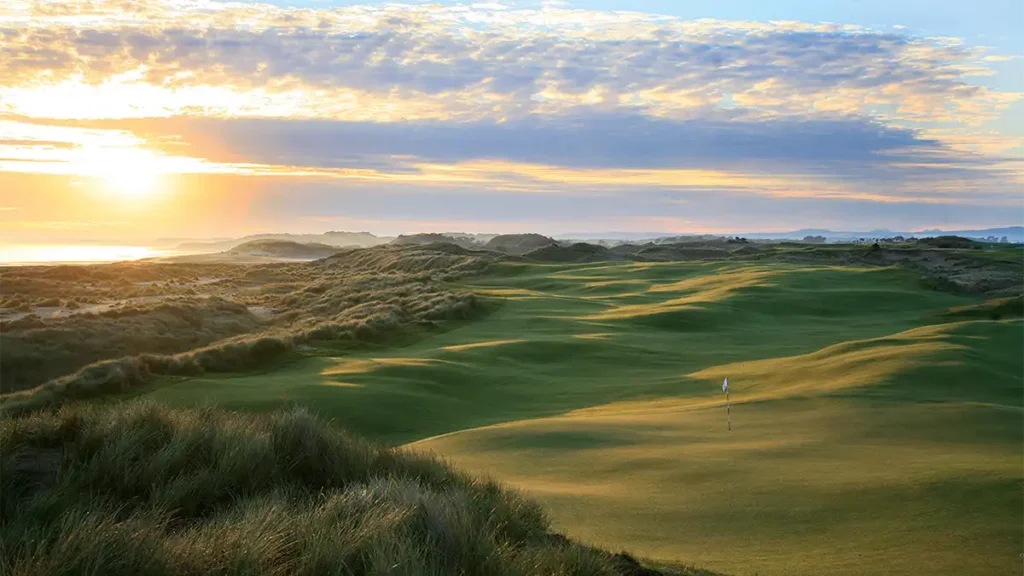
One of the more fluid discussions at AGD involved whether to rank exclusive private courses the public can never play. The prime example of which was Kerry Packer’s Ellerston golf course in the New South Wales Upper Hunter Valley, designed by Norman and Harrison. Ellerston’s entry into the Top 100 has an amusing back story. Harrison rang one morning on behalf of media mogul Packer: “The boss wants to know how it ranks. How do we go about that?”
To which I replied we’d probably need a quorum of panellists to inspect the course. “Oh, we probably wouldn’t need more than 12,” I proposed in a hopeful tone. Which led to the most anticipated course inspection in Top 100 history. A dozen-strong touring party ventured to Ellerston where we were wined and dined in the most hospitable manner on the famous Packer estate.
Ellerston debuted at No.4 (2004), peaked at No.3 (2012, 2014) and was last ranked at No.10 (2020). Following the ownership handover from James Packer to Gretel Packer, AGD chose to omit Ellerston from the Top 100 because an insufficient number of judges had evaluated the course.
As for the debate about ranking only golf courses that are open to the public, Harrison vehemently disagrees with the opinion of tour professional-turned-architect Mike Clayton.
“Clayton’s idea that if something hasn’t got public access, you can’t rank it, that’s just nonsense,” Harrison says. “That really offends me. I find that ridiculous. You are ranking a physical thing. It’s a golf course. Independent of whether five million people play on it a year or 10.”
It should be noted that Ellerston today is publicly accessible… for a price. Groups with a minimum of four golfers can play for $25,000 each, or $45,000 per golfer for a two-day/one-night experience.
2006-2016
Tasmania, digital imagery and the dawn of social media
Golf-course imagery has taken a quantum leap forward during the past 20 or so years. There was a time when sourcing pictures from golf clubs caused trepidation among Digest’s editorial staff as to whether a forthcoming image was an original photograph or in duplicate form. The transition from film to digital certainly helped Australia’s Top 100 Courses gain wider visual appeal. High-resolution, panoramic images captivated readers with their cinematic quality.
Tasmania’s world-class golf courses have been huge beneficiaries of the digital age. The launch of the iPhone in 2007 featured a basic 2MP camera and by the early 2010s nearly all smartphones had an integrated digital camera. This allowed everyone from a general manager to the course superintendent to showcase their much-loved course to the world. You have to wonder how golf courses in far-flung destinations like Bridport in north-east Tasmania would have gained popularity if not for course rankings, internet search engines, iPhones and the dawn of social media.
Photographer Gary Lisbon says the digital age ignited golf tourism in Australia: “The first images I took of Barnbougle – actually they were in a helicopter – of Lost Farm went around the world. It won a press award for ‘Best Photograph’ because it gave people a real sense of, Wow! Oh, my goodness, that’s a golf course. I need to play there. Likewise with any of these current images that the crop of photographers are taking. They invoke that sense of FOMO (Fear Of Missing Out).”
An inconvenient truth: the urgent need for renovation
Golf course rankings are often the bearer of bad news. But a slide down the Top 100 can be the catalyst for introspection. All courses must undergo renovation at some stage to bring them in tune with modern architectural standards of turf quality, drainage, irrigation, green construction, bunker maintenance, length and strategy.
No course is beyond scrutiny. Royal Sydney – which sits on this country’s most valuable piece of real estate at Rose Bay – once rated No.4 in the Top 100’s infancy (1989, 1991). It has hosted 15 Australian Open championships. Notwithstanding the influx of new facilities precipitated by a golden generation of course construction, Royal Sydney members accepted the blunt reality that their course was well past its best. Upon slumping to No.52 (2022), Royal Sydney embarked on a radical overhaul by American Gil Hanse with landscaping from Australian Harley Kruse. That decision has reaped immediate dividends as Royal Sydney re-entered this year’s ranking at No.19.
A great example of a measured approach to redesign is Bonnie Doon in Sydney’s eastern suburbs. Always ranked in the second 50, Bonnie Doon fell to No.88 (2008) when the fashionable private club acted to halt a potential slide outside the Top 100. It engaged Ogilvy Clayton Cocking Mead to revitalise a layout blessed with beautiful undulating terrain and a rich sandy subsoil. During the $5 million of renovation work, Bonnie Doon sat out three consecutive rankings (2010, 2012, 2014) before re-entering at No.55 (2016). Through word of mouth, Bonnie Doon rose even higher to a career-best No.39 (2024).
That Bonnie Doon now sits at No.45 (2026) is not a sign that it’s slipped. On the contrary, it’s veritable proof that more clubs are realising the need to undertake urgent course renovations. Beneficiaries of such foresight in this year’s ranking are Royal Sydney, Huntingdale, Commonwealth, Mount Lawley and Links Kennedy Bay.
2016-2026
The age of disruption
The election of Donald Trump as United States president in 2016 heralded the age of disruption for the world’s geopolitical landscape. The COVID pandemic caused further disruption to the way people went about their business. In Australian golf, it led to a spike in national partici-pation as people sought a safe refuge.
The golf-course construction boom has slowed dramatically. Just four new courses built from scratch have entered the Top 100 in the past decade: Ocean Dunes (2016), Cathedral Lodge (2017), Bougle Run (2021) and 7 Mile Beach (2025). It’s tempting to add Lonsdale Links (2020) and Sandy Links (2020) as they are materially different to their original layouts. Significantly, the number of Top 100-calibre courses to have undergone major renovation would approach three dozen.
Drone technology a game-changer for course photography
Remote-controlled ‘drones’ have revolutionised the way we picture golf courses, according to award-winning photographer Gary Lisbon. One of his first drone shoots occurred at Kooindah Waters on NSW’s Central Coast in 2016. Drones allow a photographer to access more vantage points in a shorter time frame – at a fraction of the cost of using a helicopter.
“The benefits of drone footage are extensive,” Lisbon says. “Because our window of shooting is so tight – sort of 45 minutes in the morning, 45 minutes at night for the best light – you want to be able to get to as many places as possible. When you’re either walking around the course or in a motorised cart, you can’t always be where you want to be for the sun to fall on the hole at the right time.
“With a drone, I can stand in one spot and I can get to five, six or seven holes very easily. It’s been invaluable in that regard. At the start of the day, I can put the drone up and see where the sun is going to land first off. So I can do a bit of reconnaissance and scouting ahead of the sun actually coming up.”
Drones add a three-dimensional perspective to the topography of a golf course that can’t be obtained on foot.
“When you take a photo at ground level in 2D, it can look very flat and uninspiring. So typically, the more height we can get, the better,” Lisbon says. “Over the years we’ve climbed up ladders, we’ve stood on the back of carts… But drones give you the ability to vary that height quite significantly to really capture the full reveal of the golf hole, particularly with bunkering dips and hollows.”
Hiring a helicopter for a photo shoot can set you back $1,500 an hour, says Lisbon. And if the weather’s no good, you’re still paying that kind of money.
“My drone is probably about an $8,000 drone and clearly I can use it for many, many hours. The cost per hour comes down significantly… The actual drone has the camera – both still and video embedded into it. You can buy one for under 1,000 bucks these days.”
Dispute over Cape Wickham’s design
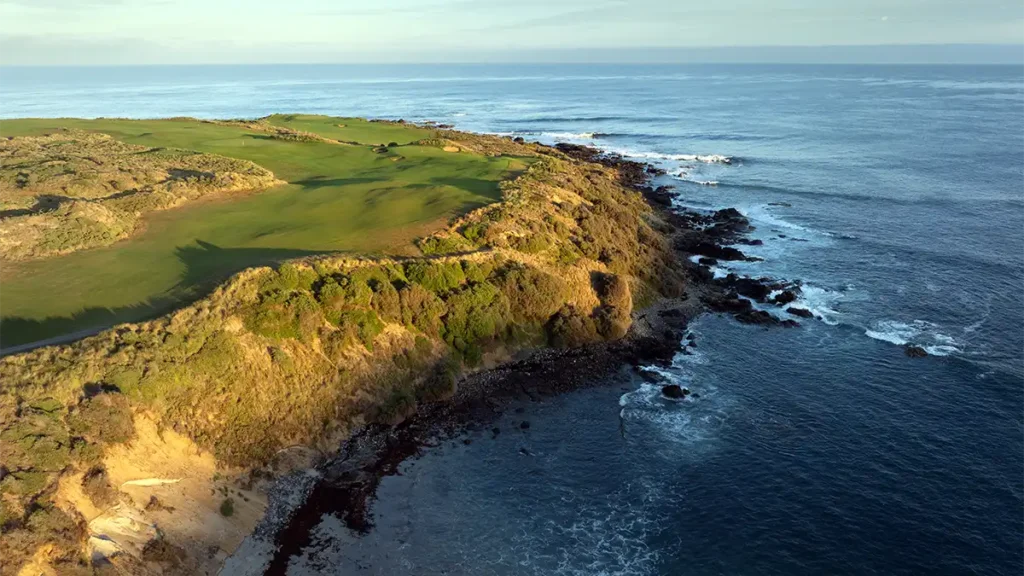
Two years ago, Cape Wickham usurped Royal Melbourne West as the premier course in the nation. It was a pivotal point in the history of the Top 100 given the Old Lady’s reverence. (Kingston Heath was the only other course to hold the No.1 mantle previously, in 2010.) Bubbling away beneath the surface was a dispute between the two men credited with designing the spectacular Wickham layout on Tasmania’s King Island.
American Mike DeVries and Victorian Darius Oliver had shared design credit since its opening in 2015. However that took a turn in 2021 when two US publications gave DeVries sole credit. DeVries’ design firm (Clayton, DeVries & Pont) perpetuated this narrative with multiple posts on social media failing to acknowledge Wickham as a co-design. This left a sour taste with Oliver, who was reluctant to enter a war of words.
Australian Golf Digest decided to settle the issue once and for all. We sought out Duncan Andrews, the man who funded Wickham’s entire construction. Andrews went into specific detail about how Wickham came to fruition: from laying awake at night wondering whether he should proceed and then whether to abandon the project due to interference from bureaucrats in the Department of Natural Resources and Environment Tasmania.
Andrews explained that DeVries was the original architect for the first four holes. Differences of opinion between he and DeVries led to Oliver taking over for the remainder of the build. Of the Wickham design controversy, Andrews said: “Well, it shouldn’t have happened. It needn’t have happened. And it’s disappointing. But the truth of the matter is they were both involved. But I think Darius played the more vital role. Not only was he the one that convinced me to come and buy it, he was the one that did the bulk of the detailed design work. He certainly also had a great deal of input into the course routing, which is pretty important.”
2026-2036
The fifth decade: Seniors living funding course redesign
The movement of courses in the fifth decade of the Top 100 should continue to be intriguing as different trends emerge. Given the nature of our landlocked capital cities, it’s doubtful any new courses will be built in congested urban areas. It stands to reason courses may be built in residential-growth corridors on the extremities of Sydney and Melbourne. However, property developers have shown an inclination to allocate space for parks and riparian wildlife passages to the detriment of golf courses.
Golf clubs with sound business models will aspire to upgrade ageing facilities. Increasingly, private clubs are seeking partnerships with property developers to build seniors-living apartments on their land in exchange for clubhouse refurbishments and course renovations. Newcastle Golf Club, once ranked No.10 (2004) and most recently at No.30 (2024), is pursuing such as opportunity to unleash its true potential. Newcastle has offloaded a parcel of land for an over-50s retirement village and the club is using the sale proceeds to build new holes designed by Bob Harrison on virgin soil adjoining the Fern Bay site.
The ranking has undergone vast change in the past 40 years. We’ve come a long way from a very manual process with a limited number of staff and panellists to what is now a well-refined process that is more transparent with a rigorous methodology.
It’s a pleasure to have been associated with Australia’s Top 100 Golf Courses along the journey. I would like to think, The Best Is Yet To Come.