The recent renovation of two favourite courses accentuates Western Australia’s allure as a golf destination.
Facelifts are all the rage in golf. Unlike many ageing Hollywood stars on a desperate quest for relevance, however, most re-dos in golf are an improvement on what went before. Western Australia provides a couple of great case studies with the recent renovations of Mount Lawley Golf Club’s layout and the oceanside Links Kennedy Bay course. Neither appeared in dire need of rejuvenation, yet both had valid reasons and both have come out of the process with far better offerings.
After a three-year overhaul, Mount Lawley’s members have been enjoying their upgraded golf course since last March, while October’s WA Open let many of Australia’s best golfers experience Ogilvy Cocking Mead’s redesign first-hand for four days amid some testing conditions. Links Kennedy Bay, on the other hand, is a more recent return, with Graham Marsh’s redesign welcoming play from the start of November after a five-year process. The two projects had differing origins – Mount Lawley’s was to summon more of the natural, Sandbelt traits from the site and Kennedy Bay’s to navigate the course around a new housing precinct – but both exemplified taking one step back to go forward two.
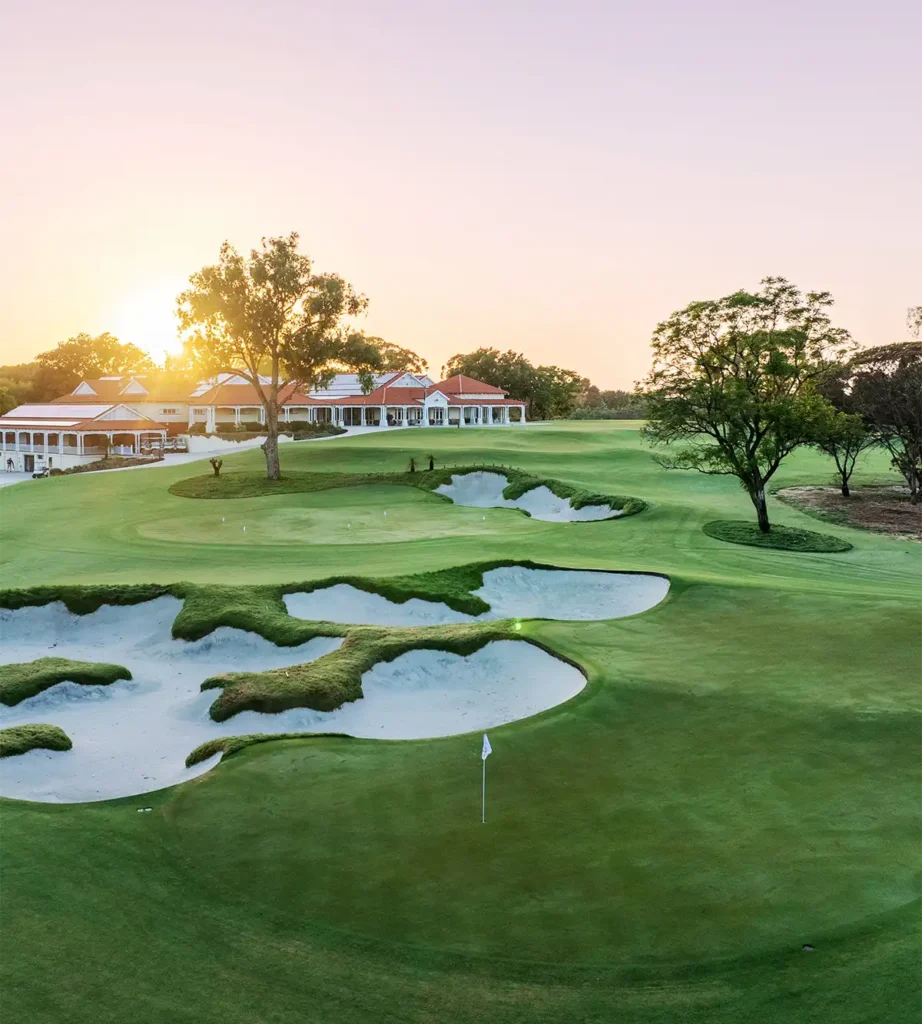
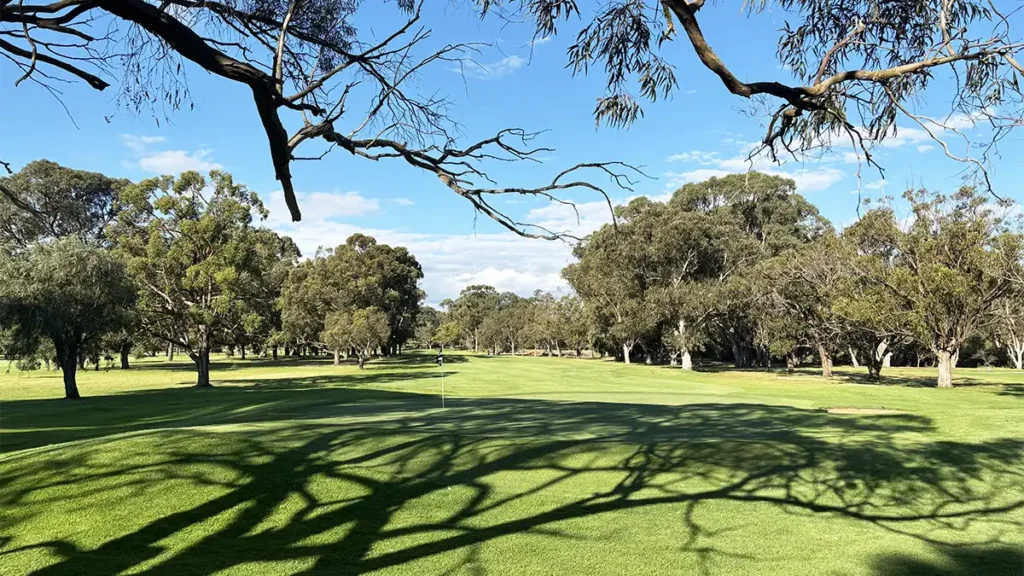
The three-stage Mount Lawley undertaking included reconstructing 21 greens and six tees, as well as renovating the club’s practice facilities. The two nines were also swapped in the redesign process. What is most noticeable from a visual and playing standpoint, though, is the bunkering. All bunkers now feature a Melbourne Sandbelt-style look, including faces that sit flush to the edge of the 007 bentgrass greens. About the only departure from that style is the long grass on the far edge of the bunkers, usually the part of the trap that’s furthest from the green. It provides a strong visual contrast to the white sand, but make no mistake, that stuff is thick and ominous.
Much of the praise for Mount Lawley during the WA Open stemmed from the playing surfaces, which epitomised ‘firm and fast’, and only enhanced the Sandbelt feels. In fluky winds for four days, seven-under-par led the way after 18 holes and seven-under stood up three days later. Players noted the need to control shots into the greens, anticipate a firm first hop and make judicious choices for greenside shots.
“That was as ‘Sandbelt’ as I’ve ever seen,” tournament drawcard Marc Leishman said after the second round. “That was rock hard. It was difficult, but it was awesome. It was so much fun to have to work shots left-to-right or right-to-left and land them on a hill to get them to a pin. I love that sort of golf and I think it really rewards good play and it definitely punishes bad play.”
Mount Lawley was always a place where position off the tee was important – and still is – but now the approach-play element is amplified, even with the greens now much larger. It’s also one of the most-played (if not the most-played) golf courses in Perth, with a hugely active membership. Fortunately for them, there is not a dull moment across the layout, including at the iconic “Commonwealth” green (which is now the fourth hole after the nines were switched). I can tell you from experience that two-putting from “Cairns” to southern WA is no easy task.
POT LUCK
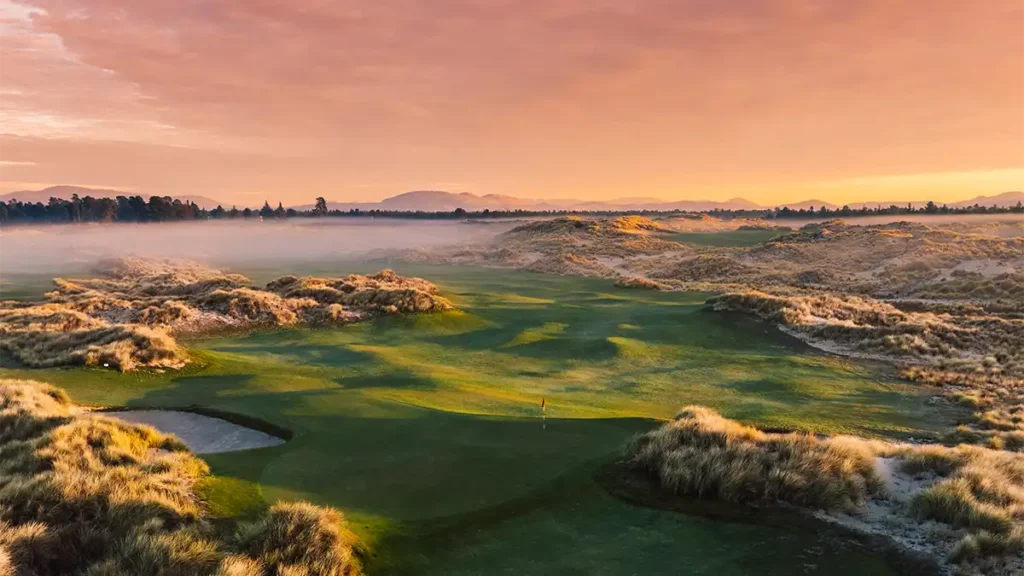
The loss to development of most of the original Links Kennedy Bay layout stung the golf scene south of Perth. The back nine of the Michael Coate/Roger Mackay/Ian Baker-Finch design in particular represented one of the best stretches of holes in the state. Five years on, the course is set to recapture that lost glory. WA golf’s favourite son, Marsh, joined industry veteran and course superintendent Trevor Strachan in penning and constructing 14 new holes and augmenting the original first four holes as Kennedy Bay takes a bold stride forward. Utilising both new and existing land for the new holes, the traits that made the old version so memorable remain. Pulpit-style greens and pot bunkers with modern EcoBunker revetted faces shape a layout that already looks well-established despite opening for play only weeks ago.
One loss in the process was the course’s proximity to the beach. While never in view because of the adjoining dunes, the old back nine brought play closer to the Indian Ocean than any hole does now. The gain, however, came in the form of Marsh’s sensitive appreciation of the layout that went before. Rather than revamp the previous incarnation, Marsh adapted its best traits and expanded on them. Fourteen holes occupy entirely new corridors, yet they look like they’ve been there for eons.
In refashioning Links Kennedy Bay, Marsh paid tribute to the lost holes by replicating several design features. The double green shared by the former fifth and seventh holes? There’s now a dual surface spanning the new 10th and 17th greens. The wonderful dell-style target at the old 15th is reprised at the new 14th green. And while the original fourth hole remains, its “Hell” bunker is gone from the fairway, but an equally sinister pit (which is so expansive it took a month to build) fronts the new 15th green.
Five years was a long time to wait, yet the resurrection of the course is something to behold. The original was one of the most genuine links-style courses in Australia thanks to its pot bunkers and a site that’s within arm’s reach of the ocean. The new version retains that quality. While the total number of bunkers across the layout is roughly the same, Marsh’s bunkering is arguably more judicious. Several holes are completely framed by the pots, guiding you visually and goading you at the same time. However, other holes and shots are bunkerless, as the contours take over instead. The raised targets, chipping swales and pot-free greens are some of the best, including at the par-3 12th, where there’s not a bunker to be found. At the 18th, a central pot 20 or so paces short of the green is about the size of a dining table yet dominates your eye the whole way up the fairway. Likewise, some of the longer holes feature greens with less movement in an acknowledgement that the golfer navigated a difficult path to get there so deserves a more straightforward passage to the cup once aboard the green.
Links Kennedy Bay is back. It was a risky undertaking to seize what was already such a terrific golf course and essentially start again. Granted, there will be golfers who miss the previous incarnation, especially those who played it for so long. Yet with time, the ‘replacement’ layout has every chance to be considered just as great as its predecessor.
FILLING THE VOID
Part of what makes golf in WA tick is the combination of quality and quantity. Both within Perth and in the regions to the south are golf courses that are difficult to beat for distinction. Even the public layouts are outstanding, and the region is blessed with sandy terrain that’s so suited for golf.
The Swan River divides Perth physically in much the same fashion as Sydney’s harbour or Brisbane’s eponymous river separates their north and south. From a golf standpoint in Perth, most of the best land and premier courses are found on the north side of the Swan, while there’s an armada of fine layouts on the coastline to the south from Port Kennedy down. Which leaves something of a gap in between as the southern suburbs lack more strong golf options, says veteran WA course architect Michael Coate.
“There’s a lot of space between the river and let’s say the area down to Kwinana,” Coate says. “There’s a lot of land there, but it’s pretty hard to get people to turn around and say, ‘Yeah, we’re going to convert a reserve into a golf course.’ And that southern area of Perth needs more golf courses.”
One existing layout nicely positioned to fill the void is Kwinana Golf Club. The course that began as six holes in 1959 today weaves between mature eucalypts, marris and tuarts, and is a legitimate sleeper course on Perth’s southern outskirts. There’s a seclusion to be found in various pockets of the course, which occupies gently undulating terrain and features extensive wetlands, but Coate rightly sees the potential for more. If approved, the plan he has put forward for the club includes an expanded driving range, a new short-game area, plus a potential executive course to adjoin the main 18.
Closer to the CBD, Royal Perth Golf Club will be a course to watch in 2026 as the third and final stage of its redesign unfolds. Arguably the most inconspicuous of Australia’s “Royal” golf clubs sits on a compact, 30-hectare site where contoured green complexes will be the new hallmark. CDP Golf (Mike Clayton, Mike DeVries and Frank Pont), in conjunction with Harley Kruse, are authoring an artful redesign yet one that makes clever use of such a small space. Sandy waste areas with native vegetation will complete the fresh look for a course that in its early years was a riverside, links-style course before a parkland style took over.
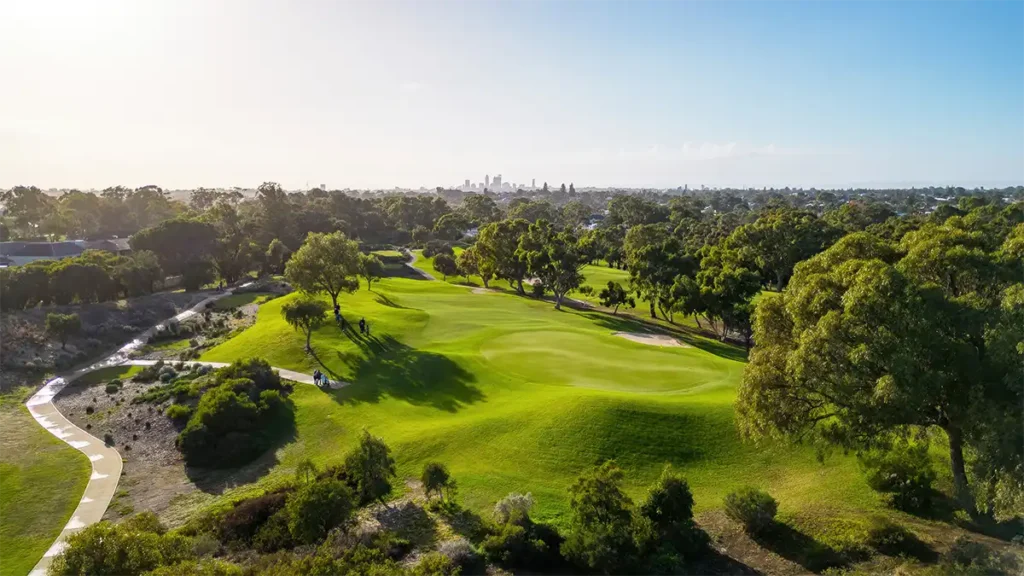
The first stage at Royal Perth focused on the first four holes plus the 16th, while the second stage centred on holes seven to nine, 13 to 15, new 18th and 19th greens. It also included turf laying, green seeding, irrigation installation and vegetation planting or propagation for the coming autumn. While undoubtedly an improved golf course is on the horizon, so too is superior water conservation, improved safety and more appropriate native vegetation.
Another Royal course will be squarely in the spotlight this month when Royal Fremantle Golf Club hosts its second Webex Players Series event from January 8-11. The ‘factory’ that produced tournament hosts Minjee and Min Woo Lee (among others) is a multi-faceted layout where several alternate tees provide built-in variety. More than merely another teeing ground next to the main one, they dramatically alter the angle of play. At the 15th, where a greenside pond is the defining feature of the hole, the alternate tee shortens the hole but tempts long hitters to try to drive the green. It’s such a strong alternative that the club is set to start using it as the primary tee.
Crossing the river, Cottesloe Golf Club (known to all in WA golf as simply “Cott”) is at last in career-best form. The final throes of an ongoing renovation by Marsh saw bunkers renovated and reduced in size in places, while the new 777 bentgrass greens gel with the site brilliantly to present arguably the best playing surfaces in the west.
Cottesloe’s gradual transformation has been a drawn-out affair. Marsh provided his course masterplan to the club to allow work to begin in 1998; the final stage was completed in 2024. The last parts centred on the final five greens, making it the first golf course in Australia to feature 777 bentgrass on all holes. Additionally, it’s the first time in more than 40 years that all 18 greens feature the same strain of grass.
The putting surfaces are the showstoppers – for their design as much as their quality. Marsh shaped surfaces to favour an approach from one side of the fairway or created lobes and sections to have the same effect. “The pin positions are much more defined and separated by ridgelines that elicit more thought and precision once one arrives at the green complex,” Marsh wrote in 2024. “These same ridgelines will reject shots away from designated pin positions if the approach shot is not executed with accuracy and distance control.”
“Cott” is not long at sub-6,200 metres but does pose specific questions – just as Marsh wished.
FRINGE DWELLING
Venturing further north, Joondalup Resort remains a beacon in Perth golf – a lesson in transformation and imagination. American architect Robert Trent Jones Jnr summoned every ounce of his creativity when penning the Quarry, Dune and Lake nines, the first two uniting to provide the premier 18-hole loop within the 27. Trent Jones Jnr didn’t just sidestep the former quarry or the limestone walls that were such features of the site; he put them centre stage. While boisterous bunkering and steep undulations abound, the most iconic moments in a round at Joondalup invariably come when a corner of the quarry needs to be carried on the nine of the same name, or when negotiating a sheer cliff face on the Dune nine. It’s roller-coaster golf without the harness and a ride unlike anywhere else.
Joondalup is now managed by the TenGolf group, which also looks after Meadow Springs, The Cut, Secret Harbour, Maylands and the nine-hole Embleton course. That’s a proverbial who’s who of WA golf; a collection of courses visiting golfers could easily build an entire trip around.
The Vines Resort is already preparing for its transition from a 36-hole facility to 18 holes plus a short course. The Championship layout – also known as the Heineken course from its tournament days – is the principal 18, rather than either of the Lakes or Ellenbrook courses. The Championship course takes in nine holes from both, offers the premier loop of holes and is, quite frankly, the combination most golfers want to play. The space currently occupied by the Lakes’ front nine will become the new short course, hopefully this year.
Across The Vines, considered bunker removal and reduction in size of bunkers has been a positive for the layout, while its reticulation system is now well in place with the playing surfaces reaping the benefits. Huge greens have always been a feature of The Vines. The true length of many approach shots hinges on the pin position. Today’s pitching wedge might be tomorrow’s 5-iron from the same part of the fairway. So widely known for its time as a top tournament venue, The Vines remains an integral part of WA golf.
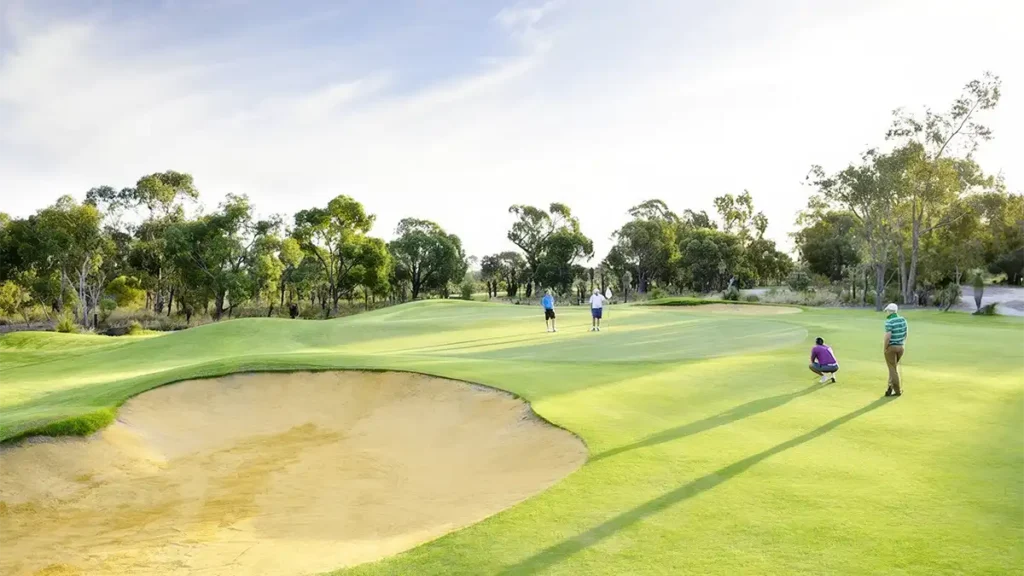
The epitome of fringe-dwelling might be Hartfield Country Club, which feels like a country course in the city. The bushland course near the Darling Range is a haven for tour pros looking to hone their accuracy. PGA Tour of Australasia player Haydn Barron says he can’t better his club handicap around the course. The layout flows across mostly flat terrain where towering gums frame most holes, accentuating Barron’s assertion.
“Our course normally trips a lot of people up because of the tightness,” head professional Rob Nuttall confirms. “Driving really is at a premium; you really have to hit it on the fairway. It plays almost 6,200 metres in length, but length really isn’t an issue – tightness is. If you miss the fairway, you get penalised quite severely.”
Hartfield’s bunkering is also a highlight. While it’s not unusual to see the classic ‘bunker left, bunker right’ architecture, there are moments during the round when the use of sand is either more strategic, abundant or restrained, leaving other traits to shine.
SOUTHERN COMFORT
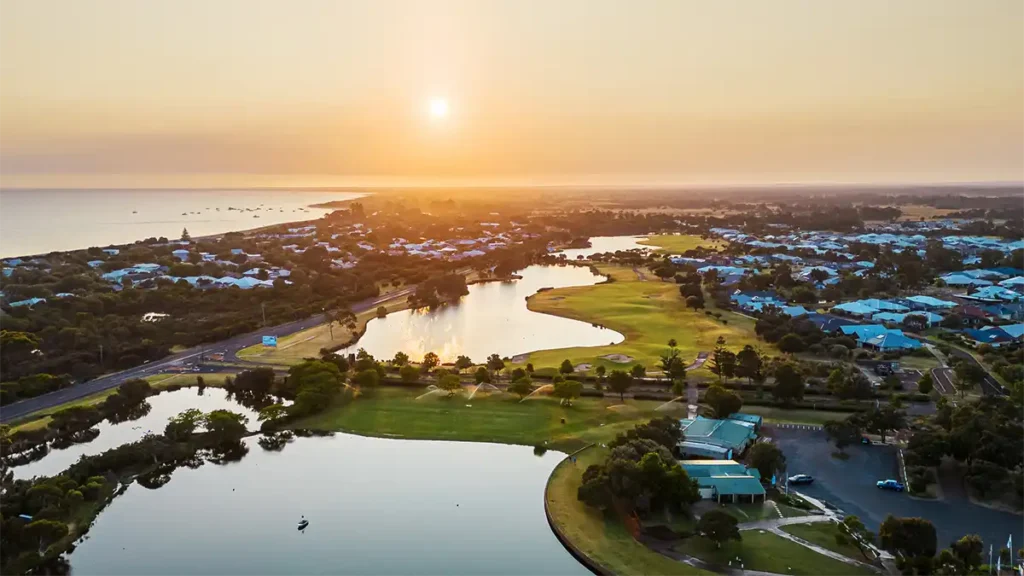
The area from Links Kennedy Bay at Port Kennedy to The Cut at Dawesville also encompasses the golf courses of Secret Harbour, Meadow Springs, Mandurah and more. Conveniently wedged between Perth and the enticing Bunbury and Margaret River regions, they act as a neatly packaged golf collective that can be treated as a comfortable commute from the city or a getaway destination of its own. However, aside from the redesign of Links Kennedy Bay, in recent times the golf energy has pulsated further south.
The revival of the old Lakewood Shores Golf Course – known to all as Binningup, for its location – is a welcome return. Binningup was the quintessential hidden gem; a course known to locals but often bypassed by visitors heading for golf courses further south. The nine-hole links-style course opened in 1986 but closed in 2020, initially as a casualty of the COVID-19 pandemic but eventually for good. Or so it seemed.
Andrew “Twiggy” Forrest’s property and investment company, Fiveight, has engaged Coate’s architectural nous (he was the designer of the original layout) for the golf course as part of a broader redevelopment of the site. Expect more activity to take place at Binningup during 2026.
Further south, Bunbury Golf Club is a solid, country-style layout characterised by strong, established treelines and ochre-coloured bunkers. Several strong doglegs and uphill holes create challenges, while a par 3 to start the round is not something you encounter every day. Go-to man Coate is set to offer renovation concepts for several holes and greens – in some cases greens he once designed himself. In the meantime, Bunbury is a terrific excursion through fulsome gums that provide separation between holes.
Down where WA’s south-west coastline wraps around towards scenic Cape Naturaliste, Dunsborough Lakes Golf Club is more than just a regional golf course. In a growth corridor within the state, it is well positioned to form the backbone of a golf trip in WA’s south-west. Nearby Busselton Airport began welcoming regular flights by the major carriers on east-coast legs in 2022, which opened the region to more travellers. And, as Dunsborough Lakes general manager Matthew Criss notes, often flights into Busselton are cheaper than those flying into Perth.
Dunsborough Lakes is a course that evolved nine holes at a time. The front nine opened in 1993, with the back nine added in the early 2000s. Those two decades reveal two slightly different design styles – the front nine is shorter and tighter, while the back nine is longer but more open. Water is a feature throughout, most notably on the final four holes. The par-5 15th is distinguished by a wetland that lines the right off the tee and switches to the left closer to the green while cutting across the fairway in the lay-up zone, forcing a decision on the second shot. The 16th, a hole designed by the late Lyndsay Stephen, is the first of a pair of wicked, into-the-wind par 4s where a lake flanks the entire right side. At the 18th, the examination is even tougher as the water juts in to front the green. Many a promising round has come unstuck at Dunsborough’s final hurdles.

Former Australian PGA champion Alan Murray penned the original course, while Phil Scott (father of Adam) and WA golf icon Stephen have had more recent design influence on a layout that gives off Gold Coast vibes, thanks to its waterways and the neighbouring residential estate.
The road south of Dunsborough takes travellers to Margaret River and on to Cape Leeuwin – the south-western corner of the country. There’s more golf to be found down there, but also plenty of other diversions, mostly of the 750ml kind. From Joondalup in Perth’s north to the imposing Cape Leeuwin Lighthouse is a 350-kilometre journey. How many stops you make along the way depends on time, budget and inclination, but however you tackle it, WA will leave you with memories that linger.