People often reach out to me asking which training aids I like and would recommend. Sometimes they come to me with an agenda—they want to gain more speed, for instance—but more often they’re just curious for something new to try.
So what follows is a list of training aids that I trust and like so much that I actually have them in my home. This isn’t an all-encompassing list—I’ll do follow-ups in the future—so consider this just a taste of some training aids that I really like, who they might be good for, and why.
1. Gravity Fit T-Pro Yellow
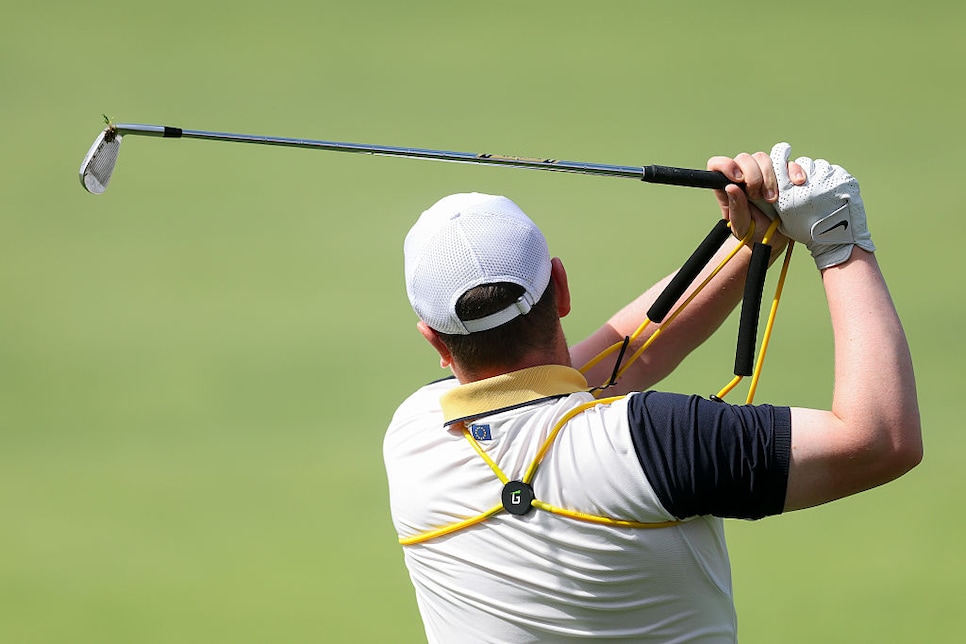
I first became aware of the Gravity Fit T-Pro when I saw Bob MacIntyre using it at the Ryder Cup.
[Photo: Carl Recine]
Basically, it’s a series of elastic exercise bands that you wear like a coat—you put your arm through each end. The bands naturally want to pull your arms close to your body, so your goal is to keep your arms stretched away from your body and the bands taut.
Doing this addresses a problem that a lot of golfers have in their swings: collapsing their arms on the backswing, or on the way through for a chicken wing.
It’s a bit more of an exercise-oriented training aid, but it’s a good one for ingraining the feel, and I like that you can make swings without hitting balls at home.
2. PutterCup
The PutterCup is a series of yellow putting rings is a training aid that’s almost impossible to make somebody worse with.
- There’s an at-home putting cup designed to be slightly elevated as it approaches the regulation-size hole.
- Then there’s what the owner calls a “speed bump”—an insert you put in a hole—whether you have a regulation-size hole at your house or you’re just doing it on the golf course—that creates a slightly raised lip.
- Finally, there’s the centre cup, which you place in a regulation golf hole to reduce its size. These all serve slightly different purposes.
The raised edge forces you to hit the putt a little harder, which can help you groove a foot-past-the-cup pace.
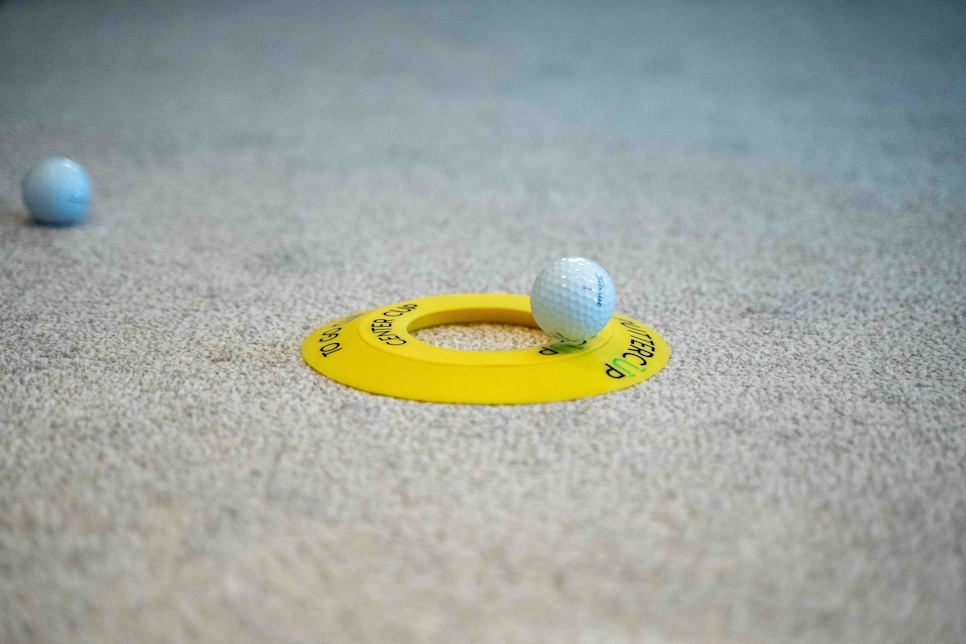
If you don’t like the raised lip, I use the centre cup design to improve my accuracy—it makes the hole about 30 per cent smaller. I like it because I don’t have to worry about doing anything different with my body. I just focus on my normal putting routine, and it forces me to be more accurate.
3. Better Golf Glove
The Better Golf Glove is what I would describe as a good player’s training aid, meaning you can tell the person who made this is a good player, which James Ledbetter, the glove’s creator, is. It dials in an important fundamental in your golf swing, but without being overbearing.
Basically, it’s a golf glove with helpful checkpoints all over it. That’s what I like about it.
- There’s a line down the thumb so you can see the angle of your thumb, which, generally speaking, should point towards your right ear.
- There are also marks on each of the knuckles of your middle and index fingers. This is to see if your left-hand grip is weak or strong—the more knuckles you see, the stronger your grip, which can tend to close the clubface.
- Then, on the inside of the glove, there’s a big black zone. This reinforces the classic advice: grip the club in your fingers, not in your palm.
It’s all very clever, and again, I don’t have to worry about being forced to swing in a certain way. I can just do what I’m ordinarily doing, except I’ve got this little system of checkpoints on my glove that lets me dial in how I control the clubface.
Your browser does not support the video tag. 4. Orange Whip
You’ve probably seen an Orange Whip before. It’s a much heavier golf club than usual, with a longer, more flexible shaft.
I use this as a warmup device to combat my bad golf swing habit of staying very centered—my backswing gets very short, especially when I’m nervous. I lock up.
The Orange Whip is a great way of forcing me to stretch it out. It makes me feel like Vijay Singh, who used to love this training aid. When I swing this, it feels like everything in my body and the club is just lengthening—which is exactly what my golf swing needs.
If your swing is out-of-control long, maybe this isn’t the best training aid for you. But too much flexibility isn’t really something that most amateur golfers struggle with. So this is something I really like, especially for warmups.
5. G-Pod Golf
I record my swing a lot. Carrying around a tripod works, but it’s heavier, more cumbersome, and you look a little weird doing it.
That’s why I love keeping the G-Pod Pro in my bag. In simplest terms, it’s a stick that you put in the ground, but it’s magnetic at the top and sticks to your phone.
Your browser does not support the video tag.
It takes about two seconds: plug it into the ground, point the camera where you want, and you’re good to go. It’s really light—weighs less than a graphite shaft—and it’s a simple way of solving the problem of quickly recording my swing.
There’s also a mini tripod version that’s good for putting. But for me, the stick-in-the-ground version does everything I need.
6. Eyeline Golf Practice T
If you follow me on Instagram (@LKD_Golf), you’ll often see this thing on the ground when I’m practising. I’ve always been a big alignment stick guy—junior golf, college, I loved them. But I’ve moved away from them since I saw Ian Poulter and his son Luke using this.
Another day of working on getting the path more ⬅️ and the AoA more ⬇️ pic.twitter.com/Z9yB4ixMMs
— LKD (@LukeKerrDineen) March 2, 2026
It’s called the Practice T by Eyeline Golf, and quite simply. It’s a better version of an alignment stick.
Think of it like a small ruler—two to three feet—that you twist to form a little T-shape. That gives you both a line parallel to your target and one perpendicular to it, which helps with alignment, ball position, and clubface angle all at once. Instead of fussing with two separate alignment sticks, you’ve got one tool that does it all and takes two seconds to adjust.
It’s an awesome little device and I genuinely don’t understand why it’s not more popular.
Your browser does not support the video tag. 7. Force Pedal
Force Pedals are squishy little domes that you place under your left toes as you hit balls. It gives you resistance, and the idea is that as you swing, you push into it—and the harder you push, the more it pushes back.
Why does that matter? Because a lot of power in the golf swing comes from how you interact with the ground—pushing, pulling, twisting against it. Most of us are capable of doing more of it; we just don’t train it. This is a really simple way to start. You stand on it, you feel it immediately, and then you’re just trying to push and pull against it. All of a sudden, you’re generating more vertical force without really thinking about it.
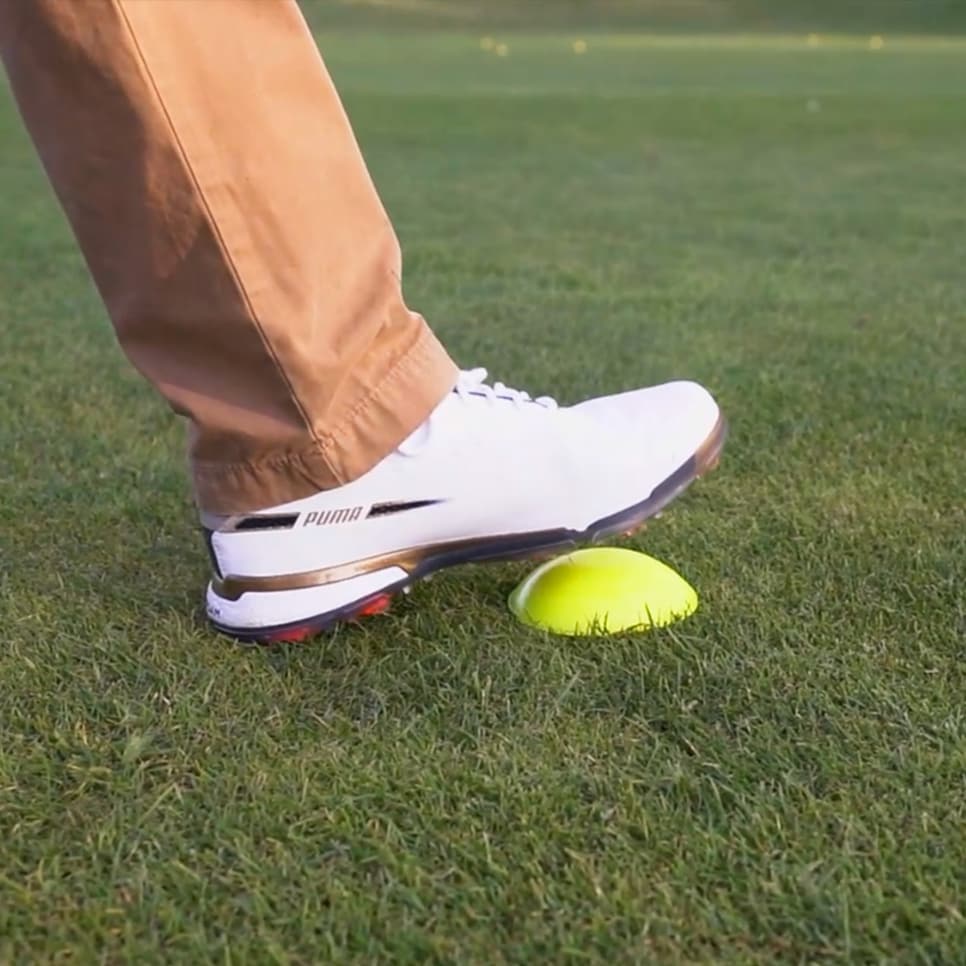
It’s barely the size of two golf balls, so nobody on the range is going to look at you funny. Keep it in your bag—it’s nothing. They’ve also just released a version that sits on a rotating base, which adds a rotational training element. A lot of good teachers use these, and for good reason.
8. TRS Slider
If you’ve seen my swing, you know I have the classic formerly-junior-golf problem: arms drop too far inside, fling out to the right. Ugly, frustrating, and a constant source of hooks and blocks.
Your browser does not support the video tag.
The TRS Slider feels like a seatbelt. You put it on your upper body, and it attaches to your arms. Yes, you’ll look a little goofy. That’s the price sometimes. It’s designed by Robert Rock—if you haven’t seen his swing, it’s about as pretty as a conventional golf swing gets.
What it does is keep your arms connected to your body throughout, which helps the club get into a better position on the downswing and forces you to turn properly. I don’t use it every day—it’s more of a checkpoint I come back to a couple of times a month, especially when the problem flares up. Matt Wallace actually recommended it to me, and he was right. It really helps.
9. Putting Mirror
There are a million of these. The putting mirror I use is from my friends Hannah and Freddie at Short Game Gains. Mine is well-loved—scratched up—but I wouldn’t swap it.
Putting setups shift around every single day. Eyes drift, shoulders open, head tilts. A mirror is just the simplest way to catch it. Take two to five minutes on the putting green before your rounds, and you’re dialled in. It doesn’t matter exactly where your eyes are over the ball—what matters is that you’re doing the same thing every time. That’s what a mirror gives you.
You see them all over the PGA Tour for a reason. Simple, light, and genuinely useful.
10. Butterblade
The Butterblade (great name) is essentially a 7-iron with a clubhead about half the normal size and a bright yellow shaft. It’s a range-only club—you can’t use it in competition—but that’s not why you’re buying it.
Your browser does not support the video tag.
It does one thing: shrinks the sweet spot and forces you to find it. When I’m working on mechanics—which is often—I’ll reach for this because it keeps me honest. You can get lost in positions and checkpoints and lose sight of what actually matters, which is striking the ball in the centre of the face. This won’t let you forget.
Flush it and it feels incredible. Then you pick up your normal club and it looks like a shovel. That’s not a bad feeling to have.