It’s always slightly disappointing, after a sexy headline, to lead with disclaimers, but before we get into the good (bad?) stuff, it does feel like these three caveats are necessary:
1. Keegan Bradley arguably deserves to make the Ryder Cup team on the strength of his performance the past two years. It’s not clear-cut – that’s the problem, as we’ll see in a moment – but he’s a top-10 player in the world, he recently won a tournament, and if I were making the call, he’d be on the team. (You’ll be shocked to know that they have not consulted me.)
2. A lot of this is not his fault. Some may be slightly his fault, but a lot comes down to circumstances beyond his control.
3. Any discourse about the Ryder Cup needs to acknowledge that playing in front of tens of thousands of rabid home fans is by far the most critical factor in determining a winner, as shown by the five consecutive blowouts leading into Bethpage… a number that would be eight if not for a fluky day in Medinah 13 years ago. The next great Ryder Cup story will be the next time a visiting team wins – that’s how difficult this is. So yes, the US could win easily despite the potential hazards.
And now that our throats are cleared, it’s time to discuss the massive iceberg looming in the distance, and to ask why the US seems to be firing all the engines, hellbent on a collision.
It starts with Bradley’s dilemma: Do I pick myself, or not? He’s currently 10th in the Ryder Cup points standings, which is just about the worst place he could be. If he were in the top six, he’d be an automatic pick when the cutoff happens in two weeks after the BMW Championship, and it wouldn’t be a topic of discussion. If he were, say, 15th, he’d be too far down the list, and picking himself would look suspicious and/or corrupt. Those are the polarities in which the decision becomes very easy. But the fact that he’s in the shadow zone, where you can formulate a really good argument for him and a pretty decent one against him, too – he’s currently 14th in DataGolf’s Ryder Cup US player pool, for instance – means that if he does choose himself, he’s going to face more than a few raised eyebrows. It’s going to be controversial, because that means there will be someone he leaves behind, like Cameron Young or Chris Gotterup or Sam Burns or Patrick Cantlay, who looks like an attractive prospect. And again, that’s even if he’s justified in picking himself.
It’s not fair, but it’s not wrong: if somebody else picked him to be on the team, it would be fine. If he picks himself, as he appears poised to do, it’s strange.
Why? Well, in part because he said very early in his captaincy that he wouldn’t play unless he finished in the top six automatic qualifying spots. That represents a good life lesson that a lot of figures in golf could stand to learn: don’t say things you may have to go back on in the future. When Bradley first got the call for the Ryder Cup, they told him they wanted him to be the first playing captain since Arnold Palmer in 1963, so there was really no need to establish the top-six criteria. But now if he does pick himself, he’ll absolutely have those words thrown in his face. In fact, it already happened – right after he won the Travelers Championship in June, he had to acknowledge the old quote and say, “Listen, this changes the story a little bit.”
Again, he’s not wrong to consider picking himself, but now he’s got to go against an initial promise. Let’s not forget why that promise was made, either; he had an intuitive understanding that it wouldn’t look great and could create a narrative that would hurt the team. But that was a year ago, outside the fog of war, before he was faced with the tantalising prospect of getting to play.
Beyond Bradley’s own words, though, there’s the simple truth of how narratives grow in the weeks leading up to the Ryder Cup. I was there at Hazeltine in 2016 when Danny Willett’s brother wrote a harmless blog post about Americans, and somehow it ended up ruining his brother’s entire Ryder Cup. That was incredibly stupid, but in some ways the week of the Ryder Cup is incredibly stupid – it’s long, access to players is bad, there’s very little to talk about, and if there’s any red meat, it will be chewed to the gristle.
So let’s consider how this could play out if Bradley picks himself. First, he’s going to face questions about it for a month – Do you think Cameron Young would have been a better course fit? Hasn’t Patrick Cantlay proved he’s a winner at these events? Do you think you’ll miss Sam Burns’ putting? – and while I’m sure he’ll have a rote answer prepared, the pressure will build and build. Not just on him, either; the US team will feel responsible for justifying his captaincy, and his playing partners in any pairs session will have an extra burden on their shoulders.
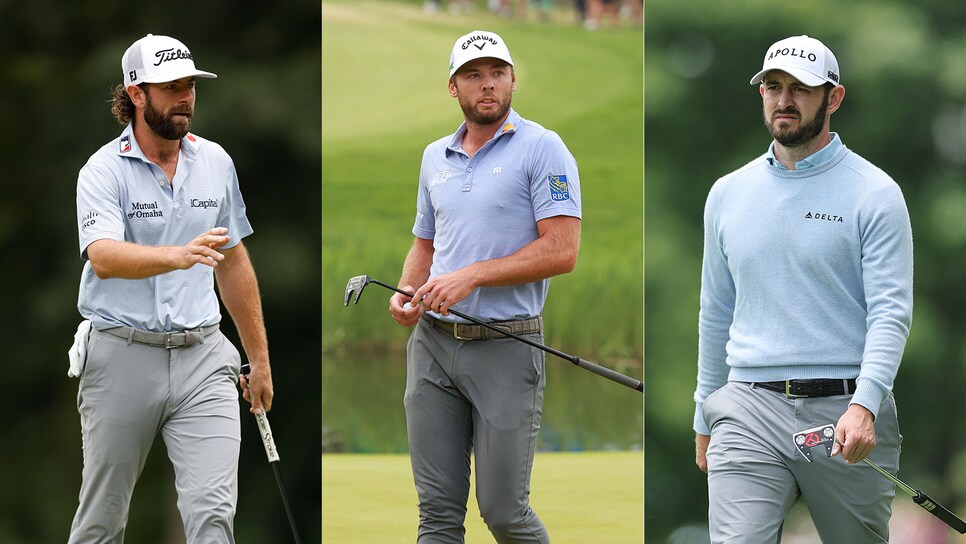
If he leaves off Young, Burns or Cantlay in favour of himself for the 2025 US Ryder Cup team, he’ll repeatedly face tough questions about the decision.
Now imagine he goes out on Friday morning and loses. What then? The questions would double in their intensity, Bradley would feel terrible – the man does not like losing in the first place – and the pressure would grow and continue spreading to the entire team.
There’s a word for this that athletes and coaches love to deploy: “Distraction.” And the cardinal rule of leading a team is that you do everything in your power to avoid distractions. So why is the US courting them?
And don’t forget the very basic fact that while he’s answering questions about his decision and trying to win his matches, he also has to captain the damn team. A couple of weeks ago, Luke Donald accepted an addendum that allowed Bradley to deputise one of his vice-captains to act as the man in charge when he’s on the course. That must have been the easiest “yes” in the history of professional sports. Why wouldn’t you agree to a tweak that muddles the leadership structure of your opponent and throws a confusing wrench into their chain of command? Who calls the shots when there’s a line-up adjustment needed and Bradley is on the 14th hole?
This violates every tenet of Leadership 101. There’s an old quote attributed to John Madden that if you have two quarterbacks on a team, you actually have none, and it’s hard not to think that if you have two Ryder Cup captains, you don’t have any. Will the players even know who’s really in charge?
What’s maddening about this is how foreseeable it was. Here was me in July 2024 after Bradley was announced:
I may have missed the announcement, but last I heard, he’s not retiring from competitive golf. Again, he’s 38. What if he makes the team? What if, like last time, he has a solid argument for making the team as a captain’s pick, and finds himself having to make a tough call… on himself? Worse, how is he going to have the time to take on the duties of the modern captaincy, which is essentially like being a two-year CEO of a major corporation, when he’s playing a full schedule?
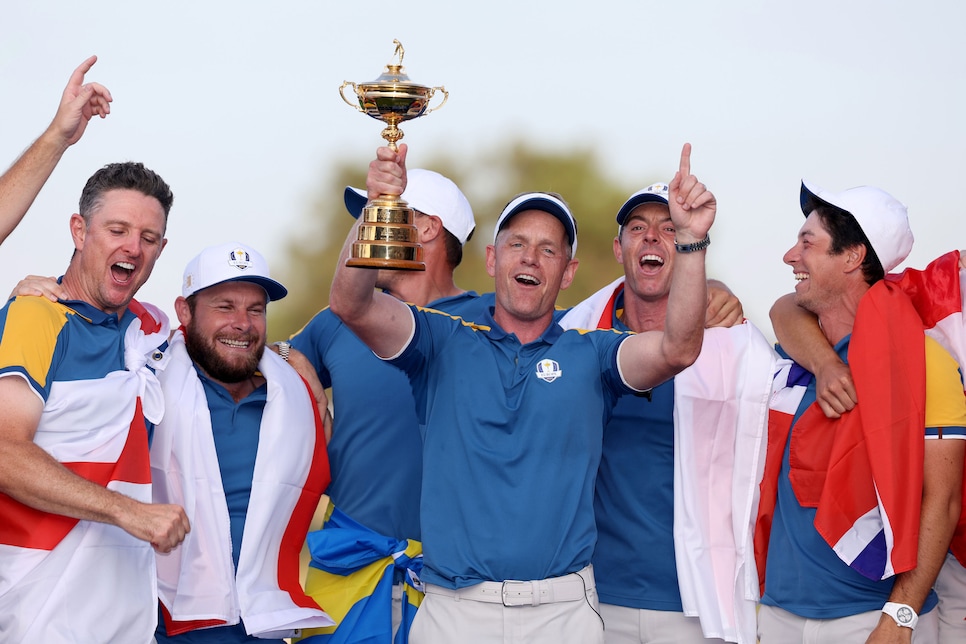
With the possibility of distractions for the US team, Luke Donald returns as European Ryder Cup captain with experience and potentially 11 players from his victorious team in Rome. [Photo: Richard Heathcote]
I don’t deserve any credit for that – it was an obvious pitfall, which is why it felt even back then that the US team was potentially putting Bradley in an impossible spot. The way it played out might be an example of Murphy’s Law… of course he’s right in that grey area, inviting a big honking distraction right into his team room.
There are still a few ways out of this mess. The easiest solution is for him to go win in Memphis and put the discussion to bed. Failing that, he could officially remove himself from playing consideration and devote all his energies to the captaincy. Third, he could forgo the captaincy entirely and put his fate as a player in the hands of the new captain.
If I were his adviser, I’d push hard for option three. It’s a win-win at this point, especially because he probably has the leverage to do a wink-wink deal with the new captain to ensure that yes, he will make the team. He’d get plaudits for sacrificing his leadership position for the greater good, he’d get to fulfil a dream 11 years in the making to play on another Ryder Cup team, and he’d be a top choice for the captaincy whenever he wanted it in the future. Why wouldn’t you jump at that opportunity?
Instead, Team USA seems hellbent on flirting with the disaster scenario: Keegan picks himself, the story blows up into a massive distraction for the entire team, an absurd amount of pressure is heaped on his shoulders to win his matches, the chain of command is in tatters, he loses, the story gets worse, communication blows up, etc, etc. And suddenly the rare home defeat becomes a more real prospect.
Last year, a prominent member of the European Ryder Cup infrastructure saw me at a tournament and told me that he really hoped Bradley would be a playing captain. He was laughing, but he was entirely serious – please let this guy take on both jobs. He could see the nightmare unfolding, and it’s worth mentioning, too, that this is all happening in the context of Europe returning a successful captain with (probably) 11 players who won in Rome. To put it mildly, this is not the year to be screwing around.
Maybe I’m wrong, and maybe the nightmare won’t come to pass. Maybe it’ll be fine. Maybe the Americans will ride the wave of home support to yet another blowout victory, and Bradley can call out the haters, Alan Shipnuck-style, in the victorious press conference. Still, the question I can’t get over is, why would you risk it when you don’t have to? There’s still time to steer around the iceberg, but it would require an adult decision to cast ego aside and admit you might have been wrong in the first place.