
How the rules can assist when ground conditions are less than ideal
As winter tightens its grip on Australia, many clubs adopt a temporary local rule to allow golfers some respite from muddy and wet ground conditions.
Many committees across the country use one of two model local rules that the R&A approves for these situations. These model local rules (MLR) are called MLR E-2: Cleaning Ball and MLR E-3: Preferred Lies. While they are attempting to achieve similar outcomes, they are slightly different, so it is important that committees understand the differences as well as the players who are using the procedures.
Sometimes, the affected parts of the course can be defined as ground under repair. However, when there are more adverse conditions such as prolonged rain or ongoing muddy conditions and it is widespread on the course, committees can easily adopt a relevant local rule allowing players some relief for an extended period.
We will look at MLR E-2 (Cleaning Ball) first. When ground conditions may cause mud to stick to the ball, using this local rule the committee can allow the player – when their ball is in the general area – to mark, lift, clean and replace the ball on the same spot. The committee could specify that it is only available when playing a certain hole or group of holes, or more commonly throughout the course.
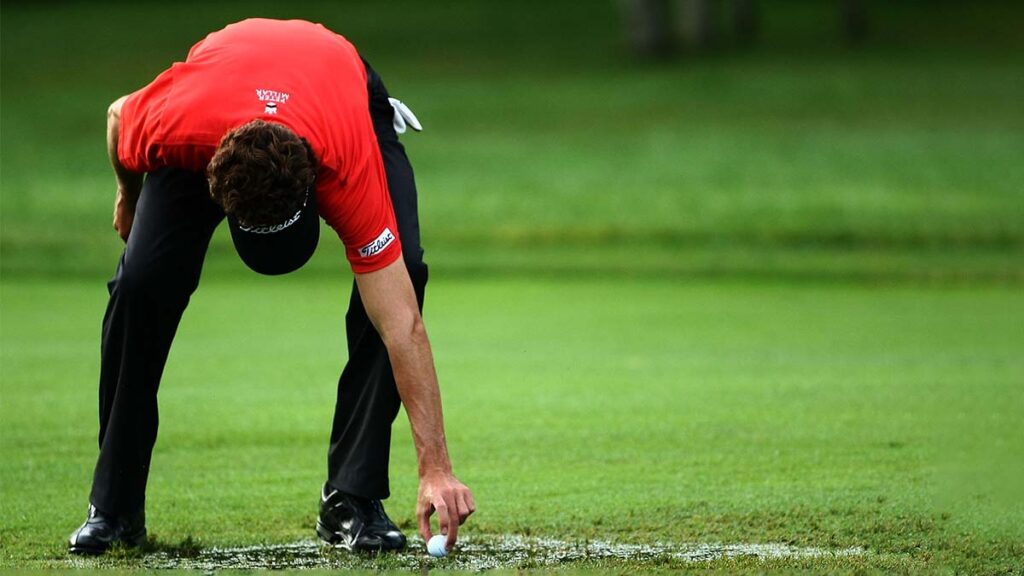
MLR E-3 (Preferred Lies) is designed and recommended for use only in areas cut to fairway height or less in the general area, as it may result in a player receiving free relief from areas where a ball might otherwise be unplayable (such as in bushes or trees). This local rule allows you to lift your ball and then to place it no nearer the hole, within a certain distance of where your ball was, normally one club-length, a hand span or scorecard length.
The committee could choose to use both local rules permitting preferred lies in the fairways and cleaning the ball elsewhere in the general area, however few do.
An obvious question is: are you permitted to clean your ball before putting it back into play? Obviously the whole purpose of MLR E-2 is to allow you to clean your ball, however when you are taking relief under any rule, anywhere on the course, you are permitted to clean your ball and even change balls. Regardless of which MLR the committee adopts, they are both relief procedures and therefore you are permitted to clean your ball in both situations.
A commonly misunderstood procedural issue is whether you must mark the spot of the ball before you lift it. With MLR E-2, as your ball must be replaced on exactly the same spot, you must mark the position of the ball before you lift it. A good tip to know is that before lifting a ball from the course under a rule requiring the ball to be replaced on the original spot, the player must mark the spot first.
However, with MLR E-3, you are going to be placing your ball somewhere else. When a ball is lifted to take relief under a rule, the player is not required to mark the spot before lifting the ball. This means whenever you are lifting your ball and you are going to be putting it somewhere else (e.g. under preferred lies, unplayable or relief from a cartpath), you are not required to mark the spot of the ball first. You can, and many do, but you are not required to and certainly cannot be penalised for failing to do so.
Stuart McPhee is a referee for the PGA Tour of Australasia and conducts entertaining and empowering rules sessions at golf clubs.
Photography by getty images: chris mcgrath; michael reaves