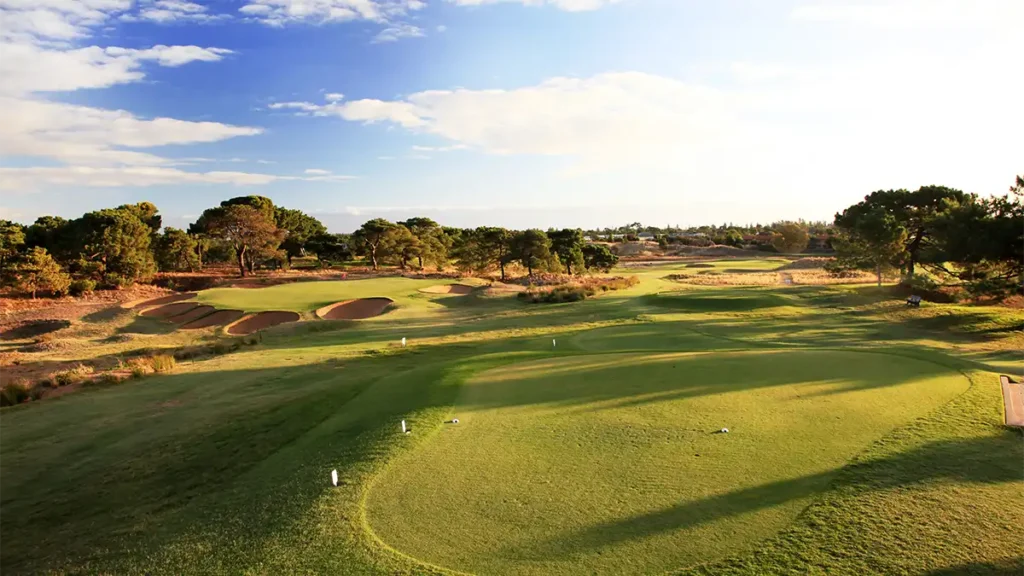
The last time the Genesis Invitational was held at Riviera Country Club, the 236-yard (216-metre) par-3 fourth hole ranked as the third-most difficult hole in the tournament. It yielded just 11 birdies and played to a stroke average of 0.204 over par. In other words, plenty difficult enough for the world’s best.
The iconic par 3, which Ben Hogan once called the greatest in America, features a Redan green, meaning it’s angled from the front right to the back left, allowing players to aim well right of the pin and use the green’s slope to funnel the ball toward the hole. It’s the type of par 3 you could watch shots come into for the entire day and never be bored. Messing with it would be like drawing a moustache on the Mona Lisa.
Unfortunately, that’s what happened ahead of this week’s Genesis, which is back at the legendary George Thomas design after a one-year hiatus due to the Palisades wildfires that ravaged local communities in January 2025. The 236-yarder (216-metre) was lengthened by nearly 40 yards (37 metres) and now plays as a 273-yarder (250-metre).
RELATED: Amateur Amelia Harris, just 17, wins her first WPGA Tour event
A number of players have been asked about the change this week, among them Rory McIlroy. Let’s just say he’s not a fan.
“I don’t think 4 plays any differently. You’re just hitting a slightly longer club,” said McIlroy following his Pro-Am round on Wednesday. “I actually think it’s a horrible change.”
When asked why, McIlroy pointed out that only 15 per cent of the field hit the green at 236 yards (216 metres) in 2024. Then he made another fair agricultural point.
“Like if you want it to be a 275-yard (251-metre) par 3, you have to change the apron leading up onto the green,” he said. “It can’t be kikuyu. It has to be another type of grass that can help you run it onto the green because again, in the right conditions, you try to fly that ball on the green with a 3 iron, it’s going to land, it’s going to finish up on the fifth tee box. That’s what I mean by why it’s not a great change.”
For those who have never played on kikuyu grass, it tends to grab the golf ball, making it very difficult to run it up onto the green. In the past, the big-hitting players of today’s game could fly a mid- to high-iron up in the air, land it softly, and get it to roll toward the hole. That is much harder to do with low iron in your hands, as McIlroy noted. The next best strategic choice would be to run it up, but the kikuyu grass does players no favours on that front.
US Open champion J.J. Spaun said that, due to the softer conditions because of the recent rain, he was able to fly a 3 wood onto the fourth green on Wednesday and feed it down to six feet (1.8 metres). Spaun made par.
“The problem with it being soft is you can’t really use the Redan as I think it’s intended by design,” said Spaun. “But with how soft the greens are, you can pretty much just fly it at the green and it should just plug and roll out maybe to the mid centre or back centre of the green and make your 20 or 30 footer (6 or 9 metres) if you have it. But I think three threes or four threes, there is going to be a pretty good score this week.”
RELATED: ‘Advancing the game’: LIV Golf teams up with R&A and USGA – here’s why
The green will only get softer on Thursday when heavy rain is expected for much of the morning. Plenty of sun and wind is expected for the rest of the week, after that, which should help dry the course out and make the challenge of the mammoth par-3 fourth that much more prominent.
Collin Morikawa, winner of last week’s AT&T Pebble Beach Pro-Am, played the new edition of the fourth for the first time on Wednesday. His take wasn’t as strong as McIlroy’s, but it was one golf architecture historians likely nodded in agreement with.
“I think it’s just a very long par 3,” Morikawa said. “There’s not a lot of thought to it other than just hitting the green and moving on, unfortunately.”