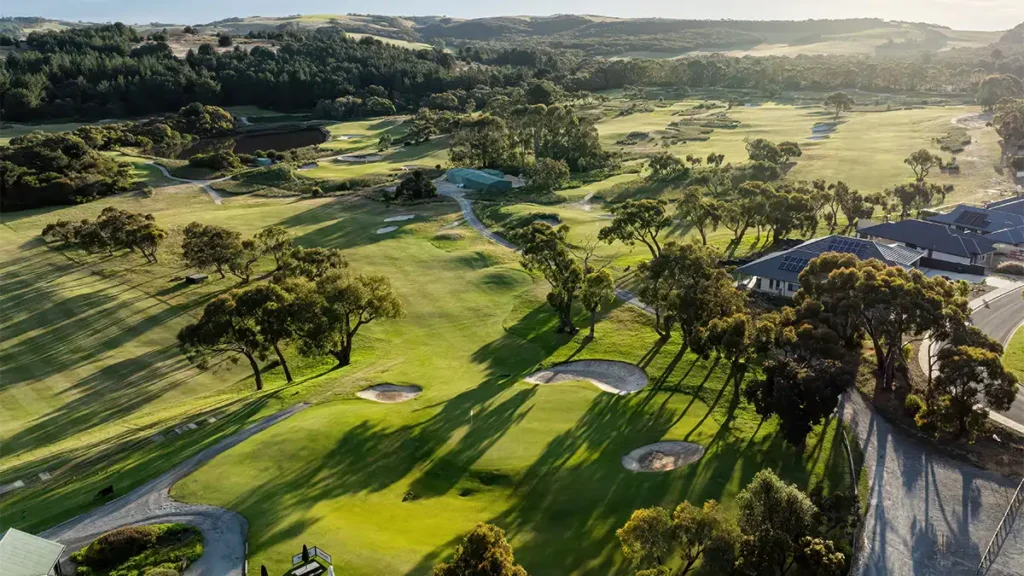
This is when Hawaii extends its annual Aloha to golf, a greeting warmly reciprocated. The PGA Tour’s traditional two-week swing through the islands stands as one of the rare non-major rituals on golf calendar. The vibrant, dramatic topography of Maui and Honolulu set against the forever-blue Pacific explodes through winter, shaking us from post-holiday malaise. The appeal runs deeper than aesthetics. Professional golf returns from its brief sabbatical with fresh-season excitement. For much of the country trapped in cold and ice, the pros’ return offers hope that our own golf isn’t far behind.
This year, that welcome has been severed to one event, the fallout from a water dispute amid severe drought forcing the tour in October to cancel its season-opening Sentry at a browned-out Plantation Course at Kapalua. What’s more, next week’s Sony Open at Waialae could deliver an Aloha of a different sort, as the tour may bid Hawaii farewell for good.
The PGA Tour stands at an inflection point. New CEO Brian Rolapp and the tour’s private-equity architects at Strategic Sports Group are engineering a fundamental reimagining of professional golf’s construction. Among the propositions is a truncated elite schedule that would push the season’s start deeper into the calendar year. (The tournaments excluded from this compressed 20-something slate may not vanish. Instead, they could be relegated to a subsidiary tier—either folded into an expanded Korn Ferry Tour or placed in a hybrid circuit occupying the space between the two tours, with the fall season absorbed into this new division.) Should this proposal advance—potentially as early as 2027—the calendar would contract significantly. Multiple sources with direct knowledge of these deliberations have told Golf Digest that both Hawaiian events, the Sentry and Sony Open, face elimination.
For the tradition-minded observer, this registers as sacrilege. The Sentry (formerly the Tournament of Champions) has maintained its Hawaiian residence since 1999. Beyond the seductive tropical tableau, the event cultivated its identity through rigid exclusivity, admitting only the previous season’s tournament victors. That paradigm shifted following the pandemic-abbreviated 2020 campaign, when eligibility expanded to encompass all Tour Championship qualifiers, a provisional adjustment that calcified into permanence by 2023. The subsequent year delivered further change, a corporate rechristening to “The Sentry” and elevation to the tour’s signature series, with the qualifying threshold extended to the top 50 FedEx Cup finishers. The Sony Open lacks comparable star density, yet it has anchored the tour’s itinerary since the 1960s and serves as the season’s inaugural full-field gathering.
While Rolapp’s pursuit of scarcity economics provides the philosophical scaffolding for this restructuring, the Hawaiian events’ vulnerability derives from a more elemental calculus: money.
Both tournaments face structural impediments rooted in geography. Their remoteness from the mainland creates cascading complications: logistical, operational, financial. Even with minimal infrastructure compared to events in the continental U.S., multiple sources with intimate knowledge of tour productions identify the Hawaiian stops as among the costliest on the calendar. Maui’s sparse population, compounded by Kapalua’s mountainous terrain, yields meager galleries and one of the tour’s smallest corporate footprints. Waialae benefits from Honolulu’s denser population base and draws respectable crowds, yet it has never emerged as a revenue engine.
The economics grow starker when filtered through private equity’s lens. SSG’s $1.5 billion investment demands returns, and with Saudi Arabia’s Public Investment Fund no longer positioned to inject matching capital, the pressure intensifies. The tour has initiated staff reductions to meet these asks, although a compressed schedule achieves it at a higher level. It would eliminate redundancies, concentrate resources, amplify per-event revenue and reduce aggregate overhead.
Of greater directional concern is the backing of title sponsors. Next week marks the end of Sony’s relationship with the Hawaiian Open. Sentry is signed through 2035; however, see if anything sticks out in the following statements. The first, from the PGA Tour in announcing Kapalua’s cancellation:
“Since it first became a possibility that the PGA Tour would not be able to play at The Plantation Course at Kapalua due to the ongoing drought conditions on Maui, we worked closely with our partners at Sentry to assess options for contesting The Sentry in 2026,” PGA Tour Chief Competitions Officer Tyler Dennis said in a statement. “While it is unfortunate to arrive at this decision, we are appreciative of the collaboration and dedication from Sentry Insurance, a tremendous partner of ours.”
As those associated with the tournament noticed, thanks were given to the title sponsor, but not Hawaii, Maui or the course. Then, in the same announcement, from Sentry:
“The Sentry is a jewel in the PGA Tour schedule,” said Stephanie Smith, chief marketing and brand officer and chief golf partnership officer at Sentry. “We were determined to find a way to play a signature level event in 2026—one that honored the tournament’s tradition and provided the quality of competition that players and fans have come to expect. Despite the tour’s best efforts, it became impossible to do that. Sentry is committed to our long-term relationship with the tour—which runs through 2035—and The Sentry’s place as a prominent event. While 2026 will not turn out as we would have liked, we’re optimistic about the future.”
Again, no mentions of Hawaii or Maui.
Sentry’s recent $1 million donation to Maui-based charities, accompanied by language emphasizing “commitment to partnership with organizations on the island,” reads as generous and strategic. But behind the public gesture, whispers circulate that the Wisconsin-based insurance giant wouldn’t object to relocating its sponsorship. While Rolapp, his Future Competitions Committee, and Strategic Sports Group wield decision-making authority, tournament sponsors exert considerable gravitational pull. The tour’s elevated event structure has already spawned resentment among those excluded, sponsors who feel they’ve underwritten a devalued asset. Few contracts extend beyond this decade, triggering frantic maneuvering as tournament officials and sponsors jostle for positioning. Sentry’s long-term commitment ensures its survival within the restructured league. The question is where.

Sony has been the title sponsor of the PGA Tour stop at Waialae Country Club in Honolulu since 1999, but this is the last year of its contract.
Tracy Wilcox
To Rolapp’s credit, the tour has long battled claims of oversaturation. Forty-plus events bleeding into indistinguishable sameness, the league seemingly allergic to imagination. His vision addresses legitimate grievances. With this many entities involved, casualties are inevitable. Bruised egos, discarded partnerships, the collateral damage of transformation.
Conversely, fans complain about homogeneity, about golf that feels interchangeable week to week. The Hawaiian swing represents the exception. Kapalua especially possesses distinct identity—the course’s dramatic contours, the field’s composition, the residual cachet of exclusivity even after expansion. Presence there still signifies something. Yes, romanticizing tropical aesthetics is easy. That doesn’t render the sentiment false. Kapalua represents precisely what should be protected, not eliminated because the spreadsheet dictates efficiency. Saving money proves pyrrhic if you’re destroying what made the enterprise valuable in the first place.
Perhaps a future exists where Hawaiian golf survives, conceivably by consolidating both events in Honolulu to leverage larger crowds and tighter economics. Right now, that scenario requires considerable optimism. Tellingly, Kapalua issued a press release earlier this week trumpeting the Plantation course’s restoration to immaculate condition following its fall closure, and photos on social media make it appear the course is in tournament-ready shape. One could argue the tour acted prematurely in canceling the Sentry, though the time frame was taxing, and the course’s renaissance owes more to Kapalua’s grounds crew and the diversion of resources from the resort’s secondary layout than to natural recovery.
Still, the subtext is as clear as the Pacific. Kapalua is reminding the golf world of its existence and making a final plea for consideration. Especially if it doesn’t get a chance to say goodbye.
This article was originally published on golfdigest.com