
AUGUSTA, Ga. — One boy was white, and soon after World War II his father became the proprietor of the Augusta Municipal Golf Course. There was inherent middle-class status to the job, as the son came to understand after he was born in the mid-1960s. The golf perks included his family receiving 50 tickets to the budding golf tournament in town called the Masters.
MORE: Our picks for the Masters, and the Bryson DeChambeau dilemma
The other boy was Black, and he knew nothing about golf and had never heard of the Masters, even though he lived four miles from Augusta National Golf Club. Raised by a single mom doing her damndest to get by, his family moved more than a dozen times before he reached middle school. Their apartment was in a crime-ridden neighborhood of government housing, near Daniels Field airport, that was separated from Augusta Municipal by a narrow swath of woods.
MORE: A weird stat to predict the Masters winner
There was no earthly reason why the two boys would ever meet, and certainly not at the scruffy but beloved muny nicknamed “The Patch.” But then, who would have thought that, in summer in 1981, a group of kids from the projects with nothing better to do would set out on a mission of mischief. They’d watch golfers tee off on the course’s third hole, race out of the thick trees to snatch golf balls and then disappear back into the green stuff. (Being industrious, the boys planned to sell them later to afternoon golfers.)
Imagine the bewilderment of the golfer who thought he’d hit the perfect drive and his ball had vanished.
“There was water on hole 3, but we were the real hazard,” Dr. Gregory McCord, that kid from the projects, recalls with a chuckle 45 years later. “If you got past us, you had a chance of finishing the hole.”
MORE: Winning the Masters was supposed to free Rory McIlroy. It didn’t unti now
It didn’t take long for word of the thefts to get back to the clubhouse, and course operator Lawson Douglas—known to all as “Red”—got on the case. He went out to the woods at No. 3, and the boys scattered except for one. McCord, a scrawny 13-year-old, was more intrigued than scared about this showdown, and when Douglas first spoke to him, his tone was more of “care than scolding.”
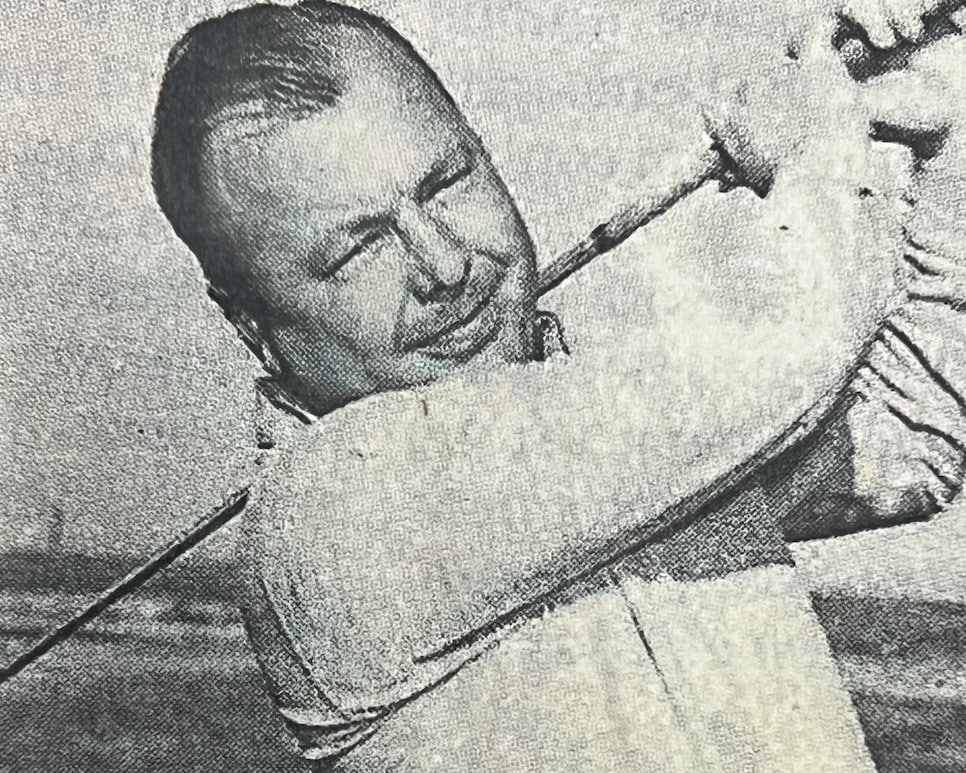
Red Douglas in a newspaper photo. (Courtesy of Jim Douglas)
Red told McCord that he could get arrested or, more likely, beat up. Douglas then offered an alternative—the kid could come work at the course and earn some honest money. Greg said he’d be there in the morning with his brother.
When Douglas’ teenaged son Jim heard about the offer, he shook his head and said something like, “You need to put the hammer down on him, Dad. Teach him a lesson.”
Jim can clearly recall his father’s response: “I’m going to teach you a lesson.”
“Son, he doesn’t have the same things you have,” Red told his boy. “You don’t know how fortunate you are to be in the position you are. I’m going to show you what golf and a little bit of hard work can do.”
It was Jim Douglas who eventually told Greg McCord about that conversation.
“Good thing his dad was a wise man,” McCord says, laughing.
Over that summer and beyond, as they worked for $1 an hour on every task given them—mow the grass, clean the carts, move the sprinklers—the two boys became friends. They squeezed in practicing golf in the late evening light. They still didn’t travel in the same circles or remotely have the same home life, but none of that mattered at The Patch.
They knew they belonged there.
• • •
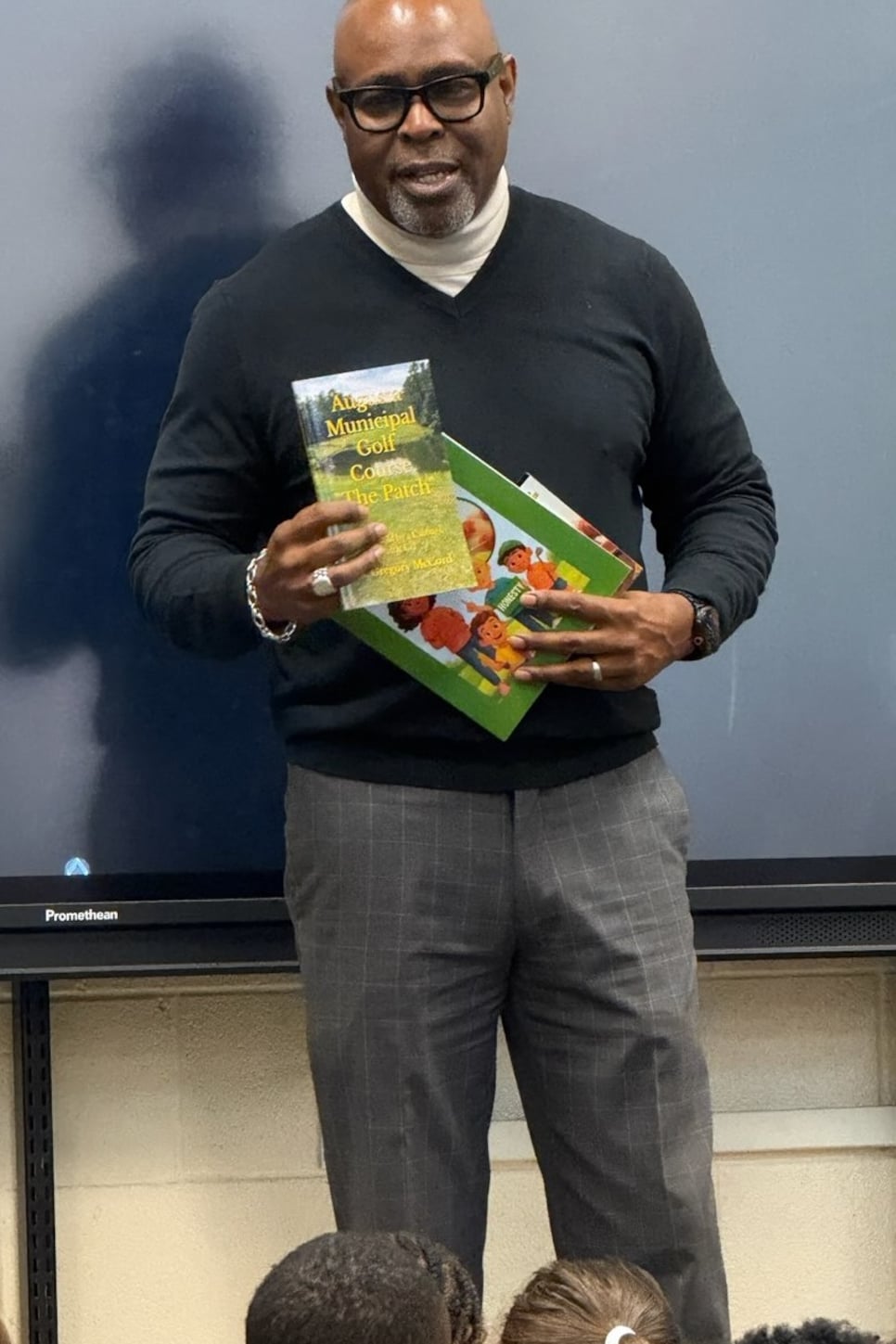
Dr. Gregory McCord speaks to a classroom about the books he wrote about The Patch. (Courtesy of Dr. Gregory McCord)
All of the memories came flooding back on a Friday in March. McCord and Douglas were among the people with close ties to The Patch who were invited to a ceremonial first day at the newly renovated course. In 2023, Augusta National chairman Fred Ridley announced that the club, along with the city of Augusta, First Tee Augusta and Augusta Technical College, would undertake a full overhaul of the facility, with a reimagined 18-hole layout done by Tom Fazio and Beau Welling; a nine-hole par-3 course called The Loop, designed by Tiger Woods; a state-of-the-art practice facility; and a new clubhouse.
The origin of The Patch’s nickname is disputed. Some say it was accurately named for being a patched quilt of green and brown. A more whimsical take ties it to the cabbage patch that grew behind the 10th green. Either way, it’s now a patch in name only. The multimillion project is among the most extensive remakes of a golf facility in America and was done so with the hope that many more people—most critically, children— will take up golf and make it a game for their lifetimes.
In what truly felt like a homecoming for both, McCord and Williams played together for their first round at the “new” Patch. McCord, 58, went on to play golf at Livingstone College in North Carolina, earned a EdD and is a longtime school administrator in South Carolina, Douglas, 60, has been the assistant men’s golf coach at the University of Georgia for more than 20 years, helping to recruit a load of All-Americans, including Brian Harman, Harris English, Kevin Kisner, Bubba Watson and Sepp Straka.
In their Patch return, they spent a surreal day trying to identify old and familiar pieces of the course while reveling in how much their muny track had been transformed into something that looked more like Augusta National than a cow pasture. They marveled, too, at the green fees staying reasonably low for locals: $25-$35 to walk, with a $5 discount for seniors and juniors. The Loop is $15 and will feature night golf for $30.
“Golf is a powerful thing, and Augusta National is doing incredible things,” Douglas said. “In recruiting, for those kids who want to play golf or get a college scholarship, the biggest barriers are money and access. So, for people to be exposed to the game in such an affordable manner, it’s incredible. Especially because this is one of the nicest courses I’ve seen anywhere. For them to make the rates what they are is amazing.”
McCord didn’t feel a hint of melancholy about what was gone from The Patch. “No, because they did such a wonderful job,” he said. “You know, everyone has an imagination, but couple imagination with money, and what you can do is unlimited. So, from a pure golf standpoint, I don’t think anybody is going to miss the old Patch.”

Jim Douglas has served Georgia as its assistant golf coach for more than 20 years. (Courtesy of University of Georgia Athletics)
Speaking at his Masters chairman’s press conference at Wednesday, Fred Riley said, “Augusta Municipal Golf Course has been a fixture in this community for many years, has so much history. We felt there was an opportunity to take the wonderful piece of property and transform it into something that is life-changing for many people in this community. We can’t find a better way to promote the game of golf to do It in our own town.”
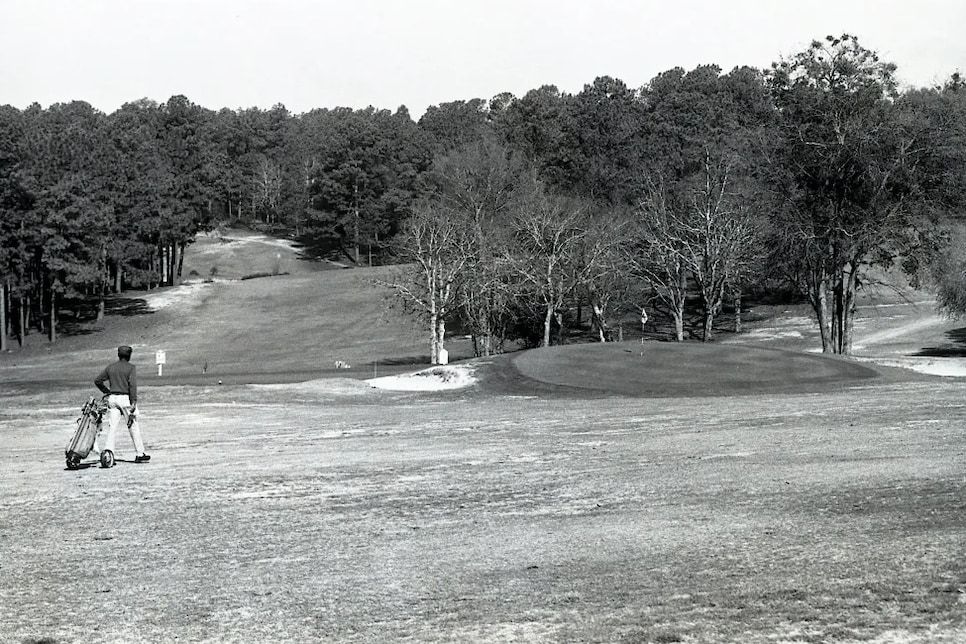
The Patch, shown in an undated photo, was opened in 1928. (Courtesy of Augusta Museum of History)
The role of Augusta National in the project, both men said, cannot be underestimated. The club won’t reveal what it contributed financially to The Patch, but the redo doesn’t happen without it. In the recent decade, ANGC has made significant contributions to improve life in Augusta, including the support of a project that improved housing and community infrastructure in two traditionally Black neighborhoods. The club and its partners also contributed $10 million to development of a new community center and headquarters for the Boys and Girls Clubs of Augusta. Next to be added in 2028 is the TGR Learning Lab, in collaboration with Woods.
• • •
The expectation for The Patch is that it will remain the “melting pot,” as Douglas calls it, that it’s been for more than 60 years. It wasn’t until 1964 that Blacks were able to play the course, but since then, people of all races and walks have clamored to play it—just as much for the camaraderie as the exercise. Black caddies from both Augusta Country Club and Augusta National regularly played at The Patch, and the most prominent was Jim Dent, who went onto a professional career that included 12 wins on the Senior PGA Tour. (The road that enters The Patch is now called Jim Dent Way.) The golf at the itself was not carefree, with McCord recalling more bare spots than grass, and Douglas remembering tiny, pushup greens that felt impossible at times to hit. “Made my short game better,” he said dryly.
Saddled with little maintenance money from the city, few workers and an antiquated irrigation system, Red Douglas did much of the groundskeeping on his own for 45 years. He worked seven days a week and never took a vacation. Incredibly, Jim and his dad never played a round together at The Patch. Still working, Red died of a heart attack at age 71 in 1991.
According to Jim Douglas, Red nurtured an ethic and atmosphere at The Patch that remains.
“It was his happy place,” the son said. “He just loved seeing people of all walks. You could put my dad in front of the president of the United States or in front of the lowest of the low, and he’d find common ground to talk about.”
McCord, of course, learned that first-hand. He honed his golf skills at The Patch but found his interactions with the other patrons more rewarding. Everybody came to recognize him as a fixture around the clubhouse, and the Douglases became a second family. That was heady stuff for a kid who never felt at home anywhere. “I always said that if I was white, I’d want to be Jim Douglas,” he said. “[His parents] poured into him like they poured into me.”
From his impoverished beginnings, McCord has lived a highly fulfilling life. After getting his Doctorate of Education, he’s served in numerous school positions and was the superintendent of the Marlboro County School District in South Carolina. He now works as a consultant in training rising administrators. McCord plays golf regularly—and happily shot 79 in his first round on the new Patch—and sheepishly admits that his more refined taste in golf courses limited his grown-up time at the old Patch.
The experiences there, however, have lasted with him over a lifetime, and because he’s worked so much with kids, McCord wanted to impart some of the lessons he learned. So he self-published two books, “Augusta Municipal Golf Course: The Patch,” and “The Cabbage Patch Kid.” The latter is for children and is accompanied by an activity book.
“I’ve been really good with mentoring programs and getting kids involved in different things,” McCord said, “but it dawned on me one day that I haven’t had anyone get into golf and stick with it. I wanted to re-write that, so to speak.”
McCord said he’s already sold 4,000 books, and just recently a mother of a young boy called him to see if he could help her son get started in golf.
Somewhere, Red Douglas is giving an approving nod.
“There’s so much that takes place on a golf course that produces the kind of individuals we want in an acceptable society,” he said. “Golf teaches you the things it taught me, and I want to impart that on your people and do it with intentionality.”
McCord’s overarching message is this: One man and a single golf course made all of the difference in his life.
“When anyone came to The Patch, you were an equal,” he said. “You started from scratch from hole No. 1. Whether you were a prince or a pauper, you signed up to play with anyone, and your golf game did the talking.”
Watch our video below for more details about the transformation of The Patch:
This article was originally published on golfdigest.com