
On Sunday, tied for the lead heading into the final round of the Masters, Cameron Young faced a dilemma: acknowledge the magnitude of the opportunity, or treat it like any other round? The answer ended up being both. The PGA of America shared this quote from David Young, Cameron’s father and coach: “Although we all accept that today is not just another tournament round, the best way to attack it is to keep our routine pretty normal.”
David brings up a conundrum: It’s Cameron’s usual game that got him there, yet the moment is so different. How can he convince himself to play like it’s a normal round? If he lets himself feel this moment is so important, so special, the pressure will mount, making it harder to perform. So, what should he do? Pretend that nothing is different? Impossible. What is he supposed to think?
He can do what his dad says: He can think both things at the same time.
David Young’s advice to his son is tapping into what psychologists call “holding the dialectic.” Its fundamental meaning is accepting two opposing truths. So, in this instance, Sunday at the Masters is unlike any other day and team Young is going to treat it like a normal day. These are two truths, and they are in opposition with each other. But they can coexist harmoniously within Cameron’s mind by holding the dialectic.
Psychologists prompt people to implement this psychological tool by swapping out the word “but” for “and.” So, instead of, “This day is unlike anything I’ve ever experienced, but I’m going to approach it with my normal routine,” the thought would be, “This day is unlike anything I’ve ever experienced, and I’m going to approach it with my normal routine.”
The difference is slight, but significant. The statement goes from one of tension, to one of acceptance. The first statement is inherently negative, while the second is positive. That’s a key distinction in the world of golf psychology.
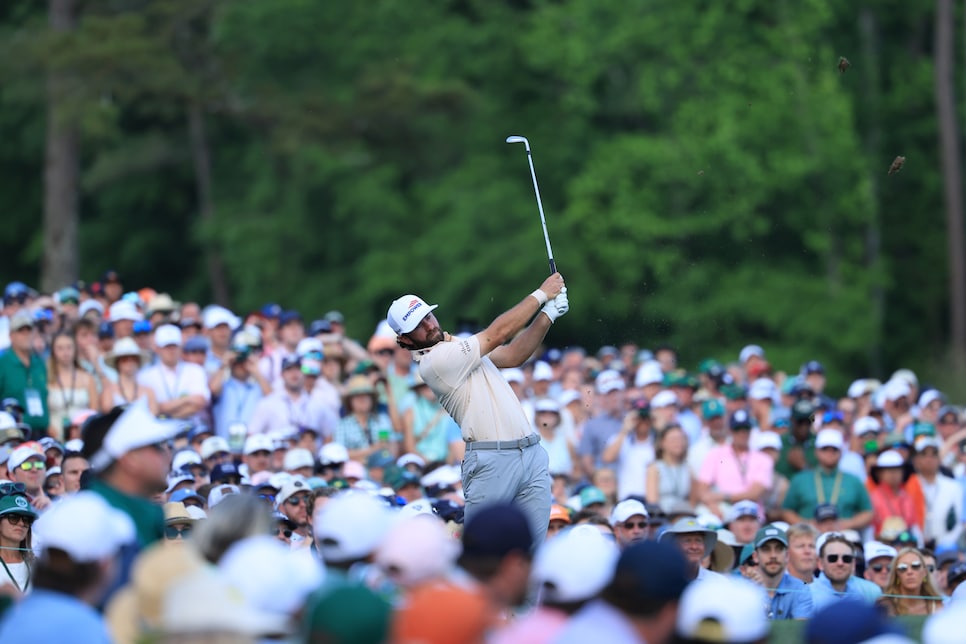
David Cannon
Through biofeedback devices that measure stress levels, renowned golf psychologist Dr. Graham has seen how training the brain to shift from a negative thought to a positive thought will change a player’s brain waves, alter energy levels, and “bring them back to being athletic and creative very quickly. So that phrase, holding the dialectic, is a really clean, easy way to pull all of that together,” Dr. Graham says. “It’s way better than fighting the negative. Instead of fighting it, you acknowledge it, and you convert it.”
This is a psychological tool amateurs should use, too. Once you start looking, you’ll find many scenarios around the golf course where you could be holding the dialectic.
I just missed a two-footer, and I’m capable of making the next one.
I usually hit a fade, and today I’m going to set myself up to keep this hook in play.
I really want to win, and I’m going to focus on visualizing the shot in front of me instead of the score.
Addressing the negative or pressure-fueled reality and pairing it with a positive reality can help you avoid a spiral. You’ve acknowledged that something bad happened, or that you’re uneasy, and then turned your attention to something far more positive. Holding the dialectic diffuses the power of the negative.
“If we can keep the golfer focused on what they can control, it empowers them to free it up and play, and not worry so much about what isn’t good, what’s not working,” Dr. Graham explains. “Over the course of the round, what they’ll find is that their emotions stay more even, their confidence stays higher, and their tension stays lower, which allows them to get the most out of their game.”
By holding the dialectic, you can change your thinking to leave space for mistakes. It allows you to miss putts, and still be allowed to think of yourself as a great putter capable of making putts. It gives you a way to handle negative or intense situations without letting them dominate you.
Cameron Young didn’t win the Masters. He finished T-3 after leading for a time on the front 9 on Sunday. Eventually, Rory McIlroy took over and secured his second green jacket. But in a situation where he could’ve collapsed, Young remained resilient. Perhaps in part because of the advice from his dad.
This article was originally published on golfdigest.com