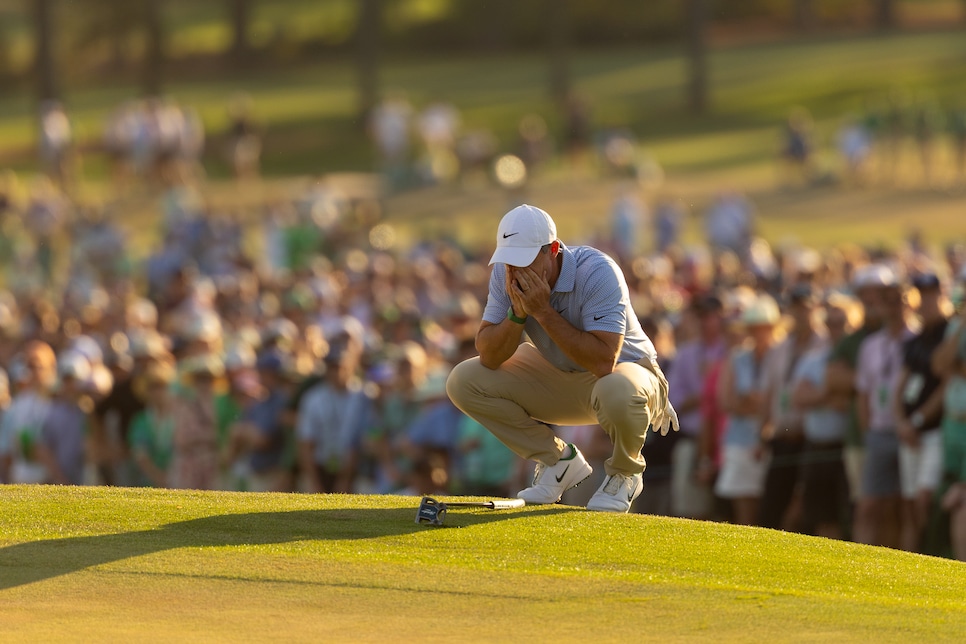
When Rory McIlroy three-putted the fourth green on Sunday at Augusta, I had it all figured out, and I told my friends: He had lost this tournament on the 12th hole on Saturday. At that point, the six-shot lead he built up through the first two rounds had disappeared, the Friday luck had worn off, and he was starting to pay for his wayward driver. Everything that had happened since, right up to the three-putt, was just playing out the string—the fool’s gold had been exposed, his game wasn’t as strong as it had seemed, and the two short misses would break his spirit. Now, he’d be swept by the tide: somebody like Justin Rose or Cam Young or Scottie Scheffler would blow him away.
For any other player, I still think I would have been right. With Rory, I should have known better.
According to us, what is the fundamental essence of Rory, here in his 20th professional season? Is it his talent? His trophies? His heartbreak? Is it his personality and charisma, which inspires legions of love but also pockets of hate, polarizing on what seems to be an 80/20 split in his favor, yet allowing no room for neutrality?
I’d submit that these are all very colorful surface decorations, effective at keeping him in the spotlight but disguising the truly remarkable thing at his core that drives the vehicle.
I’m not sure quite what to call it. You approach the idea with “resilience” or “pain tolerance,” but those words won’t bring you to the inner core. Beating somewhere at the center of the show, past behavior, past talent, is an element that is irrepressible—quite literally incapable of being defeated. Golf writing tends toward the spiritual and romantic, even in a justifiably cynical age like ours, but I don’t view this through that lens, and it’s why I don’t want to rely on a word like resilience or a phrase like “the durability of the human spirit” to describe this. To be truly understood, it even needs to be acknowledged without the baggage of wondering if he’s a “good” person. If that proposition makes you uncomfortable, to the extent that you’d like to believe in clean heroes and villains, apologies, but this is something more elemental and innate.
What am I getting at? Rory is Great with a capital G, but it’s the kind of greatness that we can divorce from any value judgment. Greatness can attach itself to both terrible and wonderful men—those surface qualities matter less than the interior force that makes them great in the first place. Rory has that force, and after two decades of watching him, I now believe that his force is both inevitable and untouchable.
All the pain he’s experienced, the suffering we know about and the suffering we don’t, is real. The effects on him are real. His story, for instance, of walking through New York City, earbuds in, deep in melancholy after the Pinehurst debacle, is so real you can imagine the cloudy day, picture his gaze in the middle distance, instinctively landing on no other human face. The tears at St. Andrews are real. The years of wondering when it would end, what happiness looked like, how much victory mattered, unresolvable doubt, all of it real.
A layer deeper, though, was the unbreakable thing. If there’s a reason to be jealous of McIlroy, it’s not the money or the fame or the legacy, but exactly this foundation, this murky center, made up of god knows what, that arms him for the long fight and renders him invulnerable. Paul McGinley, as captain of the 2014 European Ryder Cup team, relied on the metaphor of a rock persisting through the storm. Rory embodies both parts of the equation—his personality and his talent are the storm, but what makes him great is the rock.
(Of course, now you get to the question of why? Why persevere in the first place? What makes it worthwhile? While I think we should leave room for a sense of mystery about a question that at most one person can answer, I’d feel safe arguing that within this irrepressible center is a drive for greatness that wouldn’t be relatable for most of us. And it began early; in the recent Amazon documentary on the 2025 Masters, his parents said they wondered if something was strange about their son’s complete devotion to golf. So where the core is protective for Rory, I’d also argue that it’s propulsive—he can’t be shattered, but wherever this thing is taking him, he also can’t be deterred. We can’t reduce this to a desire for fame or glory or money or even competitive intensity. On some level, it just is. A shorter way of saying this is, yes, he has his conscious motivations, but maybe it’s not entirely up to him.)
Adam Glanzman
At a later Ryder Cup, in Rome, Rory spoke about his interest in the writing of Marcus Aurelius and the philosophy of stoicism, and though it would be impossible to summarize it here, one key element—and the one that seemed to interest Rory the most—was amor fati, a love of fate, which can be tidily but not inaccurately summed by words like acceptance and resilience, but without the implied passivity, in fact within the context of attaining greatness. It was perfect for him, and it makes perfect sense today; this, to me, was not Rory seeking out some blueprint for life, but touching base with the rock beneath the storm. A rock that was always there, carrying him through, but that he sought to recognize for the assurance it provided.
The assurance must have felt good, but I no longer believe he needed it. The rock, the force, destiny, whatever you want to call it (there are many golfers who would call it God, although as far as I know, Rory has never done so publicly), has been with him throughout the volatility of his surface life. You can tell this is true because without it, who could have survived all that pressure? The years of drought that painted the picture of a fallen prodigy, the almost unbelievable major defeats stolen from victory, his turbulent and thankless time as the spokesman for the Tour against LIV, and whatever he suffered in his personal life…some of it engineered by bad luck, some of it by himself, but all of it crushing to a normal soul.
He was never crushed. He was tried, he was tested, but he always had the inner store to fall back on, even if he didn’t know it. That unnamed terrain gave him all the endurance he ever needed, because at its heart was the assurance of his greatness—however long it might be deferred.
He was never guaranteed to win on Sunday, and so much could have happened to ruin that outcome, as it has been ruined before. But what I got wrong was thinking that a Saturday collapse or a Sunday three-putt would break him. Nothing has broken him yet, and the revelation that has been crystallizing for 20 years, little by little, is that nothing can.
This article was originally published on golfdigest.com