
The legend goes like this …
It was a shot that had no business being hit. Taken from the left-side pine straw at 15, born from bravado and showmanship and pure what-the-hell, to the drumbeat of everything this place had made men feel over the decades. And why not. These were writers, a haggard guild with ink-stained fingers and coffee spots dotting their sleeves, men who covered greatness for a living but never got to experience for themselves. Yet here they were, by some divine comedy, walking Augusta National the Monday after the Masters. The cathedral, briefly, was theirs.
It was getting late, a little past golden hour, the shadows long across the fairway, and it was unclear if the group would finish. This might be the last hole. Three of the writers knew each other from the beat. The fourth was something of a mystery—a guy in his 20s, fresh out of college, believed to be a runner, one of those jobs handed to interns and bottom-rung newcomers tasked with gathering information back when information required actual legwork. He had mostly kept to himself, quiet in the way people are when they know they don’t quite belong somewhere and are terrified of being found out. But he seemed to understand exactly where he was. And there’s a certain kind of person who, when handed that kind of luck, decides the only honest response is recklessness.
He lined up 200-plus yards over water. His caddie advised against it. He took a mighty lash anyway, bending a 5-iron around the loblollies, carrying the pond and the false front, the ball bouncing twice on the green before it found the flagstick and dropped.
The group lost their minds. It was a 2 on the fabled par 5, an albatross.
As they buried the kid in hugs and high-fives, one of the caddies offered, almost reverently, that if memory served, it was only the third 2 made at the 15th in Augusta National history. The first was Gene Sarazen’s Shot Heard ‘Round the World in the 1935 Masters, commemorated by the very bridge they were now crossing to retrieve the ball. The second by an Augusta National assistant pro. The ridiculous is often routine at Augusta National. But routine had nothing to do with this.
The group agreed the round should end there. They shook hands and made the walk uphill to the clubhouse, still buzzing, still shaking their heads. It was somewhere on that climb that the kid made a strange request, almost under his breath:
Please don’t tell anyone about this.
The writers exchanged a look but let it go. A man’s entitled to his superstitions and privacy. It wasn’t until later, settled into post-round beers at a Washington Road bar, that the three of them started turning it over. The quiet. The nerves. The request. And then it clicked.
The kid wasn’t who he said he was. He was using someone else’s name, someone else’s credential.
The son of a bitch had snuck onto Augusta National.
More Masters preview stories .jpg.rend.hgtvcom.406.271.suffix/1775126450482.jpeg) Crunching the Numbers Stats say this is the most important hole at Augusta National if you want to win the green jacket
Crunching the Numbers Stats say this is the most important hole at Augusta National if you want to win the green jacket  viewer’s guide How to watch the 2026 Masters (with more than 100-plus hours of live feeds)
  Memory Lane Masters 2026: 5 things we’d like to see Augusta National bring back (and 5 things we wouldn’t)
• • •
That’s the story, anyway, as it’s been passed down through golf media for 30 years. This happened in the early 1990s, the industry’s salad days, when expense accounts were fat and deadlines were merciful. Newspapermen filed once a day. Magazine writers once a week, if that. Nobody saw the Internet coming, had no idea it was about to detonate everything they’d built. So the shot became a kind of talisman, shorthand for a Golden Age that was already ending before anyone thought to mourn it.
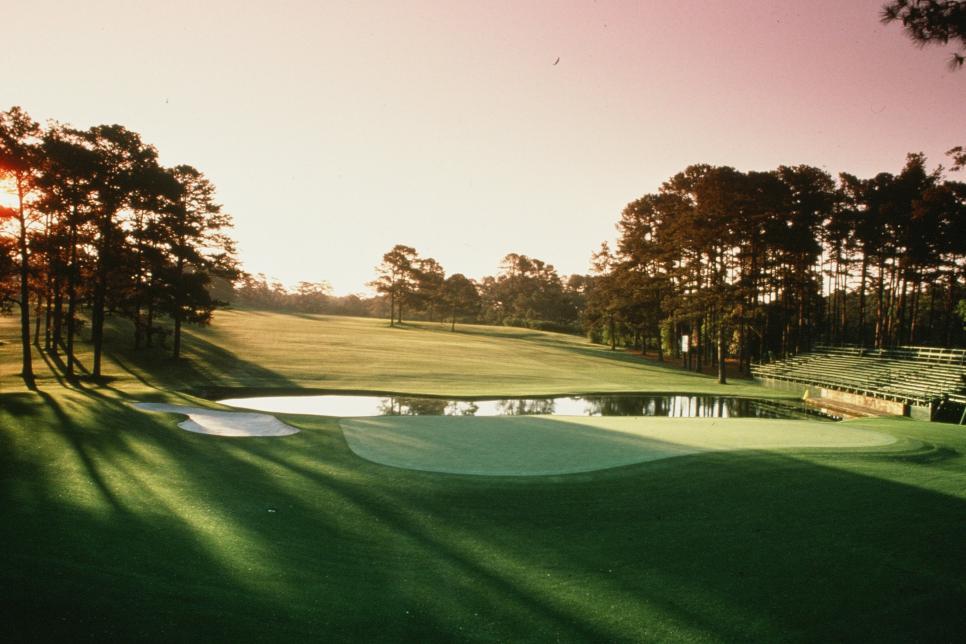
Augusta National
Most who have heard the story assume it was apocryphal. Augusta National is so relentlessly controlled, so allergic to the unscripted, that the idea of someone pulling this off strains credulity. Yet the story lived on, because some stories are too good to die. Because Augusta National has never met a secret it was willing to part with. Because as well as the club treats the press corps each April, that same press corps is also managed and contained more carefully than at any other event in golf—credentialed, badged, held at a genteel arm’s length. And so this story, almost certainly fiction, survived as something the writers needed it to be: proof that just once, somehow, someone got the last laugh on Augusta National.
The thing is, the story is actually, kind of, somewhat … true.
• • •
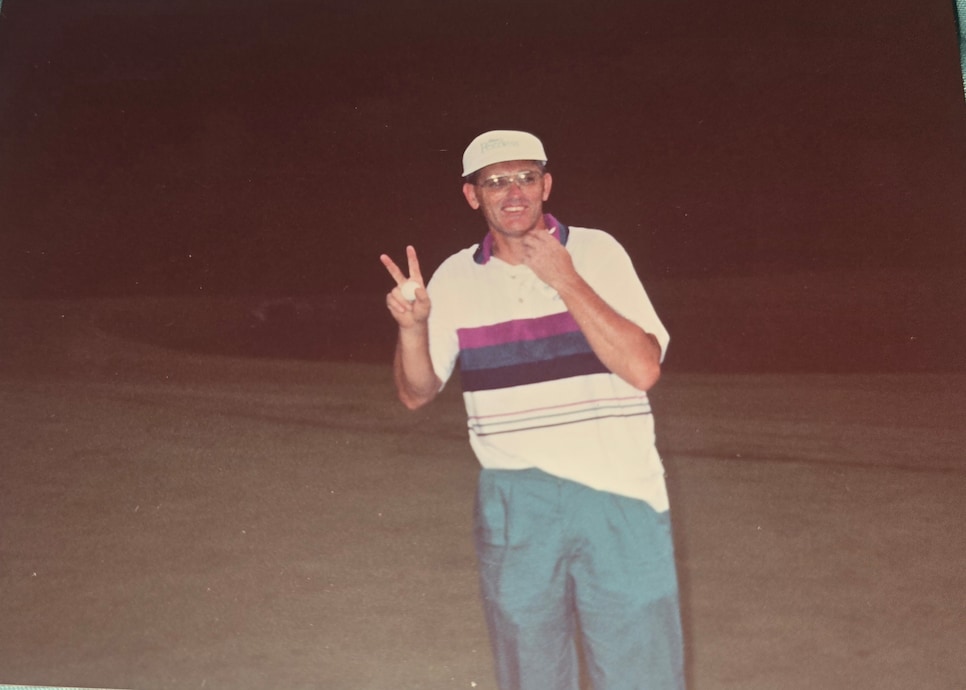
Gregg Hemann was there. He saw the albatross. He has the pictures to prove it. This is the part of the tale that holds up.
Hemann is a former mini-tour player who once had a cup of coffee on the then-Nike Tour. The hard reality about mini-tour life is it costs a lot to compete for very little, a price many are willing to pay to chase a dream. After four years, Hemann knew the chase was about to end. He was married with a 6-month-old baby, and though he was good—he once finished seventh in the Space Coast Tour season standings—a lot of others were better. He didn’t want to be the 35-year-old still searching for something that had long passed him by, so he returned to his hometown of Augusta and took a job as an assistant pro at Jones Creek Golf Club.
The job came with one significant perk. Every year, he got to play Augusta National after the tournament. The club invites those in the surrounding area who’ve helped with the Masters—local courses like Jones Creek typically provided volunteers or hosted Masters-adjacent events—and in 1991, Hemann was in. He played that day with his fellow Jones Creek assistant pro Hank Leffler, two assistants from West Lake, and they went off last.
Leffler was Hemann’s friend. In his mid-40s at the time, originally a welder and Navy man, he was humble and unpretentious, a guy who had stumbled into golf and never quite recovered. The business side of being an assistant pro—the desk work, the retail, the glad-handing—held little appeal. But playing, giving lessons, spending hours alone on the range beating balls until the light gave out, that was the thing. “One of the best iron players I’ve ever seen,” Hemann says.
With the assistants being in the last group off that day, it meant they inherited a problem. The dirty secret about the club’s post-Masters favor day is the pace is brutally slow. Everyone out there is playing what may be their only round ever at Augusta National, and they treat every shot accordingly, stopping to document, to absorb, to simply stand still and look. “You get it,” Hemann says. “But boy, one of the longest rounds you’ll ever play.” By the time they reached the 15th hole, it was clear they weren’t finishing before dark.
Hemann had laid up off his drive and was down by the pond when Leffler hung back to attempt to reach the green in two. Hemann figures Leffler had about 190 yards in, but positioned on the left side of the hole, he’d need to bend his approach at least 20 yards to have any chance of holding the putting surface. A low-percentage play under ideal conditions. In fading light, it bordered on absurd.
And then …
“Well, it was dark, and they couldn’t see,” Hemann says. “But because of where I was, I was the only one who could. And it took a hop and disappeared.”
He started yelling. The ball went down, Hank! It went in!
Leffler and the others didn’t believe him. They walked toward the green convinced Hemann had lost his mind, only accepting the truth as they approached the hole. And once it registered it was nothing but pure joy.
It was, in fact, an albatross.
“Luckily I had a camera on me,” Hemann says. “Captured him just as he took the ball out of the hole.”
More Masters preview stories  Masters Preview Masters 2026: Power rankings for the entire field at Augusta National
  Masters 2026 The Masters winner overshadowed by someone else’s defeat
  Golf Digest Logo Undercover: Inside the sprawling Masters merchandise operation
• • •
But Leffler, Hemann and the others in that group were not media members. Leffler, who died just before the 2018 Masters at age 73, spent the final two decades of his life working at Augusta National as a caddie, and his fellow loopers were not shy about spreading the word of what he had done. So how does a story this remarkable in its own right transform into a tale about a writer sneaking onto Augusta National?
Because, in a separate incident, that happened too.
The Masters holds a lottery every year for credentialed media members to play the course the Monday following the tournament. For those of us who love this game, it can be life-affirming, and is the closest thing golf has to a standing invitation inside a locked room. Which made one aspect of the legend always difficult to swallow: Who, upon winning that lottery, would give it up?
There is no Ocean’s Eleven here, no grand conspiracy, no master plan. An editor at one of the local outlets—who asked not to be identified, fearing his publication might lose its credentials—drew the lucky number in the lottery and gave it away. Passed it to a younger staffer without much deliberation. “It was going to mean more to him,” the editor told Golf Digest. The writer, who no longer works for that outlet, did not respond to a request for an on-the-record interview.
The best anyone can piece together goes something like this: In the years that followed, the writer began telling the story at Masters week gatherings, the kind of late-night rooms where the drinks are free and the audience is willing. Somewhere in the telling, it seems, the story changed. The inherited opportunity became a caper. It’s not hard to imagine how it happened. You’re young, you’re in a room full of people who are listening, and you played Augusta National. It’s not a crime to want a better story. If anything, it’s an occupational hazard.
And at some point during one of those evenings, Leffler’s albatross came up. It always did. The Jones Creek guys made sure of it; they were proud of him, and brought it up constantly.
That’s the thing about a room full of people and a few drinks and two remarkable stories breathing the same air. Memory gets generous. Details wander. Timelines bend toward the more interesting version of themselves. Nobody’s lying, exactly. Nobody’s even trying. It’s just that a story told enough times in enough rooms starts to want to be better than it was, shedding the complicated parts and keeping the clean ones. One story borrows from another. An assistant pro becomes a writer. A gift becomes a heist. The seams disappear.
Somewhere between the telling and the retelling, the two stories found each other. And the legend was born.
• • •
Folk heroes are made, not found. The truth, stripped of its mythology, rarely survives the comparison.
And yet, Hemann wasn’t bluffing about the camera. He shared the photograph, which does something the legend never could. Hemann chooses his words carefully when talking about Leffler. Loved, yes. But things were sometimes hard for him, Hemann says, and he won’t speak ill of the dead. He doesn’t need to say more. You read between the lines and the photo shifts, takes on weight it didn’t have a moment ago.
Leffler stands at the cup, fingers raised in a peace sign for the “two,” eyes darting just off camera. The grin is sheepish, almost disbelieving—the look of someone who has just done something he will spend the rest of his life being glad he did. For one fading Monday evening, Augusta National belonged to a man who had no business being there. Just not the one anyone thought.
This article was originally published on golfdigest.com