After almost three decades with Club Car, outgoing Oceania division boss Kevin Gates has a story to tell. OK, perhaps more than one.
You can hear, and see, Kevin Gates coming from a mile away. He’s got a big, broad grin, he’s tall and owns an infectious laugh that has disarmed the golf industry for three decades in his role as vice-president of Oceania sales at Club Car. Not to mention his voluntary, unpaid role as chief of morale of the Australian golf industry.
It’s hard not to have a good time around “Gatesy”. Even during a fight for his life after being diagnosed with stage 4 colorectal cancer in 2014 – which he fought and defeated, 6&5, in matchplay – he was the same old, positive Gatesy who didn’t stop playing golf. He is a certified golf addict and has no plans on rehabilitation.
In 2015, Australian Golf Digest’s Brad Clifton profiled Gates and his battle with cancer in a feature, which was photographed at his beloved St Michael’s Golf Club in Sydney. The headline was, “Golf Saved My Life.”
Ironically, it may seem as though he’s put that same life at risk during the 11 years since, all in the name of golf. The reality is he just decided to live that life to the fullest, especially before, during and after the 2018 Masters.
In late March that year, Gates and his wife, Patty, were walking their dog along the beach at Lennox Head where the couple live on the North Coast of New South Wales. But something just didn’t feel right.
“There was a little tightness in my chest and I wasn’t feeling 100 percent well,” Gates recalls. “I said to Patty, ‘Look, don’t panic.’ But, as soon as you tell someone not to panic out of the blue, the first thing they do is… panic.”

The pair walked slowly back to the car. Gates told his better half, calmly, “I don’t know what having a heart attack feels like, but I think I’m having one.” They drove to the nearest hospital, where an initial ECG appeared somewhat normal. A strained muscle caused the pain, perhaps? Not according to an additional blood test. The doctor stopped mid-printout after seeing an enzyme that is released after a heart attack.
“You’ve had a medium-intensity heart attack sometime in the past 11 hours,” the doctor said.
Within hours, Gates was in an ambulance to John Flynn Private Hospital on the Gold Coast. There, he underwent surgery and a stent was inserted into his heart the next morning. All of it was, by cardiac standards, “pretty straightforward” and Gates remained calm. He even asked the cardiologist, with admirable nonchalance, about plans to host friends in town for Bluesfest – to which the advice was to “take it easy”. Gates also enquired about the doc’s medical opinion on flying to the US a week later. “He was actually quite cool; he said, ‘Are you flying the plane? If not, you’ll be fine,’” Gates recalls.
The 2018 Masters went smoothly. Patrick Reed defeated Rickie Fowler by a shot. Gates made his way home to Australia through Charlotte, North Carolina. On the Monday after the Masters, Gates was treated to a tee-time at a regular tournament and major host, Quail Hollow Club, through a contact at the PGA Tour. Afterwards, Gates was on the highway to Charlotte airport in his rental car when that familiar tightness in the chest returned. “I had to decide instantly, Airport or hospital? I drove over a crest and saw a big sign for, ‘University Hospital – Next Exit.’ I laughed and said to myself, ‘Well, that’s literally a sign.’”
Gates had surgery to insert another stent. He was recovering when hospital staff entered his room and stood bedside. “They said, ‘How are you feeling?’ I said, ‘Pretty good, considering.’ They said, ‘Well, we need to talk about payment. We know that you’re a non-resident and, as such, we require payment [immediately].’ I said, ‘How much?’ It was going to be $US65,000. But, if I was willing to settle the full amount, it would be reduced to $US47,000.”
The larger figure converts to about $A92,000.
Gates had to connect the hospital with Club Car and their chosen insurance company. It took several days for discussions and payment before Gates left the hospital. The lesson? Firstly, that Gates advises “everyone should make sure they are properly insured for a medical emergency when they travel”, he says through laughter. “The other lesson was just how fragile everything can be; our support structures around us are everything.”
When told the story, Gates’ friend Clint Newton could only laugh and shake his head. “That’s very much on-brand for Kevin Gates,” the son of the late, great Jack Newton, tells Australian Golf Digest, having befriended Gates through decades of the two co-planning his father’s charity pro-am. “Gatesy can be in a world of pain internally and still present the rock-solid Kevin Gates externally. It’s a unique skill, and one that my old man had.”
Would Gates do anything differently? “I wasn’t going to miss the Masters,” he says.
That’s because Gates has a professional and personal, even emotional, connection to the Masters Tournament and the city of Augusta, Georgia. Professionally, Club Car was founded and is headquartered in Augusta. Personally, it’s the city where Gates met Patty, who is an Augusta local.
“Meeting and marrying Patty formed a lasting bond, not just between two people, but between me and a really special place in America; a really important place in the golf world,” Gates says.
How Gates met Patty is another good story. He joined Club Car in 1998 and was almost immediately sent to the US for a meeting at Augusta HQ. It was late November and Gates was set to spend the American holiday of Thanksgiving alone. During the conference, Gates met Patty, who was Club Car’s head of service parts and aftermarket sales. He sat in a meeting and just stared.

“I just thought… Wow, she’s beautiful,” Gates recalls.
Being a stereotypical polite and indirect Australian, he asked Patty out without asking her. He queried if she had any friends who didn’t have Thanksgiving plans as he was flying solo, thinking it was a compliment to suggest she’d be popular and in demand. Patty recommended her flatmate, but also came along herself. Halfway through dinner and margaritas at a Mexican restaurant on Washington Rd, the same road Augusta National sits on, the two friends switched seats so Patty was next to Gates.
“About two years after that dinner, we were married and here we are,” Gates says. “My relationship with Patty, and with Club Car, both underpin a connection to Augusta National. I now have some friends who are members. I’ve always promised myself that I’ll never ever take one of those Masters moments for granted.”
Gates stood beside the 18th green when Phil Mickelson won his first Masters, in 2004. “That wonderful jumping in the air – that ‘It’s my time’ moment for Phil – I’ll never forget the people standing around the green in tears.”
Nine years later, Gates was in the clubhouse when Adam Scott became the first (and so far only) Australian to win the Masters.
“I sat next to Phil Scott, Adam’s father, when one of the green jackets (members) came over and tapped Phil on the shoulder and said, ‘Mr Scott, will you come with me?’ They took him outside so he could watch Adam play the 10th hole in the playoff.”
Gates was near Bubba Watson when he carved out that slinging, hooked pitching wedge through the trees on the 10th to win the 2012 Masters in a playoff. He was there for Tiger Woods’s chip-in at 16 in 2005 and he was there to see Australia’s Nathan Green make a hole-in-one on the same hole at the 2010 Masters. “For someone like Nathan to ace 16 and get the crystal was tremendous and I’ll never forget it,” he recalls.
Gates himself has played Augusta National several times. “I made a 2 at 16,” he says of the birdie at the famous par 3. “I hit a 7-iron and rolled in the putt.”
That birdie is not even Gates’s favourite playing memory there. At one Masters, he was invited by a member on the Friday before tournament week to play the course in pre-Masters condition. The grandstands were up, but empty of patrons. Gates found himself in a group behind Mickelson, who was in town early for practice rounds.
“Jim ‘Bones’ Mackay (Mickelson’s long-time caddie) came over and said, ‘Do you want to play through?’ And I said, ‘Mate, I don’t care if I’m still here on Tuesday. I’m not going anywhere.’”

‘THIS IS NOT HOW IT ENDS’
Gates is cognisant that all these experiences were connected by his role at Club Car. After nearly three decades at the company, Gates retired earlier this year, aged 62. He is reflective not just about Augusta, or Club Car, but about Australian golf itself.
“I don’t know if all Australians really appreciate how lucky we are in terms of golf and access to courses,” he says. “We can pay as little as $40 for 18 holes of golf on some nice surfaces and good greens. There are very few other places in the world where you can physically do that.”
Accessibility is also something he’s proud of when asked about Club Car. That includes school programs, junior clinics, women’s amateur and professional pathways, affordable memberships and community-run clubs. Gates believes Australia over-achieves in professional golf because of that access. He wanted his legacy with Club Car to reflect that.
“Since 2021, Club Car has invested a million dollars into the PGA of Australia, Golf Management Australia and other associations to support and promote strategies to grow the game,” he says.
One of those associations is “The Jack”, a charity pro-am created in the late 1970s and hosted by legendary Australian golfer Newton from the early ’80s to raise money and awareness for his junior golf foundation and diabetes research. Gates befriended Newton, runner-up in both the 1975 Open Championship and 1980 Masters, and eventually the whole family. That included Newton’s son Clint,
a former NRL footballer and now the chief executive of the Rugby League Players’ Association. Club Car has long been a sponsor of the celebrity-laden pro-am, but Gates was also involved in its annual planning.
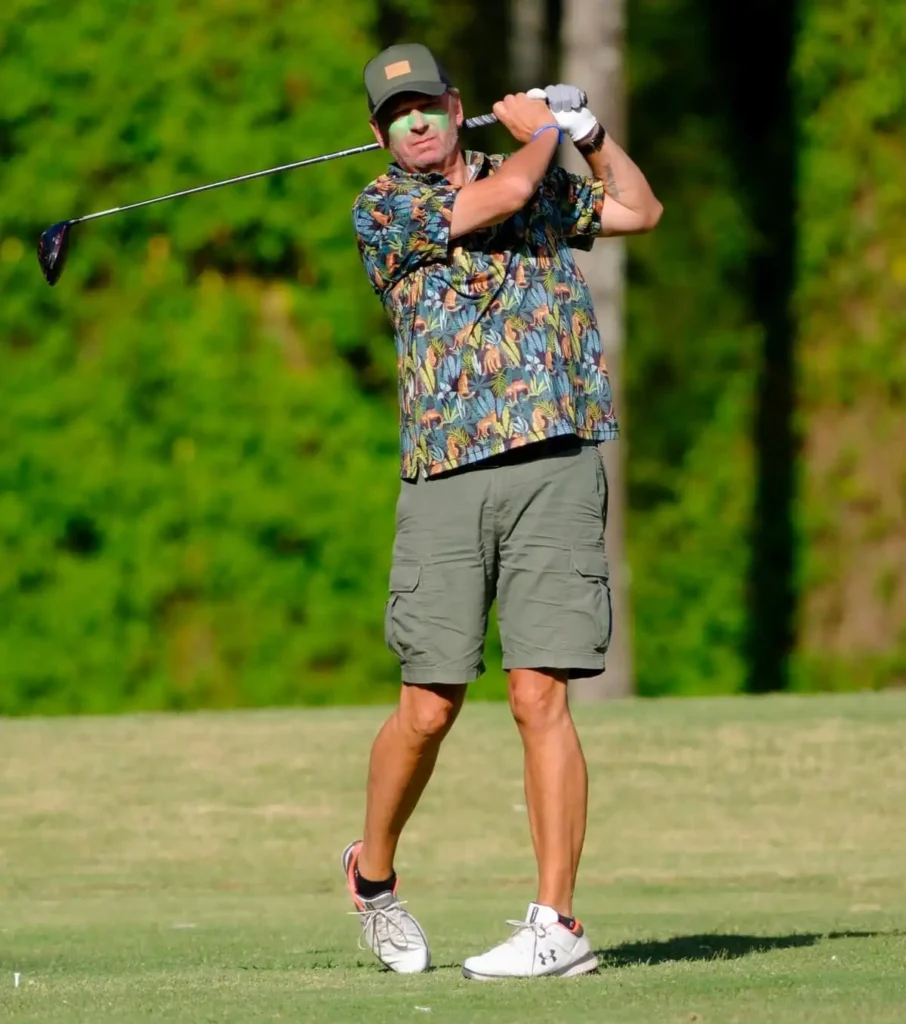
“Some of my favourite memories are how Dad and Kevin would take off in carts on the first hole in good spirits and by the 10th they were dishevelled and cracking up laughing,” Clint recalls. “My dad always said loyalty was a sign of strength. Gatesy epitomises that. He’s a loyal friend and colleague to me, and he was for my father.
“Put aside the financial side of his and Club Car’s contribution to The Jack, his investment personally through his time helping the committee over 20 years, was phenomenal. I don’t know if we would have made some of the strategic decisions, or would have been in a position to host what now is a blue-chip event in the Aussie sports charity calendar, without him. He was always honest with his thoughts.
“He was so supportive of The Jack pressing ahead in late 2021 when COVID-19 was still lingering. I needed someone who was reliable and who would not make decisions based on emotion. The community needed that edition to come together again and play golf and socialise after the pandemic.”
And as for Club Car’s impact on the recreational Australian golfer? “I believe we’re helping people get into the game earlier, and stay in the game longer,” Gates says.
While some argue that golf carts reduce the number of younger golfers walking, Gates points to the fact cart usage is getting younger.
“The younger players… golf for them is not an exercise-based activity; it’s an experience-based activity,” Gates says. “They exercise at the gym and other sports. They choose golf for the game itself.”
Gates speaks warmly of Club Car’s support during his 2014 cancer battle. It’s why, 12 years later and cancer-free for the past seven years, he decided to go out on his own terms and hand the Oceania division to successors he believes will take it further.
“I said, ‘The first thing I’d like you to keep in mind is that Club Car doesn’t owe me a cent and the golf industry doesn’t owe me a cent,’” Gates recalls telling the company while handing in his notice. “I owe everything in my life, from my wife to my house to my lifestyle, to what this company and this game and this industry has done for me. I could work another 30 years and not repay the debt that I actually owe the game of golf and Club Car.”
Back in 2014 when fighting cancer, Gates adopted two mantras. The first was, “Stay in the moment” and the second, “This is not how it ends.” Which is why, when chatting to Australian Golf Digest for this feature, Gates was soon to fly across the Tasman for the New Zealand Open in Queenstown. Indeed, his formal resignation was not how his career would end. You’ll still see him at tournaments, or at The Jack charity pro-am in the Hunter Valley.
Heck, you might even see Gates at the Masters. History suggests that can never be ruled out.