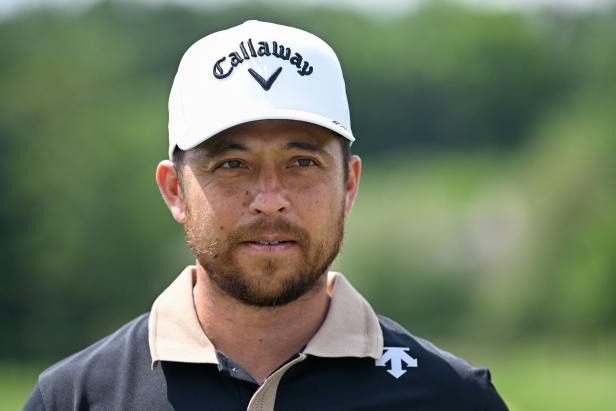
Last week saw an emerging theme of comebacks in professional golf. On the minor side of the comeback spectrum, you had Collin Morikawa winning at Pebble Beach to end a two-and-a-half year PGA Tour victory drought and potentially put himself back into major-winning form. And then there was a comeback of a different magnitude altogether on the LIV Golf circuit: Anthony Kim, after more than a decade in the golf desert, having fought injuries and substance and mental-health issues, and being relegated from the league who had seemed to give him his very last chance, managed to out-duel Bryson DeChambeau and Jon Rahm to win LIV’s Adelaide tournament and capture his first pro title in 16 (!) years.
Morikawa’s comeback is the kind we see around once each year—golf has a way of carrying even the best players on an ebb-and-flow cycle—but Kim’s has to go down as one of the most astonishing second acts in the sport’s history. Putting aside the broader context for a moment (i.e., what you think of Kim as a person, or LIV as a league), he now keeps company with some of the more improbable comebacks through the years.
Who else belongs in that conversation? Let’s take a tour through some of the game’s most jaw-dropping personal revivals, counting down the top nine.
It’s possible that Stricker doesn’t quite belong with the rest of this group, as you’ll see when reading on, since the thing he “overcame” was simply bad form. We’re including him, however, due to one of the strangest anomalies in the history of golf awards: the fact that he won the PGA Tour’s “Comeback Player of the Year” for two consecutive years. How is that even possible? Stricker lost his tour card in 2005 after a long dry spell—he once said that the slump was precipitated by playing a round with Tiger Woods, an experience so dispiriting that he wondered if he even had a place in the sport anymore—but fought back in 2006 to return to the top of the game. The justification for receiving the award a second time is that he actually won in 2007, but if that still sounds puzzling, Stricker agrees. “I don’t know if the award has the correct name or not,” he said at the time. “I mean, I won this last year and I don’t know what I did to deserve it again this year. I thought you would have to stink at golf for a while, which I did for last year.”
8. Ken Venturi
Like Ben Hogan (spoiler, he made our list), Venturi saw his career altered by a car crash, though his injuries were comparatively mild. But those to his back and wrist were significant enough to derail his career for three years. Venturi doesn’t even quite know how or why he began to play well again, but in 1964, he was back at the peak of his powers. Then, at the U.S. Open, playing 36 holes on the final day, the eventual World Golf Hall of Famer came close to collapse from heat exhaustion at Congressional, but managed to hold on to win his only major championship. As with Tiger Woods’ surge in 2019, this was a brief oasis—a diagnosis of carpal tunnel syndrome the following year started the final slide and pushed him toward the CBS broadcasting career that would last for 35 years.
7. Patrick Cantlay 
Michael Miller/ISI Photos
So much has happened with the 33-year-old since coming back from injury and personal tragedy a decade ago—and frankly, so many opinions have been formed, discarded and re-formed—that it’s very easy to ignore this part of his story. But it’s there anyway: In 2013, at the very start of his professional career, Cantlay was tagged for superstardom after a sterling amateur career when he discovered a stress fracture in his vertebrae. He barely played for the next year, and when he came back in 2014, the injury recurred and he only played six events. That cycle of aborted comebacks continued for the next two years, and the only time he actually played between 2015 and 2016 was a U.S. Open qualifier. In the midst of all this, he was out with his caddie and good friend Chris Roth when Roth was fatally struck by a car in a Newport Beach intersection. Cantlay described his state then as a kind of dull depression—”Nothing made me said. Nothing made me happy… there’s one thing that you want to do in your life, and you can’t do it.” When he finally got back to playing in 2017, he made the Tour Championship and earned $2 million, and hasn’t looked back.
6. Erik Compton 
Andrew Redington
Compton was a 34-year-old fledgling tour pro in 2014 when his remarkable backstory as a two-time heart transplant recipient became more well known to the golf public during that year’s U.S. Open at Pinehurst, where he finished tied for second to Martin Kaymer. The former college All-American at Georgia suffered from viral cardiomyopathy in his youth. Considering the severity of what he’d undergone, to be anywhere near the lead was a medical marvel, and the crowd knew it. Henrik Stenson, playing with him that Sunday, said that the cheers for Compton from the North Carolina crowd gave him goosebumps, and reminded him of the Ryder Cup. Compton’s Pinehurst success was fleeting, a journeyman career resulting in no wins and just five top-10 finishes in 170 PGA Tour starts, and a legacy changed in the wake of an arrest on misdemeanor battery and felony robbery charges following a 2023 altercation with his wife.
5. Anthony Kim 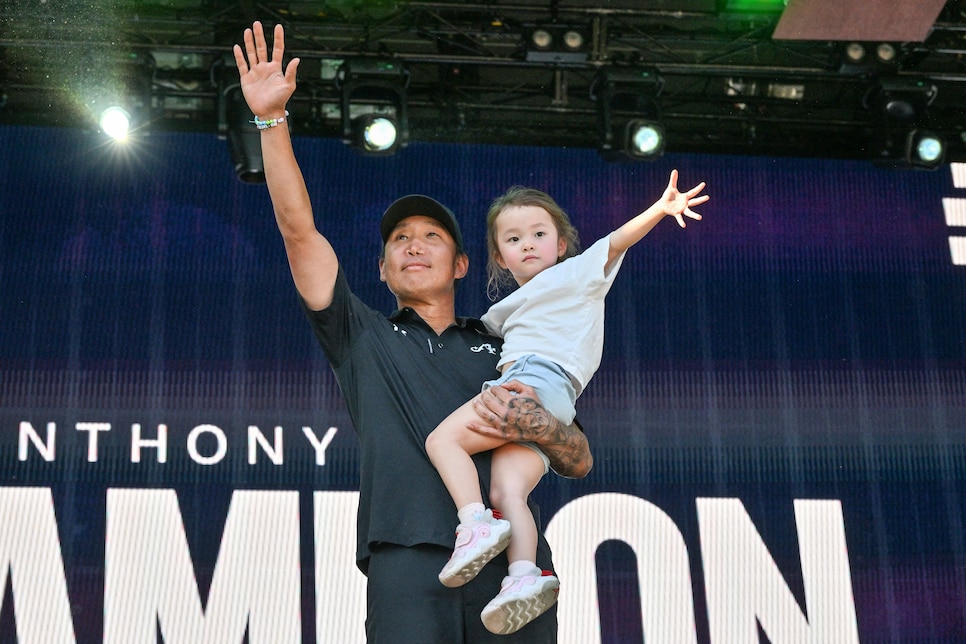
BRENTON EDWARDS
The full story of Kim’s time in golf’s shadows hasn’t yet been told, but we know there was drug use, we know there were suicidal thoughts and we know about the insurance policy that may have played a role in keeping him out of the game. We can infer, as well, that there were serious depths of darkness and despair. In fact, that seems to have started even before he left the PGA Tour, as Kim alluded in an Instagram post to “making porta potty stops every few holes” in major championships. When LIV brought him out of retirement, it was easy to wonder if it was nothing but a cheap publicity stunt, and what followed did nothing to dispel that notion. He was dreadful in 2024 and most of 2025, and his relegation at the end of last season seemed to spell the end of his time in the spotlight. Then the strangest things began happening, starting with his last-ditch success at LIV qualifying and continuing through this past weekend and the almost unthinkable Sunday charge to beat Rahm and DeChambeau and Adelaide. At 40, it’s hard to say how much he can accomplish in the rest of his career, but it’s already been one of the most incredible stories of the golf century.
4. Babe Didrikson Zaharias
We have to give a nod to Justin Ray for bringing this one back to our attention. As Ray noted on X, Zaharias pulled off the incredible feat of winning the 1954 U.S. Women’s Open while wearing a colostomy bag. This was 18 months after she underwent surgery for colon cancer, and just two years before she would die of that same illness. She was 43 and remains the third-oldest woman ever to win that championship. Even more incredibly, she won by an astounding 12 shots—a feat we might compare to the next player on our list.
3. Tiger Woods
Tiger’s signature dominant U.S. Open win came in the midst of his Tiger Slam in 2001, but his story 18 years later, in 2019, looked quite different. He suffered the ignominy of the Thanksgiving 2009 car crash that preceded the infidelity scandal and sex addiction therapy, but that was just the start of his troubles. A DUI arrest in 2017 led to a stint in another intensive program, and throughout it all, he continued to suffer physically, undergoing a seemingly endless litany of injuries and surgeries: his ACL, his Achilles, his MCL, his elbow, his back, his neck. In March 2019, just a month before the Masters, he withdrew from the Arnold Palmer Invitational with a neck strain. The fact that he managed to win both the 2018 Tour Championship and the ’19 Masters in his early 40s, following all this personal and physical suffering, remains one of the more staggering achievements in the game. Looked at today, seven years later, it’s all the more remarkable for how brief the resurgence was.
2. Skip Alexander
Skip who, you ask? The native of Durham, N.C., is someone whose story I only learned about last year, and it’s worthy of the adjective I’m about to deploy: gob-smacking. I encourage you to check out the video we made about him last year:
The story of the most badass Ryder Cup player you've never heard of.
Trust us and take five minutes of your day to watch this. 🤯 pic.twitter.com/R2Nv5egbEz
— Golf Digest (@GolfDigest) September 27, 2025
There’s also this podcast if you want some more details, but here are the basics:
—World War II veteran and solid player with a couple PGA Tour wins to his name by 1950. —Misses his flight after playing an event in Kansas City in 1950. —Catches a Civil Air Patrol flight to Louisville, with just three other people on board. —Plane crashes outside Evansville, Ind., and then catches fire. The other three passengers die. —Alexander barely escapes, but with a fractured ankle and, more seriously, third-degree burns all over his body that blackened his skin. —His family is called in to come see him, because they expect he’ll die shortly. —Somehow, he survives, through oxygen tanks, blood transfusions and skin grafts. —Even after getting home, he has to undergo multiple surgeries, including to his hands, which are stuck together by the burns and disabled. —He convinces the surgeon to fuse his hands around an actual (small) golf club. —Less than a year after the plane crash, he made it back to the PGA Tour and made the Ryder Cup team in Pinehurst. —There, he faces the European Tour Order of Merit winner and, while limping around the course with bleeding hands that require several pairs of gloves and towels, he won. —He went on live to 79 working as a club pro in Florida, with his son Buddy becoming a U.S. Am champion and a NCAA-title winning coach at the University of Florida and his grandson Tyson earning a PGA Tour card.
1. Ben Hogan 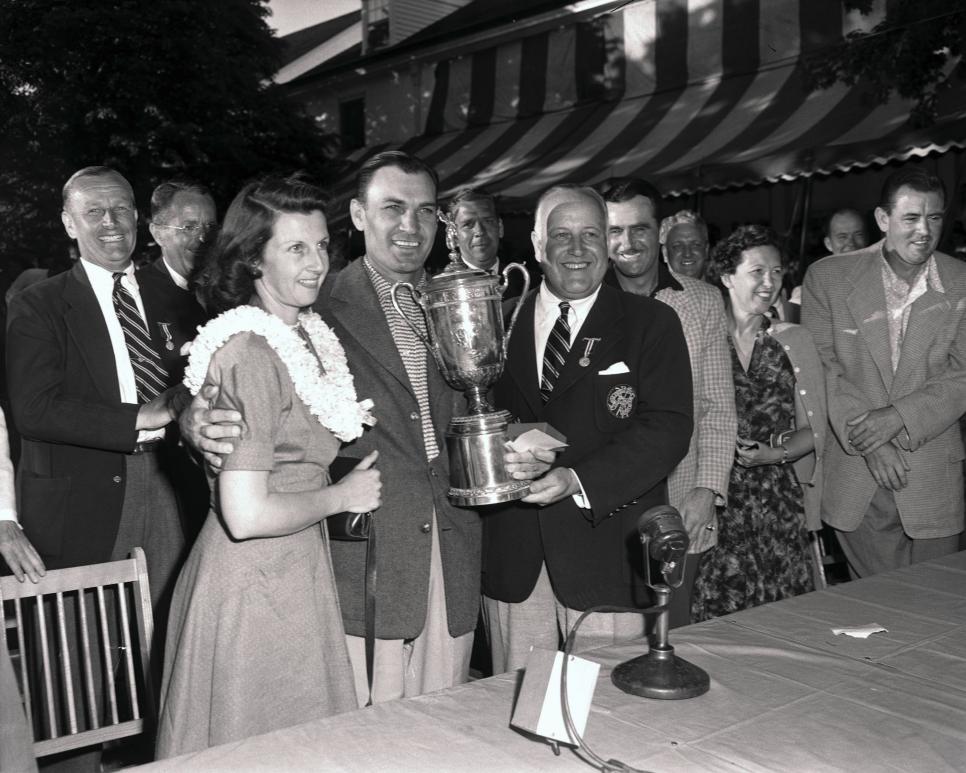
Ben Hogan with his wife, Valerie, celebrate his playoff victory at the 1950 U.S. Open.
Bettmann
Back in 2019, after Tiger Woods’ Masters win, I wrote a point by point (and very tongue-in-cheek) comparison of Tiger, Jack and Hogan, and compiled the list of injuries Hogan suffered when he endured a head-on collision with a Greyhound bus in 1949:
Fractured collar bone, left ankle fracture, double-pelvis fracture, chipped rib and blood clots that almost killed him—all of which led to a 59-day stay in the hospital and a nine-month absence from golf.
The sheer status of Hogan before the crash, and the intensity of his injuries, make this the most famous comeback in the sport’s history. “Doctors didn’t know if he would walk again” is the oldest cliché in the medical miracle book, but in this case it was literally true. All of which makes his playoff victory at the 1950 U.S. Open, 16 months after the crash, so incredible. A plaque on the 18th hole at Merion commemorates his famed 1-iron into the green that helped clinch in spot in the playoff, but that difficult shot must have seemed like a cinch compared to what he’d endured for the past year. Despite being forced to play a limited schedule for the rest of his pro career due to his ongoing post-crash ailments, Hogan went on to win five more majors.
This article was originally published on golfdigest.com