
Ami Gianchandani stood on the first tee of her first golf practice at Yale University in 2018 and had no idea what her coach was talking about. The coach had told her, “Keep your stats,” and Gianchandani was at a loss. She hadn’t kept stats before. She learned that Yale used an app, but she quickly found it to be clunky and slow. It wasn’t what elite amateur players were looking for, and Gianchandani knew it because she was an elite amateur player. When the pandemic hit a couple years later, pausing college golf, Gianchandani took it as an opportunity to take a year off and build a stat-tracking app that she and her competitors would actually want to use. Accel Golf was born.
The app doesn’t require you to pick up your phone every shot and input data. Instead, you print out a sheet and keep your stats on there, like you would on a scorecard. After the round, you scan the sheet with your phone and the app does the work calculating your stats. On the stat card, players keep track of each shot. You’ll write down how far you are from the hole on each shot, where the shot landed (fairway, rough, green or sand), whether it missed to the left or right, long or short, and you’ll record if you received a penalty. It’s a relatively small amount of information to write down, and you get a lot of data from it.
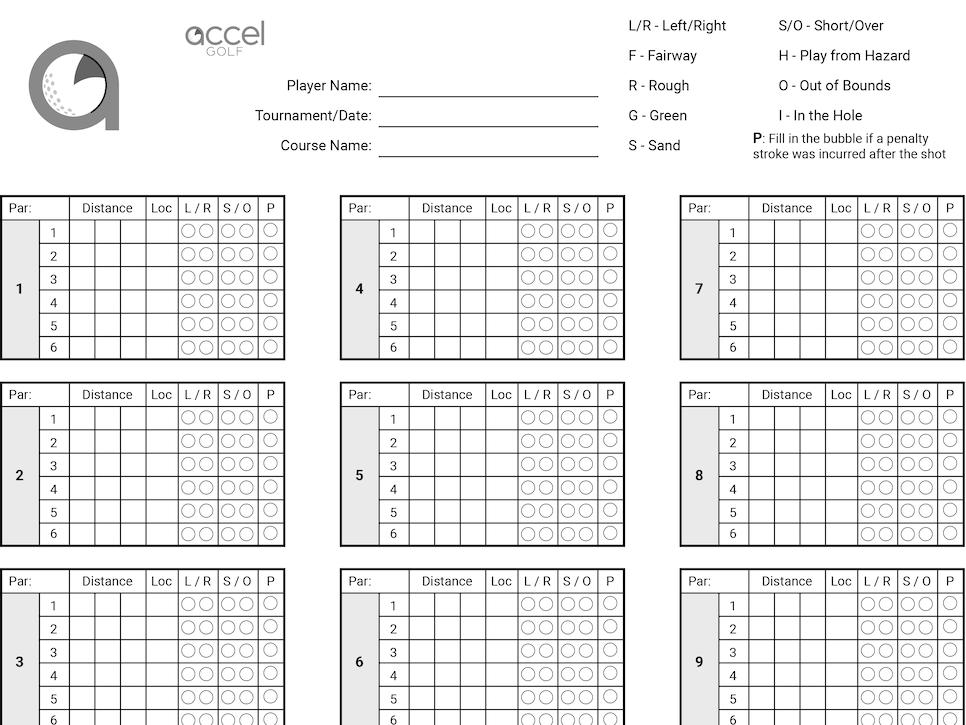
Accel Golf LLC
Accel Golf is a few years old now, and it’s being used by elite golfers across the country. The USGA’s National Development Program has their players use the app. As do some college teams. If you’ve been watching the ANWA, some players in that field have been using the app. Your game would benefit from stat tracking, too.
Gianchandani thinks that all average players should be paying attention to three key stats:
Greens in Regulation, by Yardage
Keeping track of how many greens you hit is one thing, but tracking GIR with your distance to the hole is an elevated way to look at the stat.
“It’s important for casual golfers to understand that there’s a big difference when they have a pitching wedge, versus a 5 iron, versus a hybrid into the green,” Gianchandani says.
It’s important because it’ll show you what you need to work on. Maybe the stat will show you that you’re only hitting 15 percent of greens when you’re 150-160 yards out—so there’s an opportunity for growth. And it’ll also teach you some course management. Because maybe you hit 80 percent of greens when you’re 100-110 yards out—that means you should lay up to that yardage because you’re likely to hit the green from there.
Putting Make Percentage, by Distances
“What’s your make percentage on three-footers, four-footers, five-footers, all the way up to 35-footers?” Gianchandani says. “This is important to know and to track because it helps manage your expectations on the course, because so many amateurs think they should be making all the putts from inside six feet.
“And everyone wants to make all of them, but when you see the benchmark in the app that’s like, Even PGA Tour and LPGA Tour pros are only making 80 to 85 percent of these, it’s so eye-opening for the regular golfer to see: I don’t actually need to make all my six-footers.”
 Strokes Gained
This is an often talked about golf stat. Gianchandani describes it as, “How many shots are you gaining or losing per round compared to a certain benchmark?” So, when you hear Nelly Korda’s strokes gained/pff the tee stat is 2.1, that means she’s gaining 2.1 shots per round on the rest of the LPGA players with her drives.
In the Accel app, there are options as to which benchmark you want to compare yourself against. You can compare your strokes gained against other handicaps, groups like “elite juniors” or the tours. The app uses its own data and data that is accessible online to create these benchmarks. Strokes gained is most accurate when all of the shots recorded are hit by golfers on the same course, on the same day. So while comparing yourself to golfers playing on different courses, in different conditions, across the country isn’t a perfect measurement of strokes gained, it can still give you a sense of where you game stacks up.
The four main categories are putting, chipping, approach and off the tee. But then these are broken down further. Suck as strokes gained/putting from 20-25 feet, or strokes gained from out of the sand from 15-30 yards, and so on.
“What’s really important about strokes gained is that you’re constantly being able to compare yourself to a certain benchmark in the in the best way,” Gianchandani says. “So, if an amateur is trying to break 90 for the first time, they’re gonna be able to bring up the the strokes gained stats of a golfer who has a 10 handicap and say, ‘OK, compared to this golfer with a 10 handicap, I’m losing three shots putting, and only one shot chipping, and I’m actually gaining a shot on approach, and I’m losing two shots on my driver. Based on that information, there’s a very clear path forward. That’s the best part about strokes gained. If you can understand: Losing strokes means you’re doing worse than expected, and gaining is you’re doing better than expected.”
Stat tracking apps have come a long way since Gianchandani’s first pracitce at Yale. As has her relationship with stat tracking. She knows it’s made her better, which is crucial as she’s transitioned from an elite amateur player to a professional golfer.
“One of the biggest things is constantly reminding myself of what I’m good at, because I think so many people who are hard on themselves, pushing themselves to get better, it’s not often that they can sit back and be like, “I actually played really well today, or I struck my irons really well today,” and when you have the stats in front of you that say you played well, you can’t really refute that. So for me, it’s been a big confidence boost, as well as I think an edge in course management,” Gianchandani says.
Stat tracking doesn’t just tell you what you need to work on; it gives you insight into what you’re great at. And knowing that will influence your decision making on the golf course. You’ll be able to set yourself up for success, more often.
This article was originally published on golfdigest.com