
If you’re an avid PGA Tour fan, you should consider joining a fantasy golf league in 2026—there’s no better way to stay engaged with every tournament from round to round. I’m partially to Underdog PGA Best Ball for a number of reasons, and lobbies are now open to draft. If you’re not familiar with best-ball leagues from fantasy football, it’s a variation of fantasy where you don’t select a starting lineup each week—each player on your roster is up for points. That puts a premium on drafting.
So you need to be prepared. I have many strategies and tips below, but if you prefer a video, check out myself and Byron Lindeque running through the changes in rules for the new season and talking through strategy and players to target for Underdog PGA Best Ball Drafts.
Major Rule & Format Changes
Sentry Tournament Cancelled in 2026
- Removes the biggest scoring edge from last year.
- You can no longer load up on easy Kapalua birdie-fest and cruise through Round 1.
Only 2 Signature Events in the First 7 Tournaments
- Pebble Beach (AT&T)
- Genesis Invitational
- The other five are regular events, making non-elite volume extremely important early.
Rosters Expanded: From 10 Players to 12 Players per team
- Allows you to effectively draft two schedules
- Signature-event players (FedEx Cup Top 50 / OWGR qualifiers)
- Non-signature grinders who play every week
Scoring Change: Finishing Position Only
- No more score-to-par points.
- Tough courses no longer punish you… as much.
PME 2026 PGA CONTENT
- Michael Kim on 2026 Goals, Tips, Travel, Schedule, Courses, Brooks
- Underdog Scramble Draft Reviews, Strategy, & Player Targets
- Rankings Update/Strategy, Brooks Leaves LIV, Bobby Mac (Alex Blickle)
- Players Rankings Breakdown, Debate & Discussion (Sky Hoak)
- How to Win 2026 Underdog PGA Best Ball Drafts (Byron Lindeque)
- TOP 125 UNDERDOG SCRAMABLE PGA DRAFT PLAYER RANKINGS
- Use code “MAYO” at underdog for a deposit bonus up to $1000
2026 PGA Underdog Best Ball Draft Construction Blueprint
- Early rounds: Hybrid studs who play early and are in all signature events and Majors
- Middle rounds: High-volume grinders to maximize early season events.
- Late rounds: Players fighting for status who must tee it up weekly
Prioritize “Hybrid” Players
The most valuable players:
- Play both regular events AND signature events
- Are locked into majors/signatures all season
Michael Kim has confirmed with me he’s playing six events to start the year, which makes him one of the most valuable players in the draft. His current ADP is 21.5 in early drafts and he really should be drafted inside the Top 10 as he’s in every signature event, and his world ranking should get him into at least The Masters and PGA Championship.
Beyond Kim, players who qualified through the AON Next 10 are in the first two signature events yet will likely play most of the early season events to try and stack up points to get into the rest of the season events and Majors. Expect to see a lot Max Greyserman, Nico Echavarria, Chris Kirk, Max McGreevy, and Rico Hoey early in the year.
The other five come with more strings attached: Sami Valimaki, Garrick Higgo, Aldrich Potgieter, Aaron Rai, and Min Woo Lee all began on the DP World Tour so there’s a chance they may start their years in the Middle East for the two Dubai tournaments which don’t count for the PGA Best Ball scoring. Hopefully, we’ll get more clarification as the season approaches. Plus, there are still rumblings Potgieter and Higgo may jump to LIV. We saw Rahm and Hatton do that in January two years ago.
Signature event grinders can also assist in filling your starts. Brian Harman is likely to Sony and Valero, Lucas Glover and Denny McCarthy may fill the void of a few Texas events along with the John Deere Classic. Jacob Bridgeman is the most likely SE player to tee it up at the Cognizant Classic (the most difficult tournament to fill during the draft). This give them hidden value.
VOLUME WINS EARLY
- Most important goal: maximize starts in the first 7 events.
- The best teams will have multiple golfers playing 5–6 times in Round 1.
Round 1 Tournaments
- Sony Open
- American Express (AMEX)
- Farmers Insurance Open
- Waste Management Phoenix Open
- Pebble Beach (Signature Event)
- Genesis Invitational (Signature Event)
- Cognizant Classic
You’d think this doesn’t need to be pointed out—but after seeing how people drafted a year ago and, again, how they’re going about it early this year—you can’t win Round 4 if you don’t advance from Round 1. Seems simple, people forget. And Round 1 is the only segment we can (kind of) control. The best draft strategy is to simply load up to advance and hope everything breaks your way. It’s easier to balance your squads this season with the roster expansion from 10 to 12 golfers.
Of course Scottie is going to be the first player drafted, as he should be, but you’ll probably only get four starts from him in Round 1, at best. He’ll play both signature events and maybe AMEX and Phoenix, based on his history.
There’s also a weird caveat in the Signature Event rules to get extra people into the field: PGA Tour members in the top 30 OWGR will earn entry. I can’t recall this ever being used in the past, but there are a few players who can take advantage of this, the biggest being Michael Brennan (ADP 25.3). Brennan won in Utah, so he’s in the PLAYERS and PGA Championship (and will be in The Masters for being inside the Top 50 OWGR at the end of the year), but isn’t qualified for any signature events. Currently, No. 35 in the world, Brennan will probably play a ton early in the early in the season to boost his ranking to get into Pebble and Riviera. Wyndham Clark (No. 41; ADP 39.5), John Keefer (No. 47; ADP 46.6) and Billy Horschel (No. 48; ADP 54.7) are others who can gain access to signature events this way.
Marco Penge (No. 29; ADP 62.8), Kristoffer Reitan (No. 31; ADP 66.7), and Rasmus Hojgaard (No. 40; ADP 70.2) can also all get in this way. Penge and Reitan are not currently listed in the fields overseas in January and we may see them at the very beginning of the year. Additionally, both are likely to play Canada and Scotland later in the season, which, as you’ll discover, is really the key to actually winning. More on that later.
Jordan Spieth (ADP 14.9) isn’t qualified for the Signature events, but is likely to receive sponsors invites to both Pebble and Riviera. He’s already talked about playing more to earn his way into those events without needing the invites, so he, like those others, may play a bunch early in the season and pile up volume.
Si Woo Kim is not only not going to LIV, he’s is already committed to the Sony Open! And, he historically plays in the AMEX and Phoenix as well along with being in the signature events. Five starts is very likely for Kim. Sungjae usually follows a similar path.
Although circumstances and status has changed for some of these players, using the Rabbit Hole, these are the players have played the most rounds in the first four tournaments the past two years (Sony, AMEX, Farmers, Phoenix). I wouldn’t anticipate much of a change for most these players since they’ve always made these events a part of their schedules. The Sony Open may be skipped by some of the usual, larger names since they won’t already be in Hawaii for The Sentry this year.
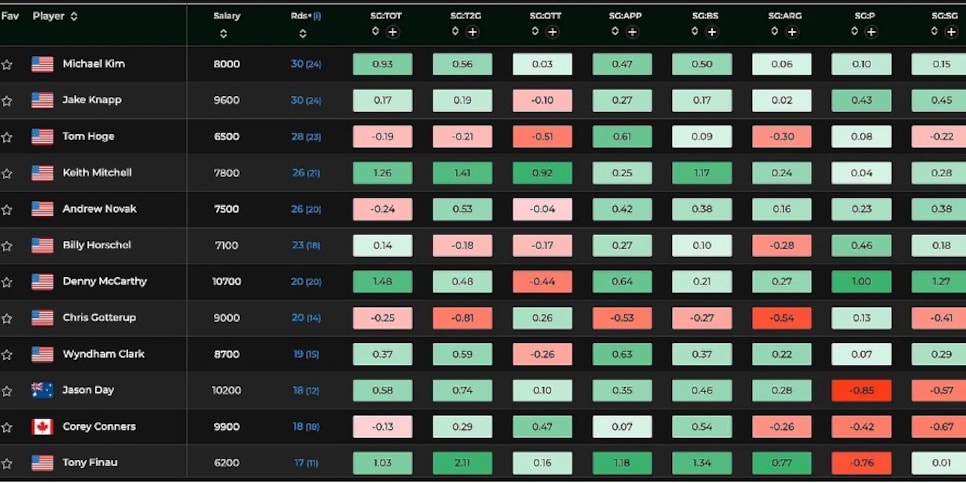
GET 25% OFF THE RABBIT HOLE TOOL AT BETSPERTS GOLF
Rankings vs. ADP for Underdog PGA Best Ball Drafts
After doing a bunch of Underdog’s PGA Best Ball Scramble drafts it’s clear rankings alone don’t win contests—team construction does. The challenge isn’t identifying good golfers, but assembling rosters that can both survive the early rounds and win late in the season.
Why Raw Rankings Aren’t Enough
Traditional rankings tend to over-optimize for early survival. My rankings especially. Players who enter many events—especially non-signature tournaments—help teams advance out of Round 1. However, that same approach often collapses in later rounds when elite talent becomes essential.
Uploading a straight rankings CSV and letting auto draft run exposes this flaw immediately. Teams end up overloaded with “volume guys” and light on top-end firepower, leaving them competitive early but outmatched when it matters most. Or the inverse, and the team has no chance of escaping Round 1.
The core issue: rankings don’t understand average draft position (ADP) or context. A human drafter knows Jake Knapp will be available later and Patrick Cantlay won’t. An algorithm does not.
Early Rounds vs. Late Rounds: Two Different Games
Winning the Scramble requires balancing two competing needs:
- Early rounds: Players who will tee it up often in events like Sony, American Express, Cognizant, and CJ Cup. Birdie-making and guaranteed starts matter most.
- Late rounds: Elite players who show up for the Canadian Open, Scottish Open while having access to the Signature Events and Majors.
My rankings skew too heavily toward the first group, maximizing advancement odds but sacrificing championship upside.
The Importance of “Signature Event Access”
Signature events shape the entire contest. Golfers automatically qualified — or those likely to play their way in—carry immense value. Missing out on enough signature-event players often means getting crushed in Round 4.
This is why passing on players like Rory McIlroy, Ludvig Aberg, and Tommy Fleetwood forces uncomfortable decisions. If you fade them early, you must compensate by aggressively targeting similar-tier players: Matt Fitzpatrick is the best version of this type of player.
Matt Fitzpatrick, usually in round seven or eight. It’s important to pay attention to what the other people in your draft room are doing. It’s pretty clear after 15 or so picks which people in your draft have a clue and which don’t. Rule of thumb: If you can’t figure that out, you’re the one without a clue.
One thing that has been overrated, however, is making sure you have enough players in signature events early. Ideally, you’ll want to end up with seven or eight of these players on your roster, but players like Harris English, Rickie Fowler, Jhonattan Vegas, Lucas Glover, Daniel Berger, Bud Cauley, Shane Lowry and Keegan Bradley are often available in the final three rounds.
Robert MacIntyre’s Rising Value
Confirmation that Robert MacIntyre will play the American Express dramatically boosts his profile. That commitment likely signals additional early starts, combined with strong late-season utility via Canada and Scotland.
With four Round 1 events and elite endgame value, MacIntyre now profiles as a Top 10 overall pick, maybe even a Top 10 pick rather than a fringe option.
2026 ONE AND DONE CONTEST
If you’re looking for something a bit more simple than an intricate draft, may I suggest the One and Done Contest. You make one pick per week and can only use a player once all year. Devote as much or as little time to your selections as you’d like.
It starts in January at the Sony Open, but there’s now $1,200,000 guaranteed in the prize pool. The top 750 get paid, and just look at this glorious, flat payout structure. Everyone inside the Top 20 will win at least $10,000 with $110,000 to the winner.
A Potential bonus: I get my dad an entry to this contest every year. He was a casual golf fan, but since I got him this entry three years ago, he call me every week to get the run down on who he should be taking this week. It’s a real win/win.
JOIN THE MAYO CUP ONE & DONE CONTEST FOR 2026
Market Inefficiencies: Who’s Over- and Undervalued?
Several ADP discrepancies stand out:
- Nick Taylor (24.8 ADP) vs. Taylor Pendrith (17.7 ADP): They are similar assets—both are in signature events, play Canada, and probably Scotland—but Taylor is in all the Majors already. Taylor often goes later than Pendrith because of the idea that Pendrith will have to play early and often to get into the Masters. There’s a strong possibility he does. By no means is he a bad pick. However, Taylor will almost assuredly play Sony, AMEX and Phoenix since, he almost always does, and is defending his championship at Sony. So, there’s a chance you get 5/7 starts from Taylor in Round 1 plus all the Majors later on. Pendrith may end up being more valuable in Round 2 if he has to grind the Valspar/Houston/Valero, but both should be treated about the same and they currently are not: Pendrith is going a about a round and a half ahead of Taylor.
- Michael Brennan (33.6 ADP): Still undervalued. Elite driving, birdie-making upside, and a heavy early schedule make him a prime breakout candidate. He’s already qualified for The Masters and The Heritage because of his win in Utah yet has no status for anything else besides regular events. Meaning, Brennan gets to beat up on La Quinta, PGA National, Houston, and Craig Ranch. Those are tough tournaments to find starts.
- Max McGreevy (42.1 ADP): A classic overdraft. Playing often doesn’t matter if you miss cuts. Volume without quality is a trap, especially with finishing-position bonuses now in play.
- Jake Knapp (42.2 ADP), Billy Horschel (54.7 ADP) & Keith Mitchell (63.5 ADP): Better late-round targets than many signature-event-only grinders. Knapp’s Cognizant commitment and Horschel’s sponsor exemption upside add value for a mix between high end and jabroni events.
- Mac Hughes (66.9 ADP): I’ve actually had to stop myself from drafting Hughes in the last round every time. You need some diversity at the end. But Hughes is the perfect innings eater pick. Despite having a full PGA TOUR Card Hughes isn’t qualified for anything besides THE PLAYERS Championship. So he’s going to have to play… a lot. If you think he can flirt with being Top 70 in the FedEx Cup, he’s someone that, like Pendrith, will have to play a lot to get back into Majors and, regardless, will fill starts at Sony, AMEX, Phoenix, Cognizant, Valspar, one of the two Texas events, CJ Cup, Colonial, Canada, Scotland, and John Deere. Although, that’s not too dissimilar from a lot of run-of-the-mill PGA players, getting almost guaranteed access to Sony/Cog in Round 1 and Canada/Scotland/ (maybe JDC) in the Championship round is absolutely massive to fill out teams. There’s a chance Hughes doesn’t go to Scotland if he’s not in the British Open. But that means you got Deere Run out of him anyway.
- Emiliano Grillo (70.7 ADP), Alex Smalley (70.6) & Austin Eckroat (70.3 ADP): If you find yourself getting too much Mac Hughes, these three can help backfill starts in the lower end tournaments throughout the year. As a former winner of both Cognizant and John Deere Classic, Eckroat is almost a lock to play in both, along with the CJ Cup, which hits the trifecta of the three toughest events to find starts. It would shocking to see Smalley skip any tournament unless he plays well enough to find himself in Majors and Signature events at some point. Grillo is a volume merchant. Sony, Amex, Cognizant, Valero, CJ Cup, Canada, Scotland, JDC—he’s going to make as many starts as possible.
Rory McIlroy & Tommy Fleetwood: Building for Round 4
Rory remains one of the most polarizing picks. Early-season absences make advancing harder, but teams that survive with Rory are overwhelmingly strong late. The data from prior seasons confirms it: Rory teams that advance tend to be the ones still alive at the end.
Drafting Rory fundamentally changes your strategy—you must prioritize early-round survival elsewhere to unlock his late-round dominance. This is where rankings vs ADP begins to come into play. I’ve actually been taking Rory in round three in most drafts now, ahead of players I have ranked above him, as he becomes a key cog to actually winning this contest because of his schedule. While likely only playing twice in seven events in Round 1 of PGA Bets Bal, Rory is one of a select few who may play in five of the six tournaments in the championship round.
He always plays in the Canadian Open and the Scottish Open while showing up to the US and British Open (obviously), and the Travelers signature event. All this applies to Tommy Fleetwood too. And, this is what makes Sam Burns the clear number two pick in drafts.
In fact, if Burns overachieves this season, because of his schedule, it may actually make him more valuable than Scottie Scheffler. You should always take Scheffler with the first pick, though, even if you think Burns will outscore him as the No. 1 pick is your only chance to build any Scottie teams. You can get lucky and grab Burns at picks 2/3/4/5 I most drafts. I’m quite confident Burns will play the Canadian Open as he’s one of three non-Canadians sponsored by RBC, the title sponsor for the event. Same reason you’ll see Sahith Theegala and Cam Young at TPC Toronto again. Historically, Burns has shown up in Scotland, where the other two skip it more often than not.
This also gives Canadian players extra priority. You know they’re playing the Canadian Open. And most have showed up in Scotland as well.
Canadian Open & Scottish Open: Hidden Round 4 Leverage
These two events quietly shape the final rounds.
- Canadian Open has become an all star event for International players. Very few high end Americans play in Canada the week before the U.S. Open.
- Scottish Open participation often reflects Open Championship prep philosophy
Players likely to appear in both:
- Rory McIlroy
- Robert MacIntyre
- Sam Burns
- Højgaard brothers
- Nick Taylor
- Corey Conners
- Ludvig Aberg
- Mac Hughes
- Taylor Pendrith
- Ryan Fox
- Keith Mitchell
- Alex Noren
- Justin Rose
Maybe both: Matt Fitzpatrick, Jake Knapp, Byeong-Hun An, Aaron Rai, Cameron Young, Michael Kim, Sahith Theegala, Shane Lowry, Wyndham Clark.
Top 100 PGA Underdog Scramble Player Rankings
Get latest rankings update at Betsperts Golf
- Updated 1/5
- Scottie Scheffler
- Sam Burns
- Si Woo Kim
- Ben Griffin
- Michael Kim
- Robert MacIntyre
- Sungjae Im
- Sepp Straka
- Cameron Young
- Hideki Matsuyama
- Jordan Spieth
- Nick Taylor
- J.J. Spaun
- Harry Hall
- Xander Schauffele
- Taylor Pendrith
- Corey Conners
- Rory McIlroy
- Tommy Fleetwood
- Ludvig Aberg
- Matt Fitzpatrick
- Jacob Bridgeman
- Samuel Stevens
- J.T. Poston
- Denny McCarthy
- Brian Harman
- Russell Henley
- Rico Hoey
- Andrew Novak
- Ryan Gerard
- Michael Brennan
- Maverick McNealy
- Jake Knapp
- Nico Echavarria
- Patrick Cantlay
- Chris Kirk
- Max Greyserman
- Michael Thorbjornsen
- Ryan Fox
- Alex Noren
- Wyndham Clark
- Keegan Bradley
- Kurt Kitayama
- Bud Cauley
- Lucas Glover
- Akshay Bhatia
- Chris Gotterup
- Harris English
- Rickie Fowler
- Jhonattan Vegas
- Collin Morikawa
- Viktor Hovland
- Billy Horschel
- Matt McCarty
- Aaron Rai
- Davis Thompson
- John Keefer
- Keith Mitchell
- Kevin Yu
- Austin Eckroat
- Emiliano Grillo
- Mackenzie Hughes
- Byeong Hun An
- Alex Smalley
- Vince Whaley
- Tony Finau
- Marco Penge
- Kristoffer Reitan
- Adam Scott
- Sami Valimaki
- Max Homa
- Sahith Theegala
- Shane Lowry
- Jason Day
- Justin Rose
- Tom Hoge
- Brian Campbell
- Min Woo Lee
- Mac Meissner
- Kevin Roy
- Stephan Jaeger
- Eric Cole
- Adam Svensson
- William Mouw
- Mark Hubbard
- Steven Fisk
- Neal Shipley
- Pierceson Coody
- Patrick Rodgers
- Ryo Hisatsune
- Rasmus Neergaard-Petersen
- Garrick Higgo
- Max McGreevy
- Aldrich Potgieter
- David Ford
- Will Zalatoris
- Rasmus Hojgaard
- Luke Clanton
- Tom Kim
- Nicolai Hojgaard
This article was originally published on golfdigest.com