Before the first snap of Super Bowl LX in February, dozens of sewing machines at a fabric plant in Buford, Ga., were ready to go. Whether the Seattle Seahawks or the New England Patriots emerged victorious, the stitchers would be hard at work come 7 a.m. on Monday, making driver, fairway and putter headcovers. Designs for both teams had been approved and were ready to go.
An email announcing the Seahawks drop went out at 9:31 p.m. ET on Sunday, a full 45 minutes before the final whistle blew but right after Sam Darnold threw a touchdown pass extending Seattle’s lead to 19 points. The soon-to-be loser’s design was relegated to the dustbin of prototypes. By Wednesday, the first head-covers were being shipped.
Joel Dahmen, the PGA Tour pro and Seattle native missed the cut at the WM Phoenix Open that weekend and so had plenty of time to watch his team win, saw the drop on X and commented simply, “Need!” (the company replied: “Keep your shirt on and we’ll send you a couple.”)
SWAG, which started in Chicago in 2018, makes most of its leather goods in a 30,000-square-foot factory it owns 40 miles outside of Atlanta. The company can produce about 300 head-covers a day, control the process and ship promptly because it isn’t waiting for its products to arrive from overseas. The company has become better at planning. It has a license from the NFL to produce branded merchandise, and the Super Bowl was an easy one to prepare for.
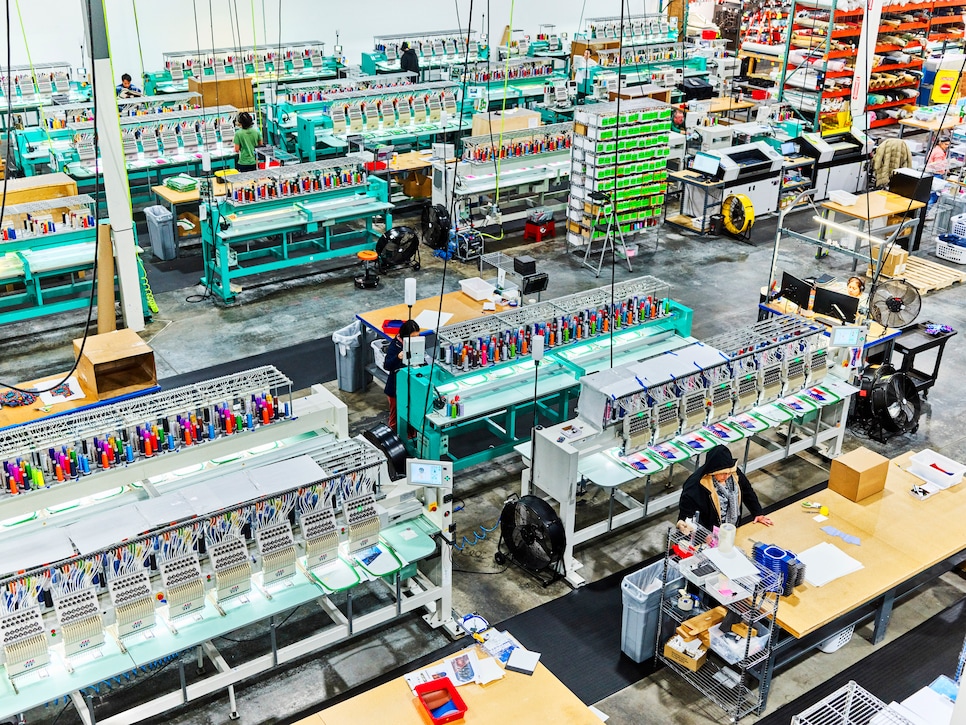
IN FULL SWING: SWAG Golf’s factory in Buford, Ga., makes about 300 headcovers per day. (Photo by Spencer Lowell)
What hasn’t been as easy to plan for is the impact of fluctuating tariffs levied by the United States. SWAG, like many small- to medium-sized businesses, sources materials from all over the world and isn’t used to this.
“You go from not really thinking about tariffs to this is a central concern for small business owners,” said Michael Negron, senior fellow at the nonpartisan Center for American Progress. “The magnitude of the costs is big, and then there’s the complexity of it, to navigate the various tariff regimes. You might have more than one tariff to worry about.”
SWAG uses magnets for the clasps on its putter covers, and close to 90 percent of the world’s magnets are made in China, as most countries lack the necessary raw materials or capabilities. The cost of the magnets SWAG uses has risen 30 percent in the past year. That’s left SWAG a choice: absorb the cost or explain to customers that an already premium-priced good—as much as $125 for a putter cover—will get more expensive. So far, the company has chosen to eat costs.
The Golf Economy
Golf equipment, clothes and merchandise are, for the most part, not made in the USA. More than 90 percent of golf clubs are imported. Shirts, shorts and quarter-zips are largely made in China and Vietnam. The main exception is premium golf balls. Both Titleist and Callaway operate plants for their top-of-the-line balls in Massachusetts while Bridgestone has a plant in Georgia and TaylorMade one in South Carolina.
The other exception is golf accessories, particularly leather goods. Lacking the scale or deep financial pockets of larger OEMs, these niche players conceive and craft their wares in small shops around the country and have been buffeted by trade wars.
When a brand says its goods are made in America, that often means a product is assembled here with materials from other countries. Leather comes from Europe and South America. Silver snaps and hi-tech sewing equipment come from Germany. Magnets, as mentioned earlier, come from China.
Historically, that made in America doesn’t mean sourced in America hasn’t been much of a problem for small golf brands. Imports from China and a few other countries have been tariffed for a long time, but those tariffs were known, fixed and manageable. Companies could account for them at the start of the year and get on with their business.
When a brand says it goods are made in America, that often means a product is assembled here with materials from other countries.
President Donald J. Trump announced hundreds of new tariffs in 2025, then decreased or increased them as forms of political gratitude or retribution. Some went as high as 100 percent and then decreased as quickly as they were introduced. Not knowing what the tariffs on materials are going to be from one week to the next makes it nearly impossible for companies that manufacture in America to predict their margins. It has also impacted how much of a given material they can afford to have in stock.
Both countries and raw materials are subject to tariffs. In some cases, say aluminum from China, there can be multiple layers. The average tariff rate in January 2026 was 17 percent. It could rise this year to as high as 21 percent if all proposed tariffs are enacted, according to the Tax Policy Center’s Tariff Tracker. That’s up from an average tariff of 2.5 percent in 2024.
However public a tariff announcement might be, the actual tariff can be hidden in the price of the product. A $160 leather shoe bag might cost a consumer the exact same amount because someone else is paying the tariffs—the manufacturer, the distributor or a middleman. Or the tariff cost could be passed on to the consumer in the form of a higher price—say $190 for that same shoe bag instead of $160.
Speed Sells
Shortly before the pandemic, SWAG acquired EP Headcovers, the factory in Buford, because founder Nick Venson wanted a partner that could make intricate designs and feared other manufacturers weren’t up to the task. After all, the original Dollar Bill putter cover—with George Washington looking hip in sunglasses—required an exorbitant 150,000 stitches. The bet paid off. When international shipping lanes ground to a halt, Venson had a way to keep manufacturing steadily to meet the COVID golf boom. Any tariffs his company had to pay were known, fixed and relatively low.
“We hit the nail on the head at the perfect time,” Venson said. “You couldn’t get stuff made overseas. We could really leverage that to build out our business when golf was booming. We continue to press forward today.”
For its premium products, speed and control are essential. “It’s expensive to manufacture in the U.S.,” Venson said. The cost of laborers with stitching and sewing skills rose even more last year by 3.4 percent, according to the Bureau of Labor Statistics. “But the biggest benefit is we can do things quickly. We have the freedom to pivot and do things in a moment that other companies can’t do.”
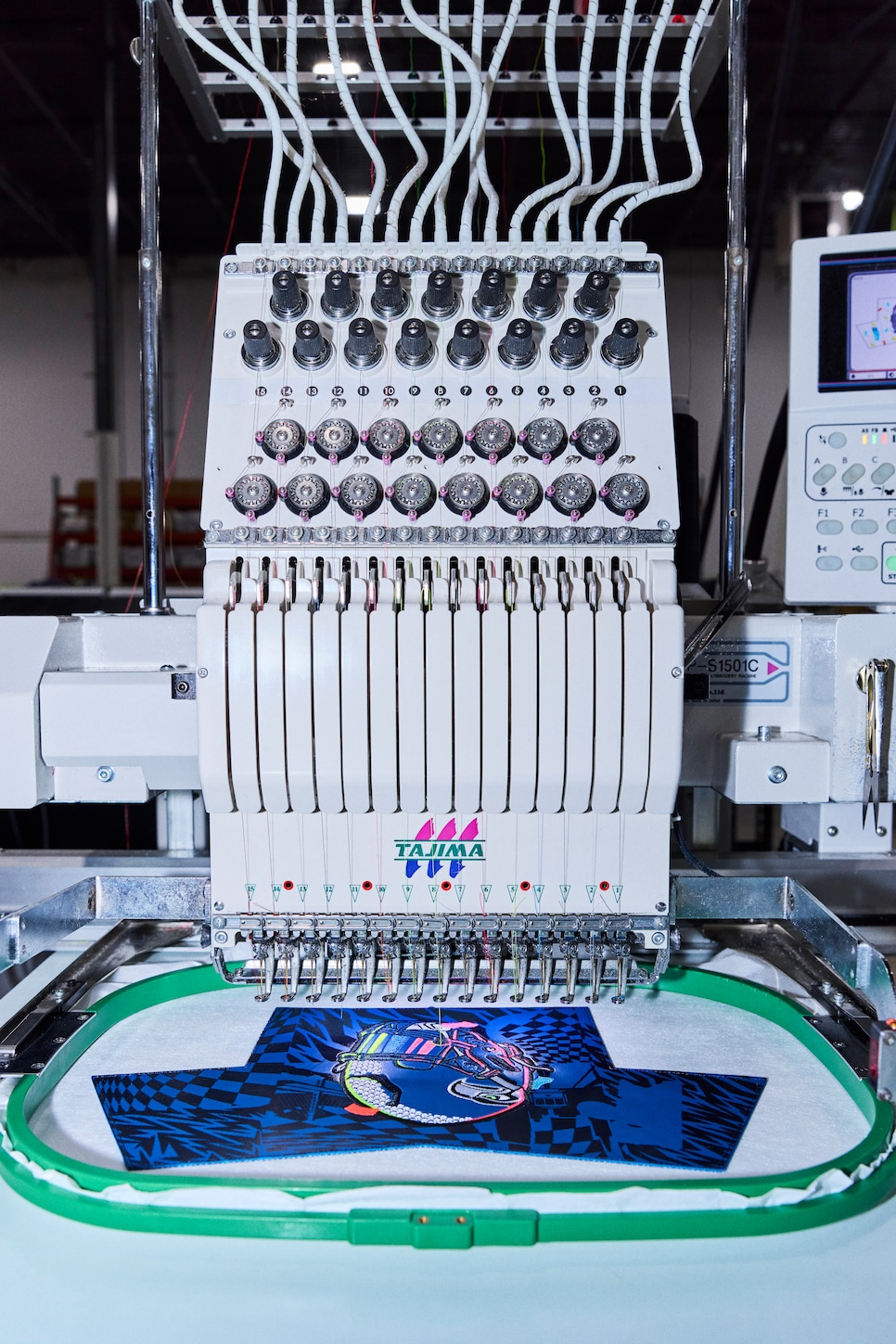
DON’T GET THE YIPS: A complex headcover design might require 150,000 stitches. (Photo by Spencer Lowell)
Football fans remember the Chicago Bears fan who brought a cheese grater to a playoff game against the Green Bay Packers. Within 48 hours, the cheese grater became an image on a SWAG headcover and the limited-edition run of 500 promptly sold out.
“If you send the product to China, you’re waiting eight weeks for it,” Venson said. “It’s not nearly as good of a customer experience.”
That said, SWAG has become more nimble when price is more important. It’s gone overseas to manufacture its Rewind Golf line of headcovers featuring references from movies such as “Happy Gilmore,” “Top Gun” and “The Big Lebowski.” At around $60, the smaller price tags make these headcovers more approachable. And timeless quotes (“The dude abides”) require only simple stitches.
Artisan Golf, based in Fort Worth, doesn’t do soft goods. Rather, it makes irons, wedges and putters that have been used by major champions and amateur connoisseurs of craftsmanship and feel. The company raised prices in January on its wedges for the first time in five years and is selling just as many. The 10 percent increase was to cover the rising cost of materials, particularly for steel billets, said John Hatfield, co-founder of Artisan. The company had waited out the fluctuations in the hope that it wouldn’t have to increase the price—until it couldn’t wait any longer.
“Sometimes it looks like a damn tennis match, and we’re the net,” said Mike Taylor, Artisan’s other co-founder.
What’s helped Artisan is its customer base. “Our clients are understanding of a price increase,” Hatfield said. “They’re loyal, but one thing Mike and I aren’t going to do is make stuff up. We just want to be fair. We’re always trying to get our processes better and more efficient, so it costs you less money.”
All Artisan putters are made with 303 stainless steel, a material that increased 13 percent in price in 2025. The price of tungsten steel rose 200 percent last year. Then came the tariffs on top.
“Making great golf clubs is not an inexpensive process,” Taylor said. “The last thing you want to be is reactionary when you don’t have to be, but these economic situations drove us to look at things in this manner.”
MORE: How U.S.-China trade tensions now extend to … golf carts
Stricter Payment Terms
Macdonald Leathergoods, based in Portland, Ore., makes high-end leather golf products, including headcovers, valuables pouches and its signature line of golf bags. The hand-stitched bags cost between $1,000 and $2,000, with prices going higher for bags made with custom leather, including alligator. The company doesn’t need to sell a lot of bags given its high price point. Plus, anyone who was going to buy a $2,000 leather golf bag will likely not balk at a $2,300 one.
“Macdonald is fortunate in that we play in the shallow end of the pool,” said co-founder Todd Rohrer. “Our customers aren’t saving up for our bags. Our commitment has always been we’ll use the finest components.”
Nevertheless, it’s taking longer and costing more to get many of those components.
Titanium-coated sewing needles and upholstery-grade material come from Germany. Custom water jet foam for the shoulder straps is imported from Canada. The carbon-fiber frames are made in the U.S., but there’s been great demand recently for carbon fiber from the defense industry, which gets first dibs. Then there are the fasteners that hold the straps together. The ones Rohrer uses are made by one company in Germany. At the start of 2025, a box cost $130, up $6 from the year before. This year, the same box costs $224.
“Those are just the standard fasteners we use,” Rohrer said. “The stainless ones are three times as much as the nickel-plated ones.” (He saves those for the gator bags.)
Rohrer is buying less of everything to manage the cost of his inventory. “We know it’s going to slow our production,” he said. “I just got off a call with a guy in Ireland who wants just a half dozen bags, but we’re going to be slower than normal in delivering them.”
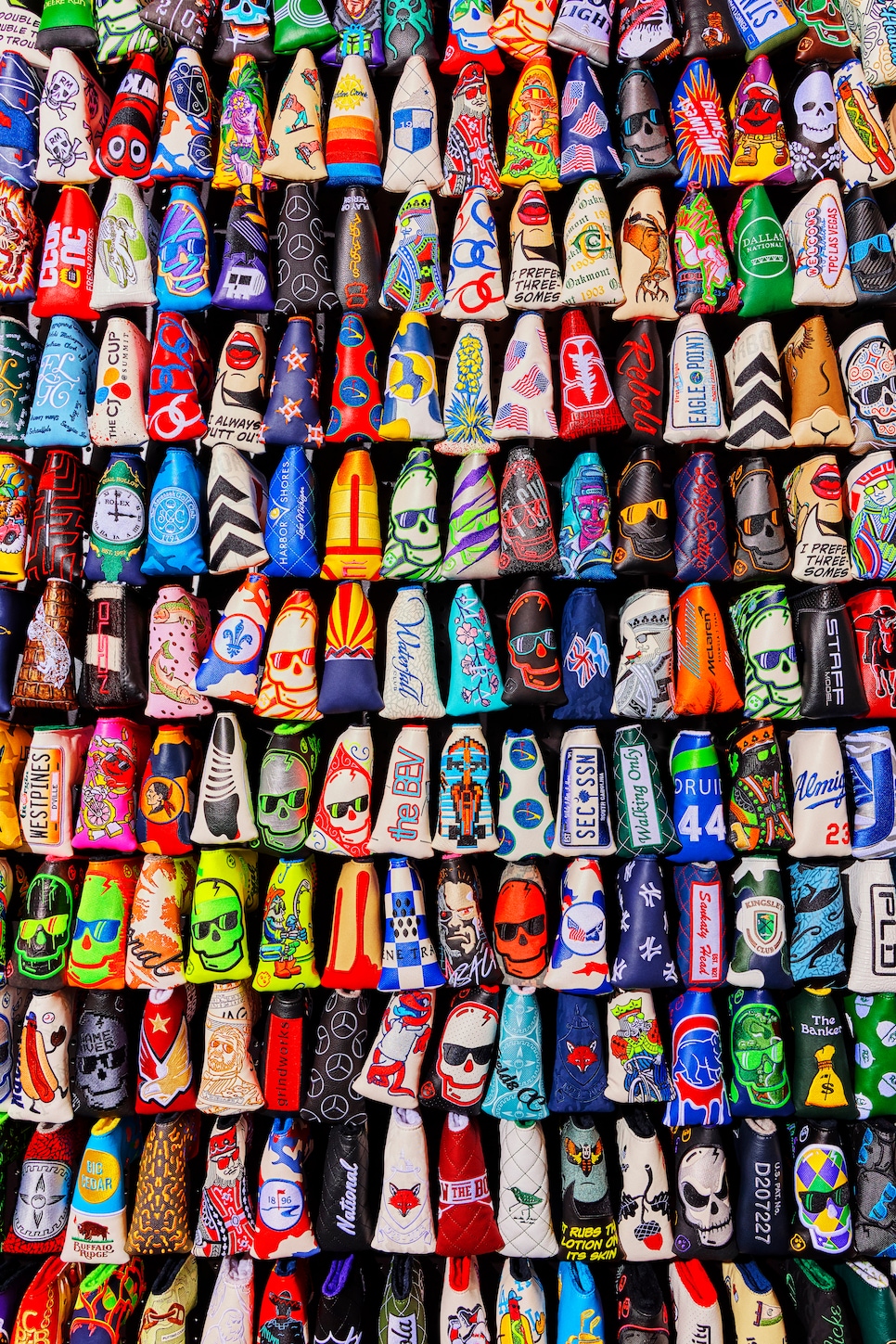
THE COLOR OF MONEY: Demand for bold headcovers has created a solid business. (Photo by Spencer Lowell)
Another challenging issue for a craft company like Macdonald is a misalignment between paying the suppliers and getting paid by the buyer. Whereas suppliers used to offer 60 to 90 days to pay, several companies said their suppliers now ask for 15-day terms.
“That lead time is critical,” Rohrer said. “We’re making a product that’s made by hand. We can’t make it if we don’t have all the materials here.”
As his component costs have gone up 18 percent with tighter payment terms, Rohrer’s costs for highly trained stitchers also has risen. At the start of the year, he caved to the math and raised the cost of all Macdonald bags between 10 and 20 percent.
Size Matters
Many small brands have had to accept that they have little control over their fate. At the start of 2025, many large golf distributors knew what was coming and stocked up on products from China before increased tariffs took effect. The result was that small domestic producers saw sales crater. Martini Golf Tees, which makes custom plastic tees in Michigan, was one. Its sales were down so much in the first half of the year that Dave Baker, the president and co-founder, thought they might go out of business.
“Had we reached the end of our life cycle? We got nervous,” Baker said.
Fortunately, the company got a huge boost in the second half of the year when the big distributors stopped buying from China almost entirely and turned to domestic producers, like Martini. Baker keeps reading the global news hoping to know what might happen next.
Many small brands have had to accept that they have little control over their fate.
Stitch, based in Cary, N.C., makes golf bags, travel bags and assorted golf accessories, many with a distinctive racing stripe. Today, the company is producing goods in a half-dozen countries. This helps insulate it from tariff volatility, but this strategy was years in the making.
Brad King, chief executive of Stitch, said that the company realized the risk of relying entirely on Chinese production after COVID. “At that time 95 percent of our goods were coming out of China,” he said. “We started finding partners that were outside of China. We also added redundant factories to make our goods, so today, we’re completely out of China, and all products have two to three vendors making them.”
A bag made in one country may be cheaper than one from another country, but taken together the company is able to manage its costs consistently. “Our customer has an expectation that the SL2 bag is going to sell for $400,” said King. “We don’t want to throw them a curveball.”
The company can do this because it has transcended being a small business: “Once you reach scale, you have flexibility on where products are made.”
Smaller golf companies can’t buy in bulk or source their materials from multiple countries. They are forced to buy through brokers who pass tariff charges to them. That’s why managing the costs of materials could be even more important in the future. “The typical importer is paying more, so they’re going to have to pass that through,” Negron said. “Is relief in sight? I don’t know. I think it’s going to be just another rollercoaster for people.”
Whatever happens, the goal of “made in the U.S.A.” brands will remain the same: keep turning out products that golfers can both covet and afford.
MORE: The cost of golf equipment could rise sharply amid new international tariffs
This article was originally published on golfdigest.com