I’m a guy who spent 10 days working at Augusta National’s North Shop at the Masters, and that’s about as much detail as I’ll give about myself or my job.
Merchandise is somewhere in the neighbourhood of a $US70 million ($101m) operation during Masters week, and while you can’t learn everything from my vantage inside the tent, you can learn a lot, and there’s plenty to tell. When I think of it now, I think of organised chaos – floods of people, endless money and one of the strongest brands I’ve ever seen. It remains, without a doubt, one of the most interesting experiences of my life.
RELATED: Jason Day had another Malbon outfit REJECTED by Augusta National
If you want the job, you have to apply, and like any job it can’t hurt to know somebody. But in this day and age, the process is thoroughly modern. I applied one fall on the main Masters website, where anybody can go so see the openings in sections merchandise, security, bartenders and a million kinds of grunt work. They use Workday software, and it starts off as a basic application plus a few questions you have to answer on video – especially if you’re going to work with patrons, they want to know what you look and sound like. Then you’ve got some memory and pattern tests, and it ends with a personality test with around 200 questions. Those are simple either/or deals: “Do you keep everything nice and tidy on your desk? Or do you have a dirty desk?” or “How would you handle some specific stressful situation?” It was repetitive, but it didn’t get very deep.
Then I waited a couple months, and in January I got the call that I had the job. I’d be working in Merchandise in the North Shop.
To understand any of what I’m going to tell you, you have to understand the North Shop itself. It used to be much smaller, much more normal, but in 2018 they redid the whole building, expanded it massively, and now the best comparison I can make is that it looks like a Nordstrom’s department store. Which is no surprise, because the word is they brought in McKinsey, along with a crew of top department store executives and a design firm from Oklahoma, to oversee the whole thing. Augusta National is really good at outsourcing big projects to the best of the best.
Remember, the only place you can buy merchandise from Augusta National is at the Masters, and whatever you find online is from the secondary market, with inflated prices. That creates a ton of demand, so they doubled the size of the place, left it in roughly the same area between the practice facility and the first fairway, armed it with 60-plus cash registers and all kinds of mannequins.
Each wave is around 800 to 850 people. That’s the restricted version!
There’s so much action, in fact, that apparently one of the main reasons behind informally branding it the “North Shop,” compared to the “South Shop,” is to try to direct some of the patrons elsewhere. Even when you look at the website, where they give tips to the patrons, they try to emphasise that you don’t have to flood the shop in the morning. In other words, even with the massive space, demand is so high that you get outrageous crowds.
To make that operation work, you need an army of people, and it starts with the men and women who work at Augusta National full-time. I think of them as the upstairs crew, because they all have desks on the second floor, and you’ll only see them on the main floor on special occasions – to show a member around, or a VIP, or something like that. At the top of the food chain in the North Shop, you had Mark Perrotta, whose official title is Chief Merchandise & Creative Services Officer, but who operates like the CEO of the place. A half-step below him is Mark Wells, the Director of Merchandise Operations, who I consider the COO. Then there’s a handful of people who work as buyers, product developers, product managers, merchandise designers and maybe an intern or secretary or two, and they all have offices and desks upstairs.
RELATED: Last stand of the Masters gnomes
In all, the upstairs crew is about 15 strong. Below them, you have the leaders of a number of sections, everything from Headwear (there are more than 100 kinds of hats for sale, in cubby holes that can be replenished from the inside) to T-shirts to Kids to Women’s to Masters Tech to Hoodies and Sweaters to the fancier Clubhouse Collection (think Italian leather handbags, cashmere sweaters and the only clothes in the entire place where you can see an actual company logo, like Peter Millar or Smathers & Branson or Seamus, and not just the Masters logo … and to give you an idea of how much that week matters to those brands, the two founders of Smathers & Branson were actually on the floor to help sell their belts). There are also the ushers who walk around the floor offering help and breaking up bottlenecks. The number of supervisors is about 15 – a lot of them are former PGA pros, many of them from North Carolina – with one guy above them as the “supervisor of supervisors.” Unlike the full-time employees, though, they’re only there for 10 days, and so is everybody who works for them.
The thing about the shop is that to get most items, you have to interact with a worker. If you want a hat, you go up to the hat counter. You look at the display, you pick out the number you want and you ask for it. It’s the same with almost every product, although there are some items you can just grab off the shelves, like the bucket hats, or the famous gnomes or little things like beach towels or golf balls or puzzles or ball markers, a lot of which you’ll find by the cash registers.
There are probably around 150 to 200 workers on the main floor at all times, all of us have a credential of some kind, and we dress according to our section. A lot of the workers are college kids, and the cash registers are operated exclusively – at least from what I saw – by young women.
Outside the shop, there’s a whole other department they call the greeters. Their job is to keep people in line, let them know how long they’ll have to wait, and generally maintain order. They have some help from security, both from the Pinkertons, who are called Securitas now, along with actual police and a few plainclothes to boot. We have those on the main floor, too. The whole scene is like a really well-behaved Black Friday crowd.
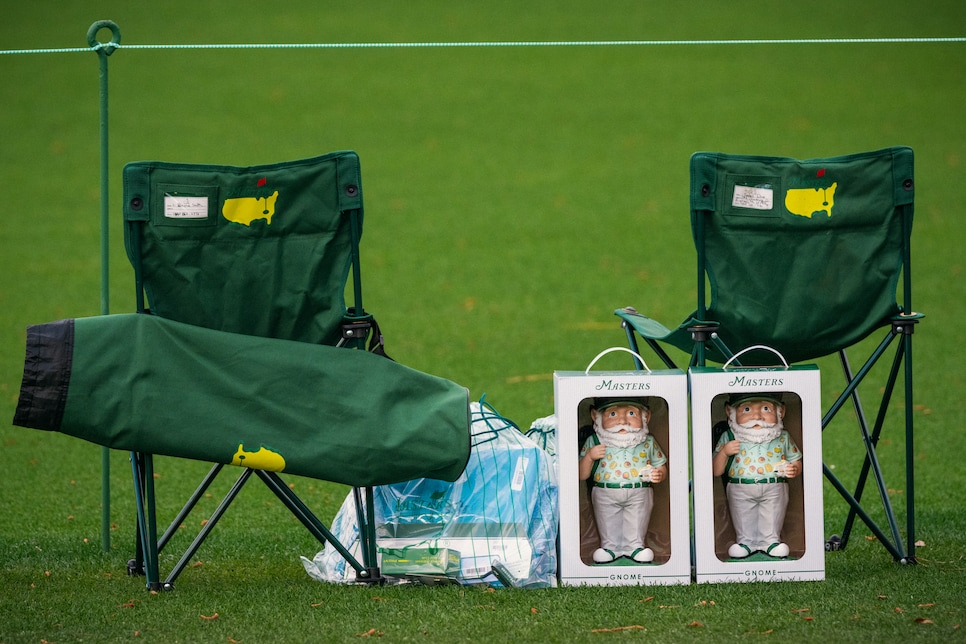
Photo: J.D. Cuban
Another interesting thing about the line – there’s a system that logs each shopper’s credential when he or she steps onto the floor, and another that logs it when they step off to the cash registers. The idea is to track how much time they’re in the shop, and the ideal is around 25 to 30 minutes. They used to let shoppers flow in whenever they happened to get to the shop, but with all the demand that was quickly untenable. Now they let them in by waves, and to show you how wild it gets, each wave is around 800 to 850 people. That’s the restricted version!
Beneath it all, there’s the basement, where all the products are stored. They have supervisors just like us and even a full-timer or two running logistics, but their rank-and-file are a lot of high school kids, who are constantly running product to the main floor using a system of dumbwaiters, some of which come up right to the middle of the circular shelving areas on the main floor. Outside, there are a few loading docks where UPS trucks are hauling products from offsite storage buildings to the loading docks, where the high school kids are waiting to move them inside, break down the boxes, and send the merch upstairs.
One funny thing about the basement is that baked into the equation for how many workers they need is the fact that some of those high school kids, every year, are going to quit after a day. When the imagined prestige of working at the Masters hits the hard reality that you’ll be spending 10 days hauling boxes in the dungeons, you’re going to get some deserters.
Some of the jobs at the Masters are filled by volunteers, like the gallery guards on the course, but that’s not true in merchandise. We’re all paid, and Augusta National will also cover lodging for anyone who isn’t local. On the main floor, we make between $13 and $16 an hour, but with time and half after 40 hours … and there are a lot of hours after 40. I logged more than 100 in my 10 days at the course, and that was pretty typical.
That’s the thing – you will earn your money. You wake up as early as you need to to get to the parking lot by 5am, clock in with your credential at the back loading dock, prepare everything ready for the day, meet with all 350 or so other workers for the morning state of the union slash pep talk from Mark Wells, and meet with your smaller units afterwards. Gates open at 7am, doors open at 7:30, and you’re on your feet the entire day minus a stop or two at employee dining behind the shop where you can spend your daily stipend. Most days, the doors stay open until 30 minutes after the last putt drops, and of course there’s plenty of work to do stocking shelves after the customers are gone. Most leave the store by 8pm, get back to your hotel room and try to get a few hours of sleep before you do it all again. If you’re lucky, there may be a moment where you get to see the course as nobody has seen it, and you may even get to watch some golf depending on how the schedule shakes out. But most of it is a grind, and it’s exhausting.
When the imagined prestige of working at the Masters hits the hard reality that you’ll be spending 10 days hauling boxes in the dungeons, you’re going to get some deserters.
Our first day on site was the Friday a week before the Masters started. On Wednesday and Thursday, the opening rounds of the Augusta National Women’s Amateur are held at Champions Retreat a few miles away, but on Friday they all get to play a practice round at Augusta. That day we only met for a couple hours of training, first as a larger group and then broken into our smaller sections. It’s not a lot of instruction, to be honest, but there is a little bit of a soft launch both on the Saturday of the ANWA final round, and the Drive, Chip & Putt on Sunday. Both days had limited hours, and to some extent it let us find our feet before the big rush started with the practice rounds on Monday.
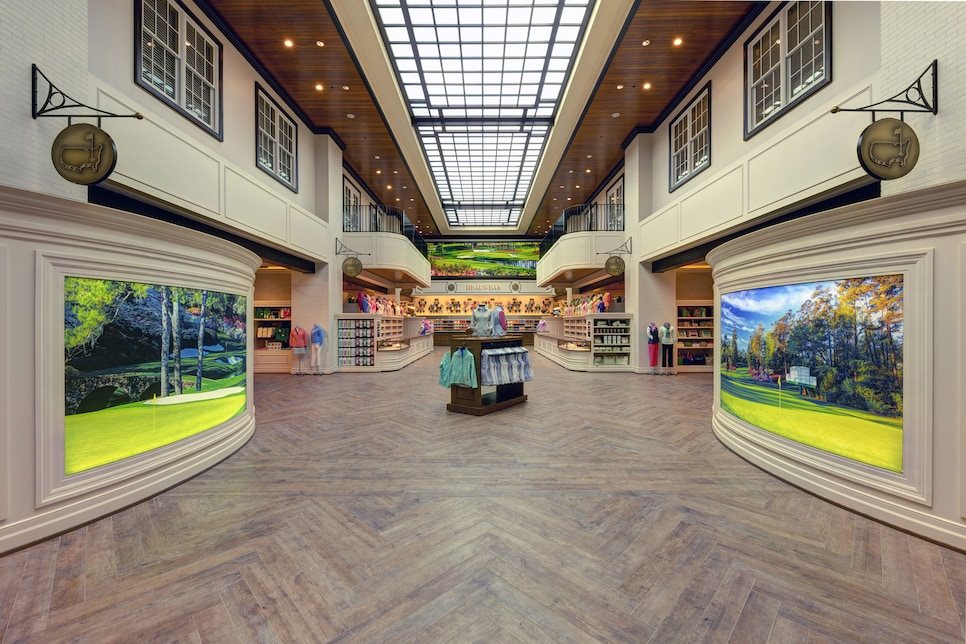
Photo: Rob Brown/Augusta National
The rush is intense. Again, you’ve got at least 800 people on the floor at the busiest times, lines outside that can be an hour long, and once they’re inside people can be very overwhelmed. Some of them might have lists of stuff they want to buy for their church group or their friends back home, so they’re in there trying to find 30 different hats or t-shirts among the crowds. Keep in mind, too, that it is Augusta National – none of these people have mobile phones, so they have to plan ahead. And even the patrons who aren’t on a mission to get to the merchandise shop (which feels like most of them) will find their way in. This is a Disney World-style design – both of the main carpark entrances will filter you right past the shops.
Upstairs, we heard there’s a VIP entrance that leads you through a hallway where they have a museum-like display of previous merchandise offerings, and if the VIPs want to buy the merchandise, they take a special elevator to the main floor. The green jackets come in that way, and once in a while you’d see somebody famous being led around the floor by one of the full-time upstairs crew, and they’d get to skip the lines – the person with them would speak to one of the counter workers and get whatever merchandise they wanted. And then they can take the elevator back upstairs to check out there.
The important rule for the workers on the main floor is that you have to keep people moving. We heard that Augusta National hated the long lines that had developed, and were trying to end the culture of extended wait times, and part of that was our responsibility. Behind the counters, we had to be efficient in getting the product to the customer, the ushers needed to keep them moving through the shop, the cashiers had to be on their game, and lines could build up even afterward at the shipping centre and checked bag area.
In order to keep the whole thing flowing, they make it hard for the shoppers to dawdle. There are no chairs or obvious places to sit down, there are only a handful of dressing rooms, and there are no obvious restrooms. Even something like a customer pulling on a quarter zip to try it on isn’t ideal, although we wouldn’t ruin anyone’s day by saying so.
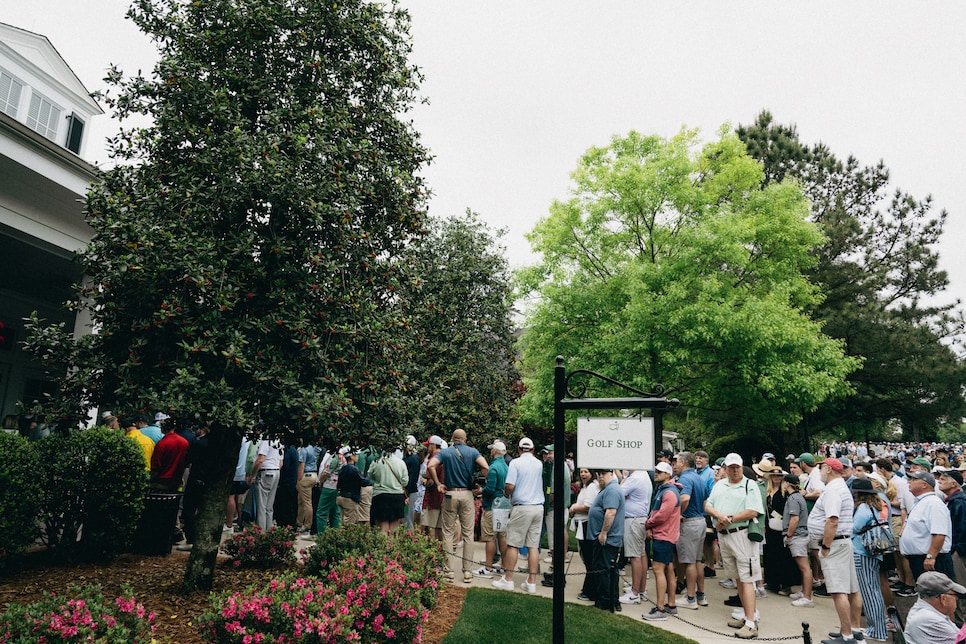
Photo: J.D. Cuban
Even with all that organisation, there’s still a chaotic element to it all. (Which got more chaotic on a couple occasions when a shopper had a medical emergency – one seizure and one heart attack, that I remember.) The leaders I observed had radios, and there’s constant communication about where we need more product, where the crowd needs to be dispersed, things like that.
And you’re being evaluated, too – all the workers get rated by their supervisors at the end. But we also get to give feedback on the entire experience, just like the shoppers do in kiosks outside the shop. If there’s some product that a lot of people ask for that we don’t sell, or some aspect of the operation that could be more efficient, we funnel that back to the people in charge.
The big enemy in the merchandise shop are the resellers – the people who come in, buy the product, and sell it online for several times the purchase price. We have some mechanisms in place to make it harder, like the limit on one gnome per customer, but in general most products aren’t as obviously coveted as the gnome, and it can be tough to spot resellers, much less stop them. There is technically no limit on how much anyone can buy (hell, it’s technically not even illegal to be a reseller, though it’s against club policy), so you remember when I mentioned the person who might be buying 40 hats for their church group back home? How do you tell that shopper apart from a reseller? It’s useful to make an example of an obvious reseller, but it has to be very flagrant. If you’re not a complete idiot, we’re probably not catching you.
The truth is, Augusta defaults almost every time to giving the patrons the best experience possible, so if it’s a coin flip between someone who might be a reseller versus an ordinary shopper, nobody is going to confront them. Sometimes they’ll stop people from spreading their stuff out on the floor, and use safety as the reason, but that only goes so far. As I said, there are a handful of police on the floor, some in uniform and some not, but they’re mostly looking for shoplifters. To be honest, I never heard a thing about shoplifting – it’s not a big problem.
There are certain things you can look out for, like an absurd amount of product or people finding a corner of the shop to spread out all their merchandise and count it, and there are occasions when someone will pull them aside and ask them to return some of the stuff, or in rare cases to return it all and leave the shop. The better way to stop them happens outside our jurisdiction, with the rumoured full-time people dedicated to finding them online and denying them credentials before they can get on site. By the way, you’re seeing that same process play out with ticket resellers, where that side hustle is getting harder than ever thanks to Augusta.
I said above that the Saturday of ANWA is a bit of a soft launch, but that’s not true when it comes to resellers – that’s a big day for them, because they went to get in the shops and grab that merchandise early so they can start selling it online the week of the Masters. Your credential allows you to get into the shops as often as you want, and it even allows you to leave the grounds and come back one time, so they can hit all the shops, load the haul into their cars, and come back and do it again. Like I said, if you’re smart, you’re not getting caught.
There is a tension at Augusta National between the reality of a private club with very wealthy, very powerful members, and the gates being thrown open once a year to the public. I came to think that the tension is most glaring in merchandise, because the culture that has emerged, with the brand becoming so popular that it’s almost a rat race at the main shop, goes against the southern gentility they like to cultivate as an image. That high-octane consumer culture has really only developed in the past few years, and while it obviously means a lot of money for the club – as I said, around $100 million for the week – it’s led to some awkwardness with the “aura” of what Augusta National is supposed to be.
Even ten years ago, it wasn’t like this. It probably wasn’t like this five years ago, and they’re trying to reverse it. Crazy as it sounds, the collectible gnomes are a great example – they upped the total supply from 500 to 1,000 in an attempt to reduce the frenzy, but it didn’t work, and now the rumour is that they’re going to get rid of them. Even the waves of 800 people they let in are a necessary development – before that change, it got so wild that it was literally “asses to elbows” inside the shop. This coming year, you probably saw that the lots aren’t opening until 6am, when before they were basically never closed. You have to imagine that’s to keep people from lining up at 4am for merchandise.
As for my time, I thought it was an incredible opportunity to get a peek behind the curtain and witness a truly exceptional operation. I’m glad I did it, and I’d even call it fun, although it was exhausting at the same time. “Controlled chaos” is the phrase that comes to mind when I think of the shop now. But I can tell you this – I came away thinking that the Masters brand is even stronger than I ever imagined.