
Trivia time: Think of an island that is named, but which sits in a body of water that is unnamed.
There is at least one answer in this world, and it is “Tree Island.” As you might guess from the simple name, it is A) an island, with B) one tree. At 50 feet by 60 feet, you wouldn’t think there’s much to it, and indeed it lives in the shadow of its neighbor, the so-called “island green” that makes up the glamorous half of one of America’s most famous holes—the par-3 17th at TPC Sawgrass. Sitting 92 feet southwest of its famous cousin, Tree Island toils in obscurity, unremarked upon perhaps unloved.
No longer! We’re lifting the veil on Tree Island, and getting into the nitty gritty of all that makes this speck of land at Sawgrass more interesting, weird and—in the end—decidedly poetic than it has any right to be. Let’s do this, Q&A style!
(And while you’re here, check out this nifty video below that we also made about the place.)
OK, what’s going on here? Why is that island even there? What’s the point?
It’s a good question, but the better question is, why is the water even there?
I promise that’s not some stoner existential query—the water that exists now did not exist when they started building TPC Sawgrass in 1979. It was swampy, sure, but it was not wet. As Drew Powell nimbly documented for Golf Digest last year, the plan for No. 17 was to have some water to the right of the green, but mostly for aesthetics … it wouldn’t be in play unless you really goofed:
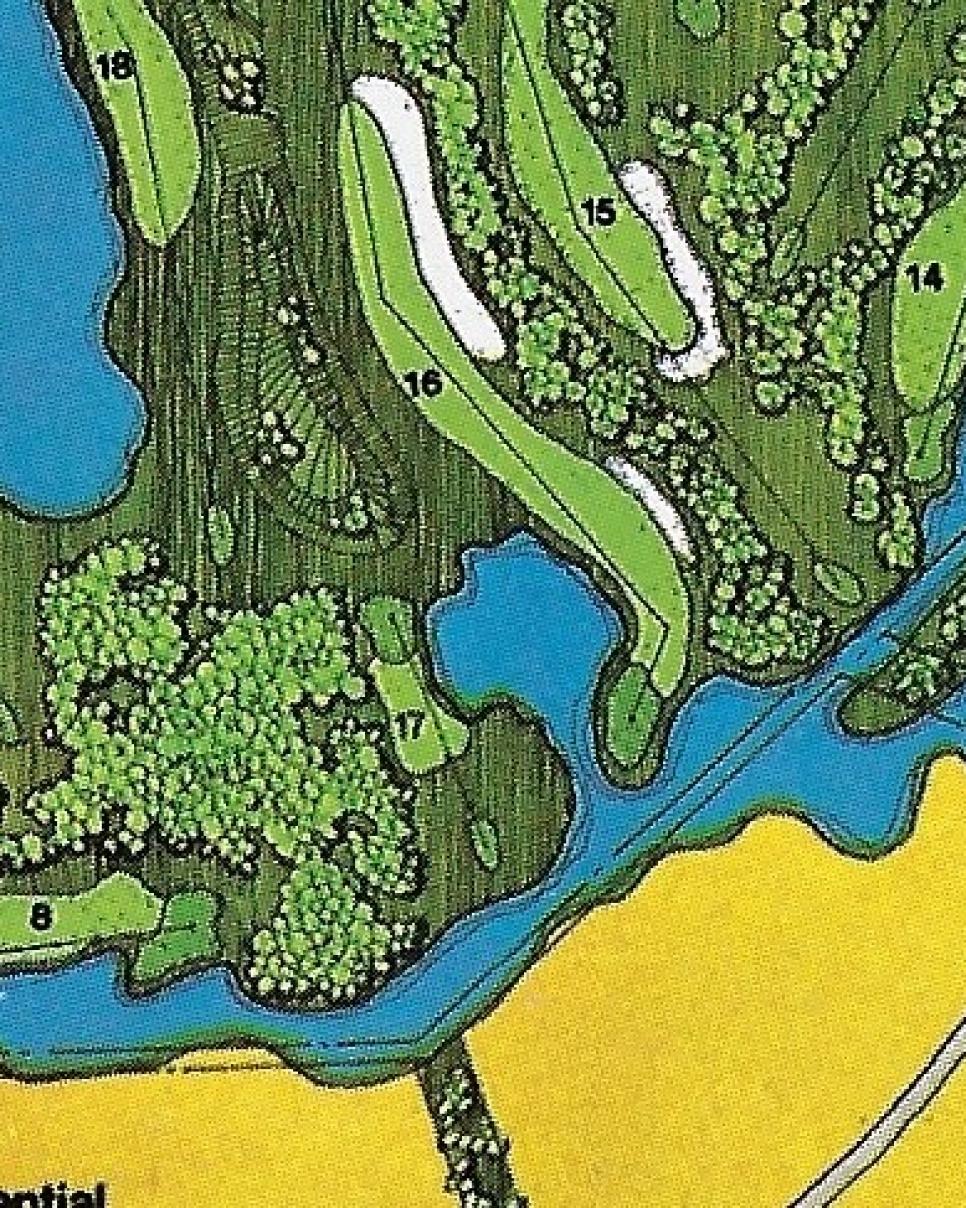
An early drawing of the Stadium Course at TPC Sawgrass shows a relatively benign 17th hole without an island green.
At some point though, he started digging deep into the soil around the course to make use of a vein of sand beneath the muck. Then, one thing led to another, and soon they had a giant hole in front of the 17th green. That’s when Alice Dye, designer Pete Dye’s wife, said, “Why don’t you make it an island?”
And they made it an island. Wow. A real “the rest is history” moment.
But they didn’t make it an island.
What?
It’s a peninsula.
Oh, you’re one of those people.
Call me what you will. Maybe I’m an “island truther.” But I’ll wear that label proudly, because facts are facts, and there’s a strip of land connecting green to mainland, and therefore it is not an island, but a peninsula. In this body of water, there is only true island. It is …
I’m not going to say it.
Say it.
No.
SAY IT.
Fine. It’s Tree Island.
But Tree Island was once a peninsula too!
Son of a $*&#$
That’s right! Here’s where it gets a little complicated. At some point very early in construction, around 1980, it was an island. Look at this picture from February 1981:
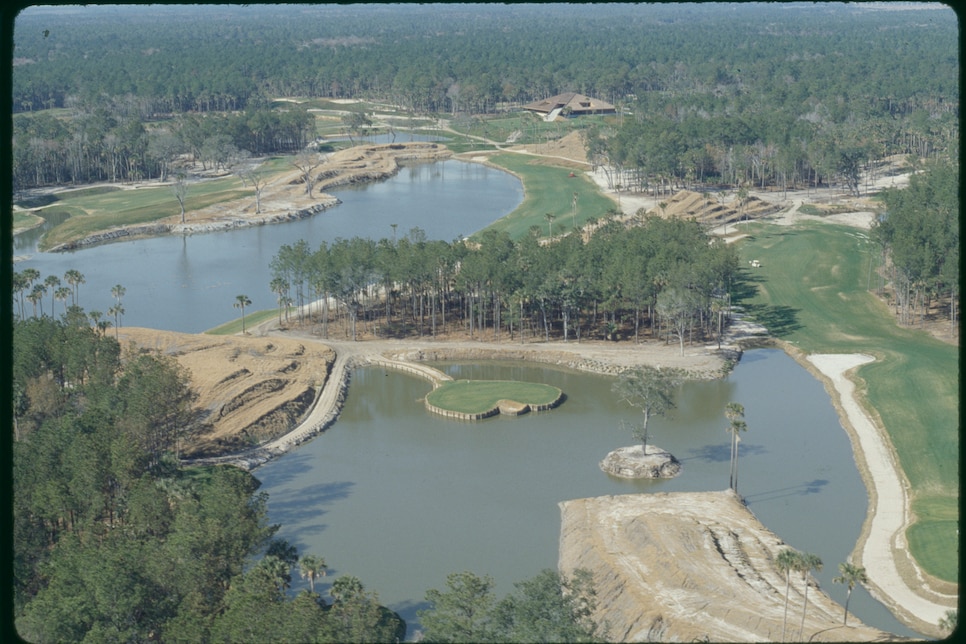
PGA TOUR Archive
OK. It’s already an island.
But then look at it here, in March 1982, when the first Players Championship was played at the course:
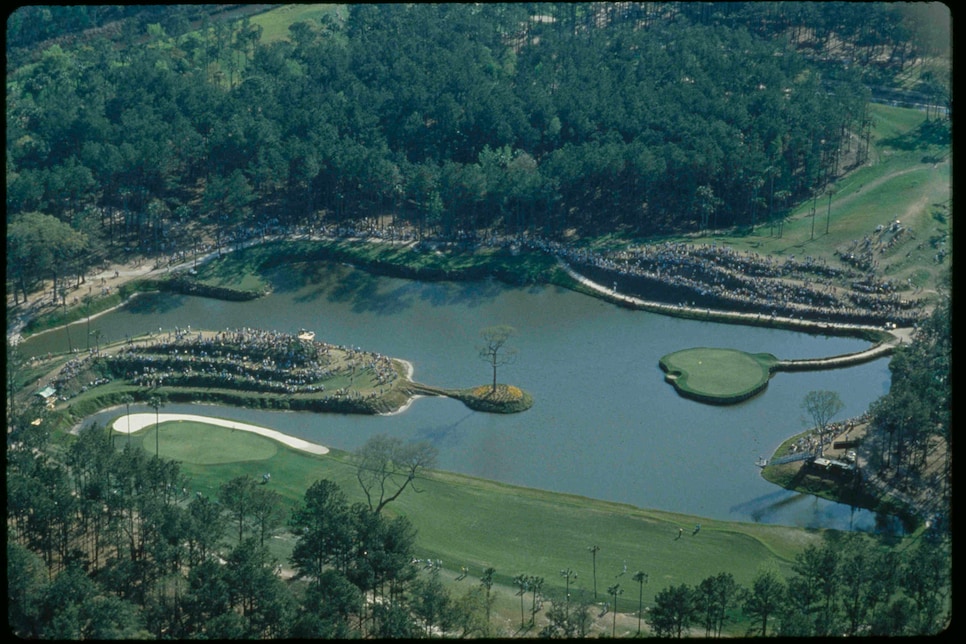
PGA TOUR Archive
A peninsula! My God!
You see???
Before we get too out of control, can I ask you a couple tangential questions?
Of course.
First, you say they started building TPC Sawgrass in 1979, and played the first Players Championship there in 1982. But the Players Championship has been around since 1974. What’s going on there?
Good noticing. They actually played those early Players Championships at a few different courses, including Atlanta Country Club (the first one, in 1974), Colonial, Inverrary Country Club (which is closed now) and then Sawgrass Country Club. But since 1982, it’s been at TPC Sawgrass every year.
Second, you said the body of water has no name. Why’s that?
Well, partly because it didn’t even exist before 1980, and partly because this part of Florida has a million tiny ponds, and if they went around naming them all, they’d have time for little else. But a PGA Tour official I spoke to for this story said that after speaking to me, he might try to push the idea of naming it. So when they call it “Dye’s Pond” or something on the NBC broadcast this year, remember it was me, Shane Ryan, who gave them the idea. And if there was any justice in the world it would be called “Shane Ryan Sea.”
OK, you need to settle down. Back to business, why did it start competitive life as a peninsula back in 1982?
That part isn’t 100 percent clear. I think a fair guess is that building a land bridge made maintenance easier. And what we can say definitively is that, looking at the 1982 picture again, it didn’t take much to connect the island to that little slice of land jutting into the water behind 16 green. Less than 10 feet, at a conservative guess?
More Players Championship Preview stories  Tee Times Players 2026 tee times: Pairings for the first and second round at TPC Sawgrass
  Ranking The Field Players 2026: Power rankings for the entire field at TPC Sawgrass
  Analysis Players 2026: Behind the scenes of the PGA Tour’s renewed pursuit of major status for the Players Did you use the word “slice” cutely there?
I did. Lucas Andrews, the Director of Golf Course Maintenance Operations at TPC Sawgrass, called that bit of land a “wedding cake,” and you can totally see it: There are plateaus or steps or whatever you want to call it coming down to the water, like the tiers of a wedding cake. That was designed as a sort of land stadium, to give spectators more viewing angles.
How’d that work out?
In this case, not well. What you can also see from that photograph is that those stepped mounds are in the way of basically everything. If you’re behind 17 tee, you can’t see 16 green because of them. If you’re behind 16 green, you can no longer see 17 green, and if you’re to the left of 16 green, you can’t see 17 tee. As former commissioner Deane Beman told me, they knew pretty much right away that it was taking more viewing angles than it was creating.
So that’s when Tree Island became an actual island?
Oh no! My goodness, no, things don’t move that quickly. What they did do, as you see here, is get rid of the mounds and keep spectators off the portion of the land closest to what would become Tree Island.
No more holding out! When did it become a &*#&$ing island???
It took a long time! By going through Getty Images, you can pinpoint a date. Here’s what it looked like in 1996, from a screenshot I took from YouTube:
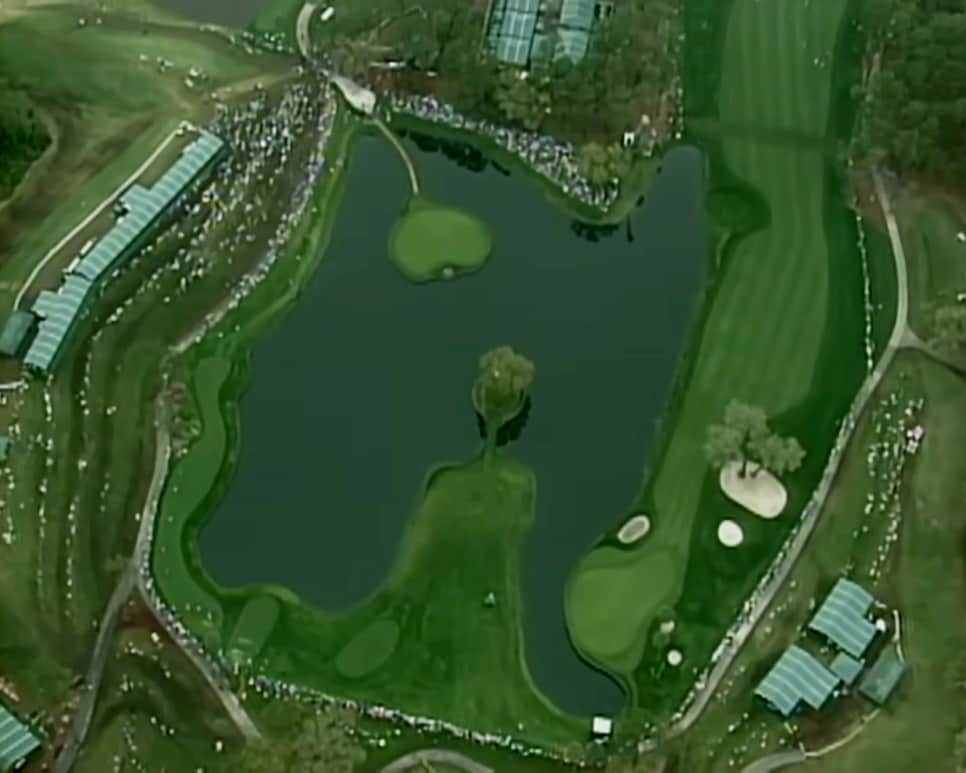
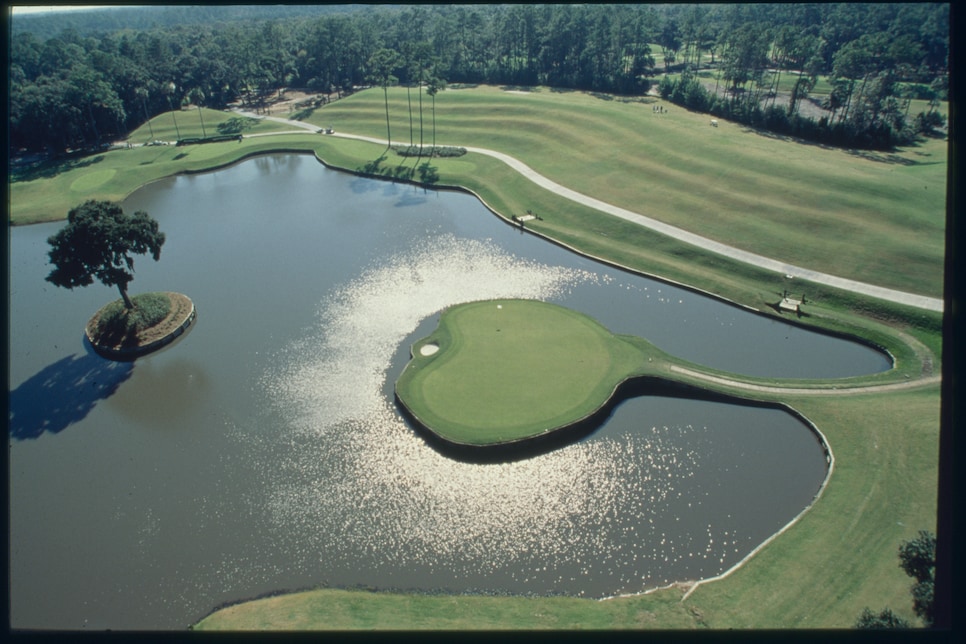
And then here’s what it looked like in 1997:
PGA TOUR Archive
So at some point after the tournament in 1996, but before 1997, they took out that entire chunk of land and Tree Island, at least, reached its final form.
We’re ignoring an important question here. Why leave it there at all, either in the peninsula or island stage?
The answer is the quercus virginiana. The live oak. The tree of the south. Simply put, that thing was too pretty to get rid of. The tree was too good.
How good?
You ever heard of the charter members of Sawgrass? They were a small group that paid $20,000 each to join back in 1980. Sometimes called “The Munchkins.” The true OGs of TPC Sawgrass. Guess what they use as their logo—the exclusive one that nobody else can use?
Tell me.
Tree island, baby.
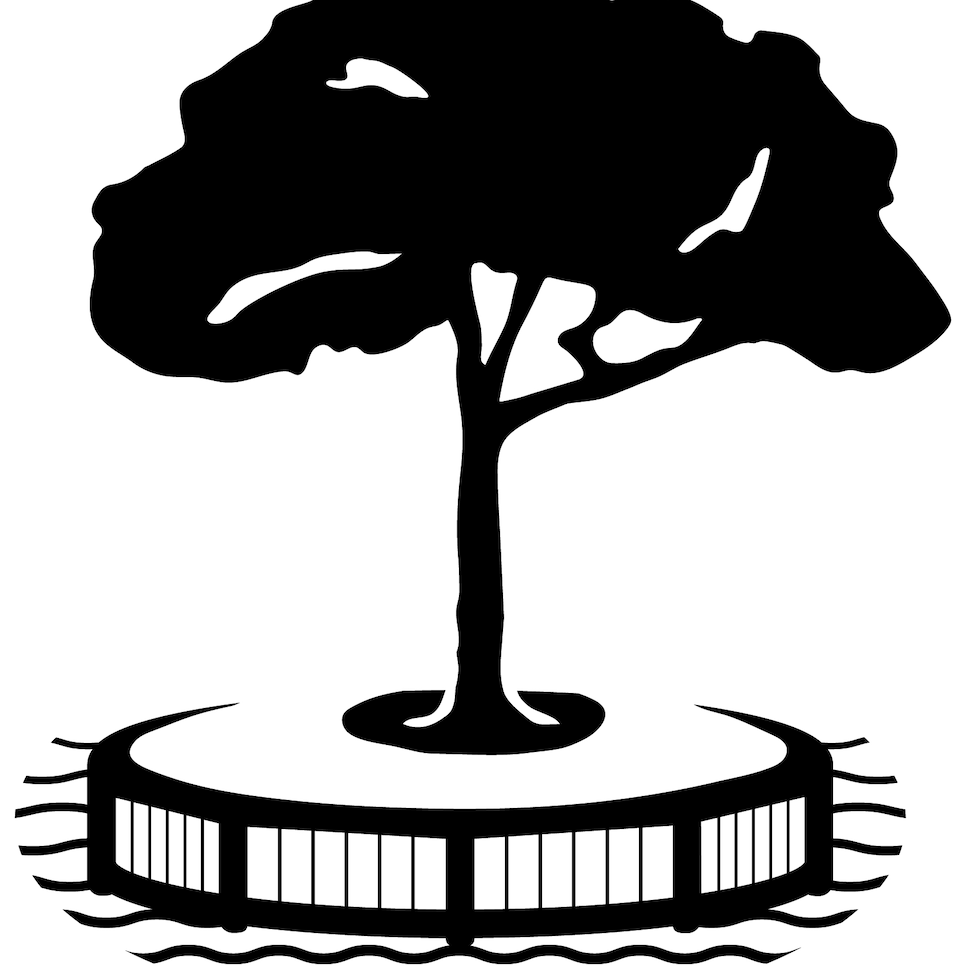 Who else likes Tree Island?
Birds.
I’m talking pelicans, cormorants and great blue herons. They love the place, and no wonder—there’s fish in the pond, a nice perching spot, and it’s completely safe from land predators.
So they just sit there all day eating?
And, unfortunately, pooping.
Why is it unfortunate that they poop?
Well, I guess it’s not unfortunate for them that they poop, but it is unfortunate for Lucas Andrews and the grounds crew at Sawgrass. You see, that poop destroys the flowers, and it’s not a long trip for them to fly over to the 17th green and poop there, too, which is even worse. Andrews and his gang have tried everything to dissuade them, from putting tinsel on strings (birds hate this, apparently) to wiring up fake hawks to—I swear this is not a joke—using one of those large inflatable men that you see at car dealerships to blow up each night when the sun sets and scaring them off. Shockingly, this last deterrent has worked the best.
They must really hate that bird poop.
You know who hates it more? The NBC cameraman who had to work on the island every year. They wouldn’t even let him have a cover over his station because it would block the view of the spectators, so he had just to stand there, a free target, praying that the birds wouldn’t target him.
Is that the worst job in sports broadcasting?
It was. Three years ago, they went to an automatic camera, so the era of the lone bespattered island cameraman came to a close.
More Players Championship Preview stories  Golf Digest Logo If you built a course today to test the world’s best players, what would it look like?
  Payday at TPC Sawgrass Players 2026 prize money payout: Here’s how much money each golfer will earn at TPC Sawgrass
  What-If History 11 ways golf would be different if the Players Championship was a major all along OK, give me eight quick facts about Tree Island as it exists today.
One, it has underground power and electricity. Two, it has a wooden bulkhead around it to prevent erosion. Three, there is no grass, but there is pine straw, there are 3,000 flowers. Four, the flowers are changed out roughly three times per year. Five, the flowers you see on Players week are pansies. Six, they used to have to change them out on Saturday night to get new flowers in for Mother’s Day, but not anymore because the schedule changed. Seven, on a normal day, maintenance is usually one guy taking a motorized skiff out for routine maintenance. Eight, Golf Digest’s Jamie Kennedy watched a playing partner hit a ball onto the island once.
Oh wow. Has anyone in the Players ever done that?
No, because you have to hit a really legendary slice, but Russell Knox came close, and Brendon Todd came closer.
What would happen if someone did? This is very intriguing.
I know. So intriguing that I reached out to Stephen Cox, the PGA Tour’s VP of Rules and Tournament Administration, and …
Are all PGA Tour titles like nine words long?
I think so, but the point is, Cox is very good at his job, and he told me that Tree Island is inside the penalty area, and would be treated as such. However, since you’re allowed to play a ball inside the penalty area if you can, that means a ball on Tree Island is legally playable.
How would you get there?
That’s the problem. You could swim, but there are gators, and that’s a heavy price to pay for a few strokes. And before you ask, no, you can’t take the motorized skiff that’s out there, because the tour has a specific rule about not using motorized vehicles during the course of play. That’s designed for golf carts, of course, but it would apply to a motorized boat too.
You know what I’m going to ask next.
I know. And yes, according to Cox, you could take a canoe or a rowboat or something non-motorized out to try to play a shot from Tree Island. Which would be amazing. If it ever happens, it will instantly be one of the greatest moments in professional golf history.
Earlier, you mentioned something “poetic” about Tree Island.
Well, the thing is that there are a few really iconic live oak trees at TPC Sawgrass, but the bad news about trees is that sometimes they die, be it by natural death, hurricane or any of the other countless ways things have of expiring. But because a few of these trees are so integral to what we know about the course, Cox and Andrews both told me that there are contingency plans to replace them. That includes the live oak on Tree Island, which is about 70 years old.
So think about it this way—that little 50 foot by 60 foot plot of land has survived all this time because of that live oak. Without the tree, it would have drowned ages ago. And what the replacement policy means is that the land will survive even after that tree is gone, but its survival will still be because of the tree.
Is that not, I ask you, one hell of a tree?
This article was originally published on golfdigest.com