After five years of unprecedented growth, Australian golf stands at a financial, strategic and ethical crossroads. Australian Golf Digest’s senior writer dissects the business of Golf Australia and how the national governing body is dealing with the many challenges confronting the sport. He asks: What is Golf Australia trying to become?
Exhausting would be a word to describe the past 12 months for Golf Australia. The national governing body completed the much-anticipated roll-out of a new handicapping system while in the process of reinvigorating the men’s Australian Open with the appearance of Grand Slam winner Rory McIlroy.
Amid the fanfare came the launch of Golf Australia Club, a handicap subscription for golfers who aren’t members of a club. Planning is also underway to run a tee-time booking system. Then two weeks before Christmas, Golf Australia announced its intention to enter the media space by launching GOLF360, a digital platform on its new website golf.com.au.
All very well and good. But the rollout of Golf Australia’s new handicapping platform, Golf Australia CONNECT, has been met with a decidedly lukewarm response from the market. That reaction is notable given Golf Australia’s day-to-day operations are underwritten by millions of dollars in annual affiliation fees paid by club golfers nationwide.
Club members, social golfers and small-business operators are entitled to wonder if they’re receiving what’s expected from the sport’s governing body. Because it appears Golf Australia is morphing into more than just a custodian of the game.
GOLF AUSTRALIA’S TRADITIONAL ROLE
It’s more than two decades since the late Jack Newton railed against the fragmented nature of the sport in a column for Australian Golf Digest. Back then, as many as 27 different organisations were attempting to run the game. National and state-based bodies – amateur, professional, junior – each had their hand out for government funding and corporate support.
The sport is much more streamlined since the formation of Golf Australia from the 2006 merger of the men’s Australian Golf Union with Women’s Golf Australia. The PGA of Australia and PGA Tour of Australasia followed suit by reforming as one organisation. Subsequently, relations between Golf Australia (headed by chief executive officer James Sutherland) and the PGA of Australia (CEO Gavin Kirkman) have thawed – as evidenced by how they share a common base at Sandy Golf Links in south-east Melbourne.
Historically, the role of Golf Australia (formerly the Australian Golf Union) was to oversee the amateur game. The board is hand-selected and the various states are meant to hold it to account. Its duties range from administering the handicap system to chaperoning elite amateurs at international competitions. Hosting the men’s Australian Open is a primary responsibility.
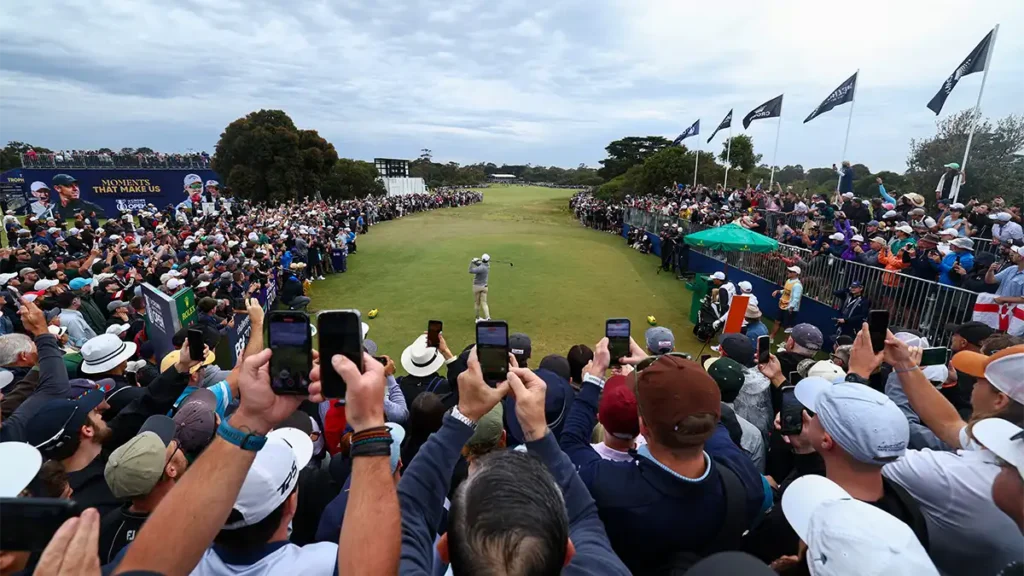
The 2025 Crown-sponsored Australian Open was an outstanding success built around McIlroy’s appearance. Huge attendances, strong TV ratings, and lavish international praise emanated from the return to Royal Melbourne after a 34-year absence. Our Open appears to be on the right track after three years in the wilderness when Golf Australia combined the men’s and women’s championships – a logistical nightmare with regard to tournament setups over two courses but somewhat an essential evil given the financial state of the books with the governing body.
But there are still areas of concern. Golf Australia announced Crown Resorts as the major naming rights sponsor just 28 days before the start of the Australian Open. It reeked of a fire sale, hardly befitting a 121-year-old championship, which now awards the winner an invitation to the Masters and Open Championship.
And while prizemoney for the 2025 Australian Open increased to $2 million (from $1.7 million), it’s still incommensurate with its feted status as ‘Golf’s fifth major’. It’s hardly the flagship event Down Under given the Australian PGA Championship has matched or bettered the Australian Open purse every year since 2015 – the PGA often running without a title sponsor until recently.
Allocation of appearance money is a moot point. Giving one player in McIlroy a vast majority of the player marketing budget certainly caused a ruckus among some pros – two-time Australian Open champion Matt Jones didn’t receive anything to play at Royal Melbourne.
Reigning champion Ryggs Johnston chose to play the no-cut Nedbank Golf Challenge in South Africa with its $US6 million purse (about $A9 million). The defending champion’s decision not to return was, at best, an insult. More broadly, it underlines where the professional game now sits. Players are being advised by managers that their most valuable commodity is time. Hence, playing for $9 million will always outweigh playing for $2 million. Until the commercial coffers are aligned, unfortunately the Australian Open will continue to rank second in the priorities of players and their managers. Though, in the end the McIlroy move proved a right one with the Australian sporting public turning out in record numbers.
TEETHING PROBLEMS AND PRIVACY CONCERNS WITH NEW HANDICAPPING SYSTEM
Nevertheless, administering the handicap system is the crux of Golf Australia’s responsibilities. Maintaining a handicapping system that is fair and equitable to all has been the lifeblood of club golf across the nation for many decades. Golf-club facilities are more harmonious when this happens.
The requirements to manage a handicapping system in Australia and run club administration software are more complex than anywhere else in the world, according to Peter Maddison, the founder of digital golf innovator MiClub. One of the reasons is because we run club events daily, whereas overseas it could be as little as once a month. Or at best, once a week. Overseas they have a practice known as ‘Peer Review’ where golfers can come home and enter scores afterwards. It relies on playing partners to check that scores are correct. Whereas in Australia we are scrutinised more heavily.
GOLF Link was the handicapping network that had operated in Australia since 1999. Developed by the AGU in conjunction with GOLF Link Partners Australia, the national system stored and calculated every golfer’s handicap with easy online access for clubs and members.
In 2010, Golf Australia adopted the USGA calculation method using the average of the best 10 differentials of a player’s past 20 total rounds, multiplied by 0.96. This method has since been tweaked, but these changes were made to restore equity between high and low handicaps. Since 2011, the R&A and USGA began creating a single uniform handicap system for use everywhere around the world. The World Handicap System (WHS) was introduced gradually from 2020. Subsequently, Golf Australia began transitioning away from the GOLF Link platform.
On October 11 last year, competition golf officially resumed on the Golf Australia (GA) CONNECT platform across the country. Golf Australia described it as “marking a major milestone in one of the largest digital transformations ever undertaken in Australian sport”. The new handicapping service collected data from more than 1,900 golf clubs, 30,000 tee markers, 450,000-plus golfers and 280 million historical rounds.
GA CONNECT’s new digital platform was developed by Golf Australia in partnership with DotGolf, a technology solutions company co-owned by the R&A and Golf New Zealand. DotGolf has been the provider of choice for handicap systems worldwide. GA CONNECT was designed to make obtaining and maintaining a handicap easier than ever. Golfers can view/track handicaps via Golf Australia’s mobile app and through the portal on golf.com.au. System access is obtained through a personal 10-digit Golf ID (replacing the old GOLF Link number).
Feedback from the wider market to Australian Golf Digest suggests the transition to the new handicapping system was far from smooth. GA CONNECT arrived more than a year behind schedule, amid widespread industry belief the project’s final cost far exceeded its original budget. Not that you would know because confidentiality agreements were in place and remain so.
On the day of GA CONNECT’s release, the handicap formula adjusted people’s handicaps. A large percentage of handicaps were incorrect due to human error when someone at DotGolf applied the wrong course ratings. It has also been reported to Australian Golf Digest that handicaps of lapsed members and even deceased golfers were resurrected in the transition. Golf Australia was warned about teething problems prior to the launch, which coincided with club championships on Australia’s eastern seaboard. Social media reaction showed that golfers were not happy.
Golf Australia’s knowledge about how to run a software project of this magnitude appeared to be lacking. The main operational issue with GA CONNECT is that DotGolf was a product meant to work by itself, not with other Licensed Service Providers (LSPs) for an Australian market. Third-party companies were used to implement the new system. Much of the development was done offshore. Golf Australia has since admitted it hired 70 additional support staff to deal with these issues – and full-time staff were also diverted from their day jobs to help resolve problems.
“At this scale, no rollout is ever simple,” Golf Australia chief executive James Sutherland told Australian Golf Digest. “Replacing the 25-year-old GOLF Link system was essential to future-proof Australia’s handicapping and golfer management systems. Our digital transformation has been driven by what is best for the golfing experience and the long-term health of the sport.”
Privacy and data security needs to be at the top of the list for Golf Australia when it comes to the new handicapping system. Some in the industry believe Golf Australia has sought member data well in excess of basic requirements to manage a handicapping solution.
Data breaches at the corporate level are becoming increasingly common. In 2025, Qantas suffered a major privacy breach after a large-scale cyberattack exposed the personal details of 5.7 million customers on the dark web. If the national airline is vulnerable to such an attack, it follows that similar breaches represent a material risk for Golf Australia and Australian golf clubs.
Ordinary club members are, for the most part, largely oblivious to the scale of this privacy risk. Current membership agreements, in most cases, do not explicitly address it either. As one senior figure within the golf industry, speaking on condition of anonymity, explained to Australian Golf Digest: when you sign up for a handicap, you are, in effect, entering a data ecosystem. Your e-mail address, golf activity and interactions within the Golf Australia digital environment can then be used to inform the advertising you are shown. That experience may also extend beyond Golf Australia’s own platforms, with golfers continuing to see related advertising elsewhere online.
None of this is unusual in today’s digital landscape. The more pertinent question is whether the average Australian golfer fully understood this trade-off when migrating to the new system, and whether the implications around data use and targeted advertising were communicated clearly enough at the point of sign-up.
Any data breach within the handicapping system would undermine years of trust built across the game and be difficult to recover from. Even a single incident could cause lasting reputational damage, eroding confidence in the management of golfers’ personal information.
Golf Australia’s Sutherland was at pains to assure club members that Golf Australia had undertaken due diligence with regard to privacy: “Partners only ever access de-identified, aggregated insights,” he said. “All marketing and communications are permission-based, with golfers in full control of their preferences through their Golf ID profile.”
GOLF AUSTRALIA CLUB COMPETES WITH ‘VIRTUAL GOLF CLUBS’
While still dealing with teething problems associated with the GA CONNECT handicapping system, the governing body launched Golf Australia Club in December. Golf Australia Club is a flexible handicap subscription designed to support the growing number of regular golfers who are not yet part of a club.
Social or casual play is a flourishing sector of the Australian golf market. Participation is surging by 5.2 percent while social club membership is growing four times faster than traditional club membership.
Some in the industry believe that by selling handicaps through Golf Australia Club, the governing body is now competing against its own stakeholders as a handicap provider. These so-called ‘virtual golf clubs’ offer a Golf Australia handicap, Golf ID and insurance cover for as little as $100 per annum. (Social Golf Australia and Future Golf are two such examples.) And it stands to reason Golf Australia’s flexible handicap subscription can impact traditional golf clubs because it provides social players the core benefits of club membership without the financial burden.
This raises a dilemma about Golf Australia’s priorities. Should the national governing body be enablers and help encourage specialists to actively work in the golf industry? Or should it be taking responsibility and thereby controlling every aspect of the sport?
Across the Tasman, Golf New Zealand appears to be taking the latter approach. Through its association with DotGolf, Golf NZ manages a wide range of services such as My Golf (NZ’s handicap system), Flexiclub (membership subscription for casual golfers), She Loves Golf, Tee Booking (powered by American Express) and Golf NZ Shop (T-shirts, towels and books).
Golf Australia’s Sutherland is adamant that it’s the right decision to offer a flexible handicap subscription to social players: “There are around 1.8 million Australians who play golf regularly but aren’t members of a club, and that is exactly who Golf Australia Club is designed to support,” he said. “This is not about replacing clubs or creating a parallel system – it is about growing the top of the funnel and keeping emerging golfers inside the official framework to encourage them on their golfer journey.”
GOLF AUSTRALIA ENTERING THE MEDIA SPACE WITH GOLF360
In a further move away from its traditional operations, Golf Australia has announced an audacious plan to become a ‘one-stop shop’ for golf. In mid-December the governing body unveiled GOLF360, a new digital media platform that combines the strength of Golf Australia and the PGA of Australia.
The joint venture has adopted the new website golf.com.au with aspirations to monetise Golf Australia’s extensive database of more than 470,000 golf club members. It hopes to enable brands – big business – to connect with four million participants and an estimated 6.7 million fans.
“GOLF360 represents a significant step forward for Australian golf,” said Michael McDonald, PGA of Australia/Golf Australia’s chief commercial officer, in a statement. “By bringing our most powerful digital assets into one connected platform, we are creating a more modern, scalable and effective media environment for partners.”
GOLF360 had been under development for 18 months. Little wonder why Golf Australia wishes to commercialise “powerful digital assets” (a database of 470,000-plus club members) into “one connected platform” (golf.com.au).
The AFL, NRL and Cricket Australia all generate substantial media income:
- The AFL signed a $4.5 billion deal with the Seven Network and Foxtel/Kayo in 2025 that runs through 2031;
- NRL has a $2 billion contract with the Nine Network for a term of five years;
- Cricket Australia has a $1.5 billion deal with Seven and Foxtel from 2025-2031.
By comparison with golf, Australia’s three largest mainstream sports have a completely different business model from which they funnel money into grassroots sport. They’re not funding it through affiliation fees, they’re getting top-shelf media revenue through TV broadcast rights. Historically, golf has actually had to pay to get our product on commercial TV.
Golf’s television audience has grown in recent years but in reality continues to lag well behind major sports. Last year’s final round of the Australian Open at Royal Melbourne averaged 267,000 viewers nationally (even with Rory McIlroy). By comparison, regular-season matches in the A-League in 2025 averaged 366,000; the NRL season drew 614,000 per game; AFL averaged 477,000, and the 2025-2026 Big Bash League attracted an average audience of 807,000. The gap underlines how far golf broadcasts still have to go in competing for mainstream television attention [Source: VOZ Total TV].
It’s clear Golf Australia is trying to take a leaf out of the AFL, cricket and NRL playbook with a media play. All three devote substantial resources to their media departments. But those three governing bodies aren’t .org organisations. Golf Australia had been a .org (until it adopted the website golf.com.au) and by definition should be servicing rather than competing with media to help boost and grow the game.
Sutherland, however, defends the launch of the GOLF360 digital media platform, saying: “As the national sporting organisation, Golf Australia has always had two fundamental responsibilities: governing the game and growing the game. Those responsibilities haven’t changed and they are not in conflict, they are complementary.”
PRAISE FOR GOLF AUSTRALIA’S FISCAL PRUDENCE
Golf NSW has been a perennial thorn in the side of Golf Australia. During the past decade Golf NSW has resisted the offer to join One Golf, the umbrella structure linking the states with Golf Australia to “tackle the sport’s biggest grass-roots issues”. Golf NSW is the only state not involved.
Some 182,414 club members belong to NSW/ACT golf clubs. Theoretically, Golf NSW provides 38 percent of Golf Australia’s revenue from affiliation fees (although states pay different rates).
Golf Australia’s profligacy post-2006 used to be a source of angst for Golf NSW. The early days of the new entity at a centralised hub in Melbourne’s CBD were characterised by a transient culture that welcomed tennis players (Paul McNamee) and rowers (Nick Green) while farewelling generational talent such as Dominic Wall (to the R&A’s good fortune). At one point, Golf Australia’s balance sheet had alarms bells ringing.
Golf Australia has learnt to live within its means. It has exhibited financial prudence under the current board and CEO Sutherland. In the most recent 2024-2025 financial year, Golf Australia announced a profit of $2.1 million.
“Golf Australia are in a much better position than they have been. Credit should go to the board and the management team for turning around the organisation from where it was, to where it is today,” concedes Golf NSW chairman Michael Medway.
That acknowledgement matters. But so does perspective. Between the 2020-2021 and 2024-2025 financial years, Golf Australia’s reported revenue more than doubled, rising from approximately $27 million to more than $57 million. In isolation, that growth is impressive for a national sporting body operating in a crowded and competitive landscape.
Margins, however, tell a more sobering story. Early COVID-era surpluses gave way to operating margins below 1 percent in successive years, before recovering modestly to about 3.7 percent in the most recent reporting period.
In simple terms, Golf Australia became significantly larger, but not proportionately stronger.
RELIANCE ON GOVERNMENT FUNDING
Finances aside, the so-called ‘War On Golf’ by all tiers of government should be the burning issue for the national governing body and the state organisations. Golf courses on public land face an uncertain future in metropolitan areas where recreational space is at a premium. Golf needs a loud voice to advocate its position.
Golf Australia, however, has adopted a notably more cautious stance in the fight to protect Moore Park Golf from proposed changes by the NSW Government. Rather than taking a prominent, upfront public position, Golf Australia appeared to favour quiet advocacy through back channels over leading the campaign to preserve the course’s 18 holes.
In October 2023, NSW Premier Chris Minns announced the Labor Government’s intention to repurpose 20 hectares of Moore Park by mid-2026, effectively reducing the course to nine holes to create additional green space for surrounding suburbs. The move was not without irony, given successive NSW governments have approved extensive high-density residential developments in the immediate area.
A major driving force in the Save Moore Park campaign was club member Jared Kendler, who advanced an alternative proposal that retained all 18 holes while also delivering additional recreational amenities for the broader community. Golf NSW, Golf Australia and the PGA of Australia lent their support to the campaign, but appeared reluctant to publicly challenge the government in a more direct or forceful manner.
And you can understand why. All three have received state government funding towards staging professional tournaments: the Australian Open in Sydney and the Australian PGA in Brisbane. Hence, when Golf Australia could’ve affected the outcome with Moore Park was at the very beginning – before the various appeals stages.
Which begs the question: could Golf Australia – and Golf NSW – have been more demonstrative with the NSW Government if they weren’t so reliant on government funding for the Australian Open and support programs?
Sutherland refuted strongly that the governing body was slow to act: “Suggestions that Golf Australia’s approach to Moore Park has been ‘cautious’ or ‘relatively late’ are factually incorrect,” he said. “Golf Australia has consistently and actively advocated for the best possible outcome for golf at Moore Park from the outset.”
Nevertheless, it’s not just Moore Park that’s under threat in Sydney. It’s Carnarvon and Wallacia golf clubs – and basically every public course that sits on council or Crown land in the greater metropolitan area. Good luck to suburban Melbourne courses now the Australian Open is back on the Sandbelt and the Presidents Cup is on its way to Victoria with generous government funding.
In a nutshell, Australian golf is overly reliant on government money while the sport is booming. What should worry the industry is that corporate sponsors aren’t bashing down the door during the largest participation increase in three decades.
It’s a message Golf NSW’s Medway conveyed at a state chairs’ meeting as well as to the PGA of Australia. Medway says they must capitalise interest in golf into commercial revenues and grow the sport for generations to come: “Are we really getting the value for the Australian Open that it should be bringing from commercial partners? Maybe now that we’ve had that event with Rory McIlroy last December, it’s a platform to build on and ensure the national Open can feed from the top down to grassroots golf – for the whole sport to present a product that is attractive to commercial partners.”
MORAL RESPONSIBILITY TO PROTECT JUNIOR GOLFERS
Generating corporate revenue is a delicate balancing act. Golf Australia needs to tread carefully since aligning itself with Crown Resorts, the major sponsor of the 2025 Australian Open. The gambling giant stands accused of “sportswashing” to improve its tarnished image.
In 2023, the Federal Court of Australia ordered Crown to pay $450 million for breaches of money laundering laws. It was Australia’s third-largest corporate fine. The gambling giant was found to have committed at least 546 breaches of the Anti-Money Laundering and Counter-Terrorism Financing Act, between 2016 and 2022. Crown admitted its Melbourne and Perth casinos didn’t properly monitor high-risk gamblers, some of whom had links to organised crime syndicates.
Accepting sponsorship from gaming companies is fraught with risk, yet has become a reluctant reality as sport and gambling increasingly intertwine. That doesn’t mean it should be embraced – nor excused.
Gambling remains a blight on society in many people’s eyes, and Australia is particularly exposed with the highest average gambling spend per person worldwide, estimated at $1,918 annually [Source: Gambling Industry News]. Poker machines, meanwhile, have long been a reliable revenue stream for golf clubs across the country – underscored by the fact Australia is home to slot-machine manufacturer Aristocrat Leisure. And in recent years we’ve witnessed a proliferation of advertising for online gambling on TV, websites and social media. In Australia, sports betting through licensed operators is legal as long as the betting occurs prior to the sporting event starting.
The real issue here is junior golfers. Approaching 10 percent of club members are juniors aged 18 and under. It stands to reason they will visit the golf.com.au portal to check their scores and handicaps. The Golf Australia app already has advertising for TAB, Australia’s biggest multi-channel wagering provider with 9,000 venues across the country.
Which raises a further question: does Golf Australia have a moral responsibility to limit junior golfers’ exposure to advertising for legalised sports betting, particularly when many may be visiting its platforms simply to check a handicap? And if so, what safeguards, if any, have been put in place?
“Golf Australia applies internal processes that go beyond these requirements to ensure a responsible and appropriate experience for golfers across our platforms,” Sutherland says. “For example, gambling advertising is restricted for Golf ID users who are logged in and recorded as under 18.”
It would be a shame to undermine all the good work of Golf Australia’s junior initiatives. The flagship of which is MyGolf powered by Ripper GC, the national introductory program for children aged 5-12. Participants are known as Little Rippers as a nod to Cam Smith’s LIV Golf franchise, which is the principal partner in a three-year collaboration to inspire the next generation of Australian golfers. More than 40,000 kids participated at 476 locations last financial year.
A STRONG NATIONAL ORGANISATION IS GOOD FOR THE SPORT
Once again, Golf Australia should be congratulated for how it staged the 2025 Australian Open. The world took notice and every Australian golfer should be proud of how it was presented. The governing body should also be commended for how it has consolidated its finances in recent years. And Golf Australia should take some credit for the rise in participation numbers (since inevitably it receives the blame whenever playing numbers decrease).
The jury is still out on the transition to GA CONNECT. That much-anticipated project would have stressed everyone involved. But as Golf NSW’s Medway alluded: “Programs are hard. It could have been a disaster. They could have had to fall back to GOLF Link. They didn’t have to do that. The new app’s in there. Is all the functionality you’d expect day one in the hat? Probably not, but it’s a modern platform to now invest in.”
The reliance on government funding needs to be addressed. So, too, the generation of corporate revenue. And the moral responsibility for future generations of golfers. It would take an eternal optimist to envy the burden placed upon Golf Australia.
The total sum of infrastructure at golf facilities across Australia is huge. However, Golf Australia doesn’t control any of the assets or the dirt on which they sit. It oversees a veritable cottage industry with 10,000 volunteers scattered across clubland in semi-director roles. And 50 percent of those board members change every single year. Yet its role is to goad clubs into action with best-practice advice and solutions.
From three decades of covering golf in Australia, frustration with the national governing body has been a constant theme. That is perhaps inevitable: we are a very democratic industry but the structure doesn’t make it easy for change to be affected. Even so, it does highlight the importance of transparent communication in the way the governing body engages with the golf industry.
Where Golf Australia seeks to play a central role in shaping the game, an increased degree of openness should occur with stakeholders – clubs, service providers, the media and golfers.
Photographs by getty images/Josh Chadwick, SOPA Images