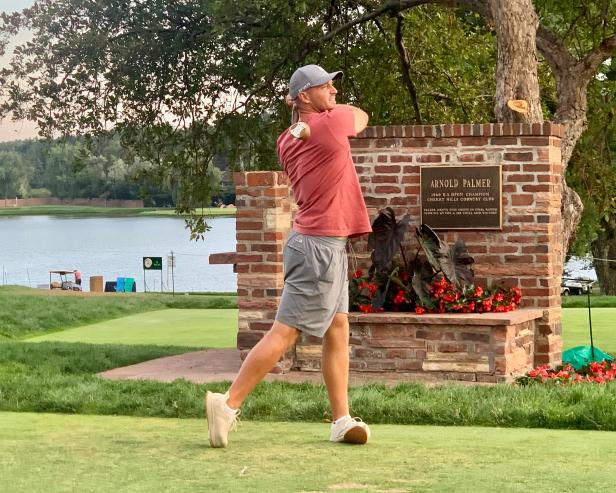
In a previous life, more than 17 years ago, the tall, athletic frame of Chris Malec [middle] cut an imposing figure for the East team in the All-Stars senior high school ice hockey game in Rochester, New York.
It was March 2008 and Malec – finishing high school in Webster, a town 15 minutes away – had just helped the Webster-Thomas Titans to a win in the 2008 Division II New York State Public School Ice Hockey Championship game. They defeated the Thousand Islands Vikings, 5-2, for the high school’s first state ice hockey championship.
A week later, Malec returned to the rink for the high school All-Stars game at the Lakeshore Ice Arena – appropriately named given the stadium sits on Rochester’s frosty waterfront, across Lake Ontario from Canada and its cities of Toronto to the west and Kingston to the east. Malec scored two goals during the East All-Stars’ 7-6 loss.
“I still love [ice] hockey, and I miss it very much,” Malec, a card-carrying member of the Challenger PGA of Australasia having won July’s first ever tour qualifying school held in the US, tells Australian Golf Digest. He carries a deep voice and a pronounced upstate New York accent.
But by 2008, another passion was brewing in the background for Malec. Although ice hockey rinks and a lone hockey stick couldn’t provide any deeper contrast to lush, green fairways and 14 lofted clubs, Malec had fallen in love with golf.
“I started playing golf in sixth grade. I was 12 years old and I became addicted right away,” Malec recalls.
Somehow, Malec had unknowingly become a real-life Happy Gilmore. In his first ever round of golf, he shot 108 across the treelined fairways of Webster Golf Club. He was a natural.
Similarly to Adam Sandler’s character, his 6-foot-2 frame could crush the ball a long way. And like “Mr Gilmore”, Malec needed to harness that power and athleticism. On arrival in Australia recently, Malec was fitted and signed to Titleist and was smoothing drives with a 181-mile-per-hour ball speed without breaking a sweat.
“In eighth grade I met my first coach, John Graham. He is now a putting instructor on [the PGA] Tour,” Malec says. “He graciously took me under his wing. I thought I was good, but the Rochester District Golf Association was strong. I got my butt whooped one time, by a dear friend of mine, Yaroslav Merkulov, who eventually played [college golf] at Duke [University]. I witnessed him shoot a 63 as a seventh grader and I was in ninth grade. It lit a little fire in my belly; like, I want to be as good as this kid.”
Malec worked hard at his golf game in between high-school hockey commitments, but after graduating, he didn’t have any Division 1 college golf offers. He played a year of golf at Monroe Community College in Webster. He helped “MCC” to a national championship at the 2009 NJCAA Division III title at Chautauqua Golf Club.
“That one little year propelled me to what turned out a three-and-a-half-year career at the University of Louisville,” Malec recalls.
Once he’d transferred to the University of Louisville – the Kentucky hometown of two-time major winner Justin Thomas – Thomas’ father, club pro Mike Thomas, would invite the Cardinals college team, including Malec, to regularly play and practise at Harmony Landing Country Club, Thomas’ home course. Malec won a college stop in Indiana at the famed Ball State University’s home event. Malec turned pro in the northern summer of 2013 and moved to Orlando, Florida.
“I pretty much ran out of money both times [I relocated to Orlando], so I would always move home to New York and caddie at Oak Hill Country Club which I had done since 2009,” Malec says of the famous club, which most recently hosted the 2023 PGA Championship won by Brooks Koepka. “They’ve always been great to me [in allowing me] to come back and earn [some money caddieing]. I love Oak Hill.”
Malec would occasionally see Rory McIlroy playing with the professional golf staff at Oak Hill, but he never spoke to the eventual sixth winner of golf’s career Grand Slam. He left McIlroy, who became a member at Oak Hill given his wife, Erica, is from the area, in peace given that McIlroy was probably in town for family visits. “[Erica] went to Irondequoit High School, which is the neighbouring high school to mine,” Malec says.

A PLAYOFF GIFT
Malec is now 35 and based in Fort Worth, Texas. For the past 12 years, he has mostly bounced around mini-tours like the All Pro Tour in the US. He made three starts on the Canadian Tour and one on the Korn Ferry Tour. While in Canada earlier this year, Malec received an e-mail about a quirky, inaugural Q-school for the Australasian Tour – a 72-hole event being held at Kinderlou Forest Golf Club in Valdosta, Georgia.
In July, Malec would go on to become medallist. But his victory wasn’t without significant drama in the final moments. Malec shot a final-round 68 and Patrick Healy a 67 to both finish 72 holes tied at eight-under-par. A playoff would crown the medallist, with a season exemption into every single Australasian event up for grabs.
Malec and Healy were about to putt out on the second playoff hole when Healy’s stomach dropped; he’d discovered he accidentally had a 15th club in the bag, having returned a back-up putter there before the playoff in preparation to leave the golf course. His opponent had a tasty birdie putt, but Healy conceded the playoff hole due to the rules infraction.
“I felt for him,” Malec says. While Malec took the golden ticket Down Under, seven other players received a category on the Australasian tour from Valdosta: Healy, Dustin White, Harrison Davis, Jayce Hargrove, Ty Gingerich, Jaron Leasure and New South Wales amateur Hamish Murray.
Naturally, this unique new pathway caught the eye of professional golf’s pre-eminent voice on Q-schools, mini-tours and pathways, Ryan French. Michigan-based French is better known by his social-media handle, Monday Q Info, which brilliantly shines a light on the captivating stories – both inspiring and heartbreaking – of thousands of pros from around the world each week who are attempting to play their way onto a major tour. There isn’t a Q-school or Monday qualifier in any corner of the world French doesn’t know about. When contacted by Australian Golf Digest, French had already spoken with Malec. That’s how dialled in the Monday Q Info founder is.
“Chris kind of epitomises the guy who needs to keep his career going,” French says over the phone. “He caddies [at Dallas National Golf Club] and had never been anywhere in the world, really, and he played his way onto the Australia tour. He had enough money from [winning] Q-school to play the first three weeks [of the Australasian season in August]. Then he went home [to the US] for a break and caddied as much as he could to go back to Australia.”
Malec isn’t the only American taking full advantage of the new Australasian Q-School. While the top six and ties at Kinderlou Forest received a category in Australia, the top 20 and ties became Full Tournament Members, which simply allows them to play in events when organisers need to fill the fields. Of the 21 players who finished inside the overall top 20 and ties, 17 are American.
That crop includes Florida’s Scotty Kennon, a college stud who played at the famed Wake Forest University, the former college of Arnold Palmer, Curtis Strange, Webb Simpson and Cameron Young. After turning pro, Kennon recently Monday-qualified his way into the PGA Tour’s Wyndham Championship. Kennon was destined to be a golfer, having grown up in Bandon, Oregon, before moving to Florida’s Jacksonville area as a teenager. Now 22, Kennon lives at Neptune Beach, only 25 minutes from TPC Sawgrass where his father caddies. He’s champing at the bit to play in Australia.
“The most important thing for me is trying to lock up a category, because I’m a Full Tournament Member right now [meaning] I don’t actually have a category, so I’m not quite into everything,” he told Australian Golf Digest. “I recently finished [college] and I’m trying to figure out pro golf. It’s such a good chance to come here and get reps in and learn a lot from the established pros. I’ve always wanted to come down to Australia, thought it was a super-cool country. I’m grateful to the Aussie tour.”

GOING GLOBAL
The question is, why host a Q-school for the Australian tour in the US at all? There’s a simple answer: the demand was there. There were more than 50 entries from players, says Nick Dastey, the PGA of Australia’s general manager of tournaments and global tour relationships.
“Our strategic alliance with global tours meant we wanted to think outside the box to offer [Australian and international] players the chance to experience the region and our tour,” Dastey says. “We also believe that the stronger the depth and quality of play across our tour, the better it will be for our players when they do get their opportunities internationally. We know our best young players have the talent; we just want to provide them with the level and depth of competition required for them to transition to the likes of the DP World Tour and PGA Tour seamlessly.”
Dastey says the response the qualifying tournament received in its first year has Australasian officials exploring how to run it back with another Q-school in the US.
“We are absolutely exploring what this looks like moving forward,” he says. “We had a great first experience at Kinderlou Forest in Valdosta. It was a great venue and real test of golf. They were a tremendous host this year and we would love to return.”
The concept is reminiscent of a groundbreaking partnership that Australia’s National Basketball League (NBL) forged with the NBA in the US through the Next Stars program. The pathway saw some top American prospects, such as LaMelo Ball, skip US college to play professionally in Australia with the Illawarra Hawks. He and fellow American R.J. Hampton sparked a trend of young American players choosing the NBL as a professional alternative to college basketball in a developmental bid to prepare for the NBA draft. Playing in the NBL took Ball from a projected second-round NBA draft pick – some even worried he would go undrafted – to being selected by the Charlotte Hornets as the No.3 NBA draft pick in 2020.
French says there couldn’t be a better time for any tour, Australia’s or another, to create a legitimate pathway to a major circuit like the DP World Tour. Why? Well, earlier this year, the PGA Tour decided to reduce field sizes from 2026 to prevent tournaments from not having enough daylight to make a 36-hole cut on Fridays. The Sony Open in Hawaii and WM Phoenix Open were among seven PGA Tour events that will have field sizes slimmed to 120 and won’t have a Monday qualifier anymore. Three other tournaments will reduce the number of spots they’re offering for Monday qualifiers from the usual four to two.
“The Papua New Guinea Open [which started the Australasian Tour’s 2025-2026 schedule in August] was a great example that guys will go anywhere for a start… they don’t care [where],” French says. “If you’re all-in on your dream, you’re all in on your dream. Logistical [hurdles don’t stop aspiring pros]. Just playing in a Monday qualifier costs about $US1,500 to $2,000 and it’s believed that a good tour pro has about a 7 percent chance of getting through a Monday qualifier. Chris [Malec] just wants a place to play, and he’s going to figure out a way to make it work.
“Never has there been more talented players and never in recent history has there been top tours cutting cards. Even the Korn Ferry Tour is cutting cards next year. So, the opportunity is there for the Aussie tour, for sure.
“I think we’re going to see the DP World Tour be the first choice [versus the Korn Ferry Tour or others] of players trying to get to the PGA Tour, relatively soon. I think it better prepares you for the PGA Tour. It offers a variety of courses. It travels better. More and more players are saying that. To me, it’s the way to go.”
On the PGA Tour of Australasia, the top three points earners on the order of merit, not already exempt, earn a card on the DP World Tour the next year. There is also co-sanctioning for the Australian PGA and Open, meaning there are two winner’s categories on the DP World Tour on offer in addition to the three cards. In late August, the Australian Open was further boosted when Augusta National announced the Stonehaven Cup winner would be invited to the 2026 Masters, as well as winners of several other national opens globally.
Safe to say, Malec is excited about the DP World Tour pathway and to play in the Australian Open alongside major winners such as Cam Smith, Adam Scott and, of course, McIlroy.
“Just to have an opportunity to play in a tournament alongside him (McIlroy) is… I’m pretty speechless about it,” Malec says. “I couldn’t be more excited for this year and just very optimistic of what’s possible. I feel I’m playing some good golf. I want to keep building upon it and see how far I could really take this. My dream has always been the PGA Tour and to play golf at the highest level with the greatest. I’m just honestly so grateful and I have an opportunity and a platform to start right now here in Australia.”
The pathway is new and certainly out-of-the-box thinking. For Malec and players like him, it would not have seemed a possibility at the beginning of this year. But, as Malec’s high-school hockey coach, Dave Evans, would say to him frequently: “Follow your dreams and never give up, no matter how unlikely.”
Main picture: Getty images and UCLA Golf.