
As a teacher who has worked with amateurs and tour pros for 30 years, I can tell you that short-game fundamentals have evolved quite a bit over time. This is especially true as technology has advanced in ways that make it easy to study and analyze what good players do. I used to have to video the best players and try to spot the commonalities that led to their successes. Now I have the technology to confirm what was previously, to some degree, guesswork.
What has become apparent is that the techniques, movement patterns and strategies high performers use around the greens are not at all what they’re doing in their long game. In fact, it’s almost the complete opposite! If you think finesse wedge shots are a mini full swing or that putting comes down to focusing on the length of your stroke, you’re probably not scoring your best—maybe not even close.
The first step toward developing a great short game is to change your thinking. Here I’m going to help you throw out the old fundamentals that have proven to be less effective and give you some new ones that will make you dangerous when you grab a wedge or a putter. I’ll get you moving in the right direction. —With Ron Kaspriske
More From GD Schools  Watch Here: 9 Short-game shots you need to know DISTANCE WEDGES OLD FUNDAMENTAL: Slow down your arm swing NEW FUNDAMENTAL: Shorten your backswing and rotate through
When I speak of distance wedges, I mean a less-than-full shot into a green that flies lower and is designed to one hop and stop close to the pin. Highly skilled players rarely hit their wedges full—and neither should you. When you go all out, you make contact less predictable, the ball flies too high and accuracy becomes more of a challenge.
The key to executing a distance wedge is to make a slower, shorter backswing and use good full-swing body dynamics to deliver the club into the ball. You want a short enough backswing so that you are inclined to get your body shifting and turning into your lead side as you approach the ball. When I’m working with tour pros, the average amount of forward shaft lean at impact is 13 degrees. They produce this with the proper movement of the pelvis and sequencing rather than trying to lean the shaft forward with their hands. Here are two drills to help you copy what the pros do.
BACKSWING: REGULATE THE MOVE 
As I mentioned, your backswing should be short enough that it prompts you to rotate your body toward the target in the downswing. How short? I’ll give you two backswing lengths to practice so that you’ll have two distances you carry the ball with each wedge.
Set up square to a ball positioned evenly between your feet in a slightly narrow stance. Take the club back slowly and pivot away from the target with your weight remaining fairly even from one side to the other. Rotate back until your lead arm is parallel with the ground and the butt end of the club is pointing directly down behind the ball on its target line (above). That shortened backswing will encourage you to use your body to deliver the strike. The second backswing is even shorter. The butt end of the club should be pointing at the ball upon its completion.
DOWNSWING: GIVE THE BALL A PUNCH WITH YOUR PELVIS 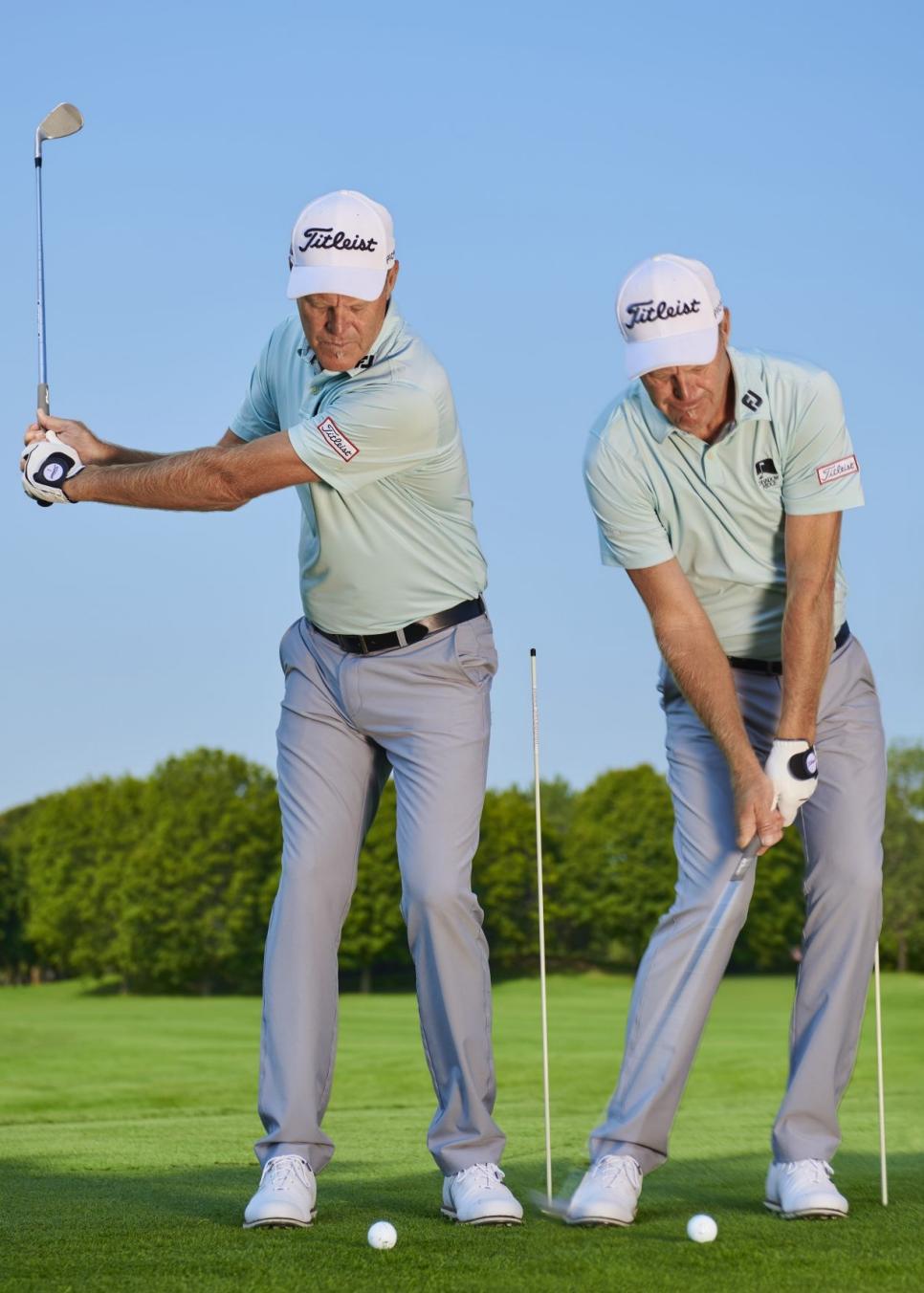
Forward shaft lean at impact is key to getting the right contact and trajectory on your distance-wedge shots. You produce it by first shifting laterally into your lead leg as you start down. You then use the ground to rotate your body toward the target as the club moves through the bottom of the swing. The common mistakes are too big of a backswing and decelerating in the downswing with minimal lower-body movement. To help you get a feel for the correct action, set an alignment rod in front of your lead hip (or imagine one) at address. The goal is to bump that rod as you swing down (above) and then rotate toward the target with your body. That’s what I call a “pelvic punch,” and it’s the engine of your distance-wedge game.
This article was originally published on golfdigest.com