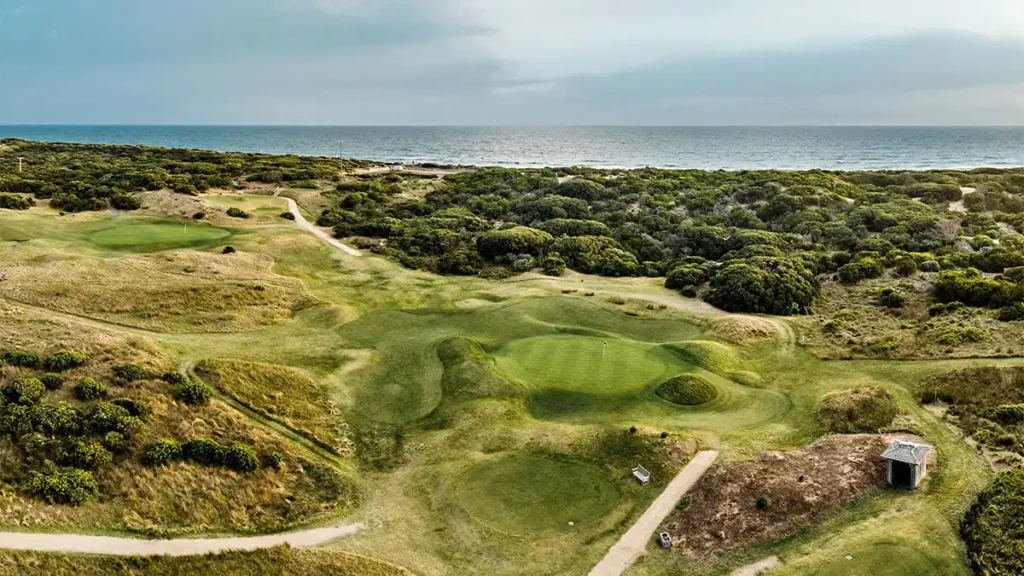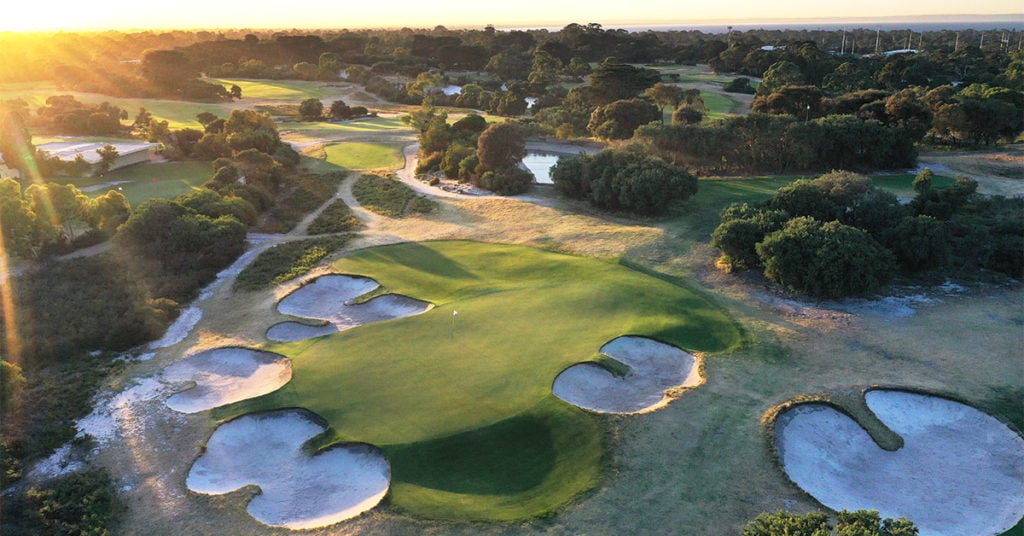
HOBART, Australia — Australian pro Mat Goggin was 13 years old aged 13 in the late 1980s, enjoying his first year of playing golf, when his grandfather insisted he head to 7 Mile Beach in Hobart, Tasmania, to hit balls off the sand. “Granddad was obsessed with Seve Ballesteros; he would say, ‘Go practice on the beach, because that’s how Seve learned to play golf,’” Goggin recalls.
Goggin was a fledgling junior member at Royal Hobart, where Jack Nicklaus won the 1971 Australian Open. He would look up from 7 Mile Beach to the rugged sand dunes—then covered by a planted pine tree forest—and wonder, ‘How cool would it be if Royal Hobart was there?’”
When the 7 Mile Beach Golf Course finally opened this month, the Charlotte, N.C.-based Goggin, now 51, had just won the New South Wales Senior Open while back in his homeland. A boyhood dream had taken 35 years to come to life, and Goggin played a huge role in making it happen.
In early 2010, links golf was still on Goggin’s mind months after sharing the lead with five holes remaining in the Open Championship at Turnberry, where a senior Tom Watson was beaten in a playoff by Stewart Cink. During a brief stint back in Australia, Goggin—a five-time winner on the now-Korn Ferry Tour—took former European Tour winner-turned-course designer Mike Clayton, or “Clayts”, to 7 Mile Beach to survey the land. “Clayts was amazing to me throughout my career; I only ever wanted him to be involved and to study the site and tell me that it wasn’t just me who saw potential there,” Goggin recalls.
Clayton interpreted the sandy peninsula overlooking Tiger Head Bay with the same enthusiasm.
After that, Goggin started passionately putting his concept to the Tasmanian government. Three years went by before environmental studies commenced. The proposal hinged upon 7 Mile’s ability to extend golf tourists’ visits to the island, both domestic and international. Doing so would require, among other things, Hobart to construct a world-class course as good as Tom Doak’s Barnbougle Dunes (and Barnbougle’s Lost Farm course), which opened to global acclaim in 2005 on the northern coast of the state. Cape Wickham (which Mike DeVries had co-designed) and Ocean Dunes followed on Tasmania’s King Island in 2015 and 2016, respectively.
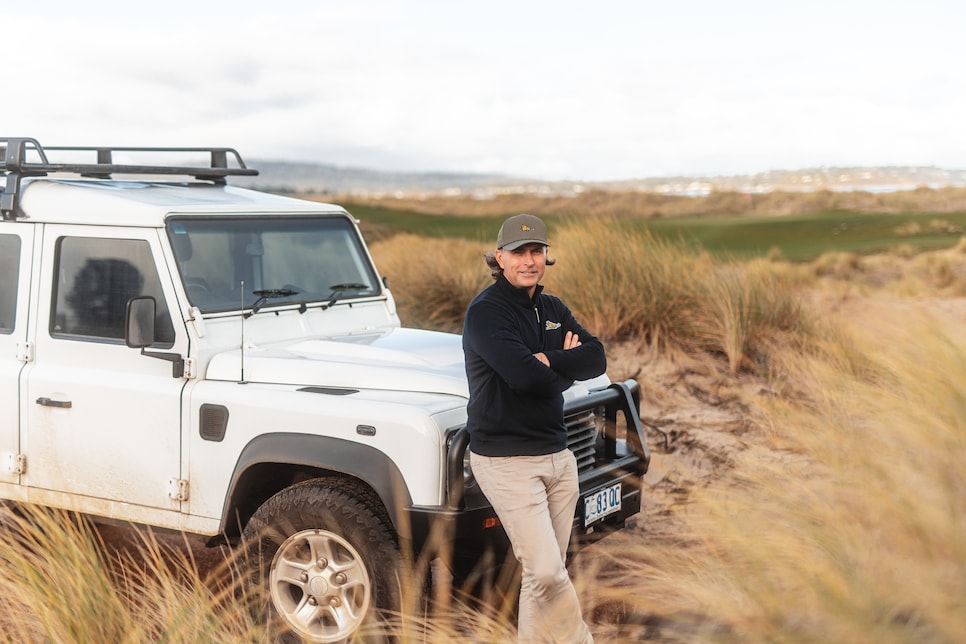
Mat Goggin first dreamed of a course at 7 Mile Beach when he was a kid practicing on the sand like Seve Ballesteros. (Courtesy of 7 Mile Golf Course/Will Watt Images)
“The success of Barnbougle Dunes helped [the Tasmanian government] understand golf tourism,” Goggin says. “If 7 Mile Beach had come first, I don’t think it could have been possible. So, they gave me a non-exclusive development license to do a soil test.”
By 2019, Clayton and Michigan native DeVries had cemented a successful partnership (Frank Pont is now also part of the firm). Finally, in February 2020, DeVries first turned soil at 7 Mile Beach.
“That was a week before COVID-19 hit, so I spent five days in Hobart before flying back to the U.S. and [due to border closures] we couldn’t go back for almost two years,” laughs DeVries, speaking via phone to Golf Digest.
In late 2021, Devries was able to immerse himself in the dunes for 18 months.
The result is an architectural masterclass in self-restraint; an Irish beauty of a links course. Devries was determined to achieve two things. Firstly, that 7 Mile Beach would be a great walk with seamless connectivity. Secondly, that every shot was engaging to golfers of all abilities. Celebrated as a modern minimalist in course design, DeVries refrained from chasing 18 of the highest possible tee boxes for the sake of ocean views. Doing so would create arduous walks uphill to every tee and back down, slowing pace of play and tiring golfers. 7 Mile has gradual build-ups that sometimes take two holes to reach vantage points atop the dunes, such as the breathtaking, short par-4 fifth. The majestic vistas from the tee and marvellous journey down to a quirky, three-leaf clover of a green beside the shore will undoubtedly become the signature hole in time.
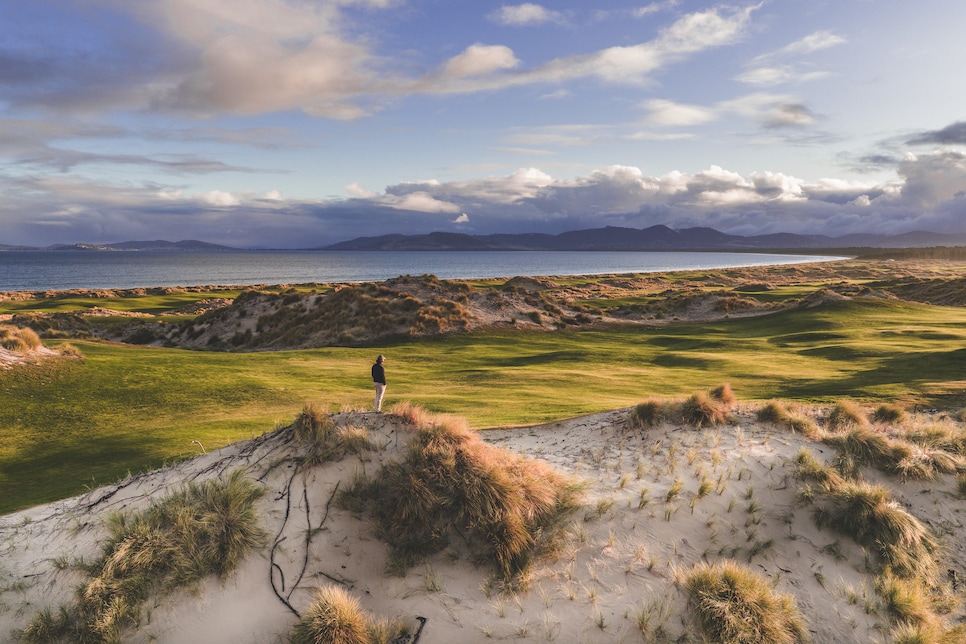
Mat Goggin surveys the course. (Courtesy of 7 Mile Golf Course/Will Watt Images)
“I’m a believer in the rhythm and flow of the walk; the distance between greens and tees but also how you experience the landforms,” DeVries says. “On one hand, 7 Mile has dunes that are 20 meters high and [on the other], the course goes down to the shoreline, essentially. There are low dunes, and then a deflation basin in the middle of the course at Nos. 12 and 15. There are mid-dunes and high dunes. How we traverse the course over all that is critical to creating an experience that moves seamlessly from one hole to the other.”
Perhaps 7 Mile’s true charm, aside from 18 holes of firm and fast fescue links turf, is in its experimental quirkiness. Several holes have multiple tee options, but not just in front of each other. At the par-3 second, tees on the right are perched high and level with an infinity green. From here, the ocean is visible from the tee. However, a handful of tees down and on the left, considerably lower, render an unrecognisable other par 3. Golfers peer through an alleyway and a small dune up to the green. This brings a large, left greenside dune into play.
“You first see the ocean walking up to the green on No. 2, as well as 90 percent of the golf course, and it’s a spectacular reveal,” Goggin says.
On the par-4 eighth, a dual green may become 7 Mile’s most talked-about feature. Not a shared green one would find on seven holes at St Andrews’ Old Course, rather two individual putting surfaces reminiscent of some of Japan’s great layouts. A large dune in the center of the fairway exacerbates the choose-your-own-adventure journey of this medium length par 4.
Goggin explains the dynamic between Clayton, the visionary, and DeVries, renowned for his hands-on approach to shaping every contour, is how they dug up the crown jewels of 7 Mile’s design.
“Originally, DeVries didn’t like the connection [of the left green on No.8],” Goggin recalls. “Then we went to lunch and DeVries stayed on his bulldozer. Forty-five minutes later, he called us and said, ‘Come back, I completely rebuilt this green. It’s going to work.’
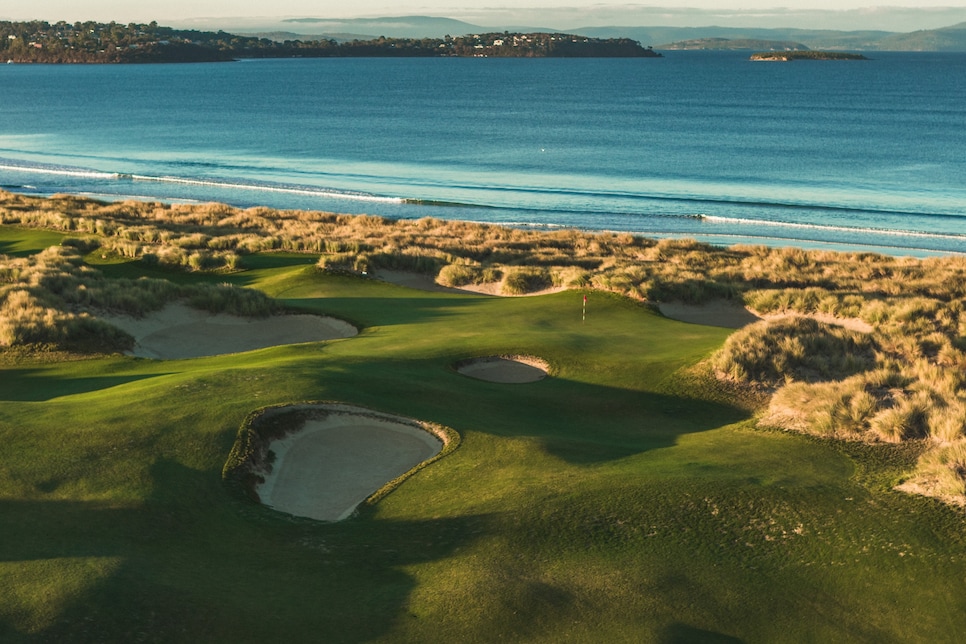
A view of the short, par-4 seventh. (Courtesy of 7 Mile Golf Course/Will Watt Images)
“A lot of the alternate tees came from Clayts because DeVries is the details guy, who builds the holes, while Clayts has the time to see the forest for the trees, as such. He looks at a golf hole in its totality and says, ‘It’s a cool hole, but what if we switch that here?’”
No. 10 is a driveable par 4 with a clever, center-line fairway bunker, while the highlights for the rest of the back nine include par 5s at 12 and 15, as well as par 3s at 14 and 17. The latter boasts a green site tucked just behind the breaking waves.
“I think 7 Mile Beach is more old-world links golf, asking the golfer, how many ways can you craft the shot at hand?” DeVries says. “You’re seeing [new courses] being built with these massive sandy waste areas, which are beautiful, but sometimes they require very little commitment to a shot.”
Since opening on Dec. 4, demand has been high for the world’s newest links course, particularly being located 10 minutes from Hobart airport. Hobart itself is a stunning, historic port town full of sandstone buildings, pubs, restaurants and boutique whiskey distilleries. There’s also an understated charm to 7 Mile, as golfers walk into what looks like a rustic campsite, with a pro shop inside a shipping container, a boutique coffee cart with additional beer taps, and a temporary clubhouse with lounging. Goggin’s sister, Emma Richmond, is the food and beverage manager and, along with her staff, can be seen making fresh espresso for golfers.
7 Mile’s popularity figures to only increase once the U.S. design firm of King Collins Dormer—of Sweetens Cove and Landmand fame—craft another 18 holes on the northern side of the peninsula. Eventually, 7 Mile Beach will have a membership base with a new clubhouse and will interchange which course is open daily to the public. At $A290 for the South course (approximately $200, U.S.), 7 Mile Beach would rank high among the world’s best value destination links golf.
7 Mile’s website promises the North course will be “different in character and equal in brilliance. If the South course is our dramatic Irish links, the North will be our classic Scottish masterpiece.”
No doubt, the North course will only double the reasons to travel from around the world to play two courses conceived by an imaginative teenaged golfer who just wanted to be like Seve.
This article was originally published on golfdigest.com