
AUGUSTA, Ga. — Is experience the best teacher? Or is the first time the charm?
Conflicting clichés often are thrown around to explain the outcome of a golf tournament, the winner being the phrase that best suits the narrative.
When it comes to who’s holding the hardware at the finish of the Augusta National Women’s Amateur, however, experience is, to use another cliché, gaining momentum. Consider that the last three champions of the event—Rose Zhang, Lottie Woad and Carla Bernat Escuder—each had played at least once in it victory.
It’s a trend that looks likely to continue in 2026. Asterisk Talley, the 17-year-old from Chowchilla, Calif., who didn’t make a bogey in either of her two opening rounds at Champions Retreat and starts the final round in the lead at 11 under par, is playing the ANWA for her third time. Meja Ortengren, one shot back and playing in the final group with Talley on Saturday, is making her fifth ANWA start. Maria Jose Marin, also tied for second, is playing for a fourth time.
Going down the leaderboard further, for the second straight year the top five and ties entering the final round is entirely comprised of returning players with the closest first-timers six shots back.
It’s not just the top of the board, but the field overall. Through two rounds, the stroke average for returning players (37 of the 72-player field) is 72.041 while the average for first-time players is about a half-stroke higher at 72.536.
Granted, the event only began in 2019, so the sample size is small. Still, why do “veterans” seem to be playing better?
“I think the first time you get to play Augusta National is very intimidating, and there’s a lot of things going around outside of just the golf part,” said Ortengren, a 21-year-old from Sweden. “So I think you need maybe at least a year to get to go around Augusta twice and see how it’s really like in competitive settings.
“For me, myself, I’ve learned a little bit every single year, and I now feel more comfortable of playing at such a big stage.”
Marin, a 19-year-old from Colombia, echoes the benefits of getting comfortable.
“One of the biggest challenges the first time that you play Augusta, it’s everything that’s on your mind that you see on TV and all the expectation that you have from the course.”
If the refrain sounds familiar, you only have to look to the “other” tournament that Augusta National hosts—the Masters. Just once since 1935 has a player making his debut in the major championship gone on to win the green jacket: Fuzzy Zoeller in 1979.
Of this year’s contenders, Talley has the “best” experiences to lean on. In 2025, she shot a final-round 68 at Augusta National to grab a share of second place. In 2024, after being the youngest player to make the cut, she shot a two-under 70 for a T-8 showing.
“You have to be a little aggressive at times, and I think knowing the course a little better is going to help you in those situations where you need to be a little more aggressive or you need to hit a good shot in that moment,” Talley said. “I think just knowing where to miss and where not to miss on this course is going to be pretty crucial, and just being around it for that long is going to help a little bit.”
“I think it will help her a ton,” says Chris Zambri, who oversees the U.S. National Development Program, in which Talley is a team member. “She’s got to have nothing but good memories. It’s not a ginormous sample space. We’re talking about two rounds, but she’s playing great golf. She’s a really good player. … She’s got that kind of mental strength and confidence in herself. That’s probably a big reason why she might go out and play well.”
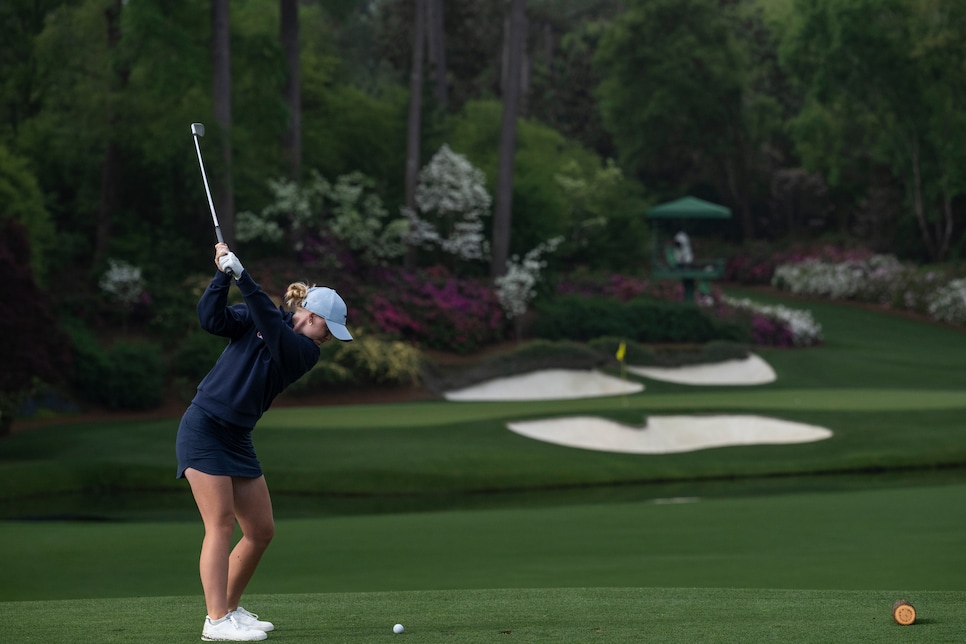
Now playing her fifth Augusta National Women’s Amateur, Ortengren says she’s more comfortable in handling the atmosphere surrounding the event.
Logan Whitton
If Talley has good memories, then Marin’s are … well something different. The reigning NCAA individual champion has made the cut in two of her three previous starts, but posted disappointing rounds of 76 and 78 at Augusta National.
Not surprisingly, Marin says that her past experiences have led to her altering her approach to the course during the practice rounds at Augusta National. Where before she tired some of the famous shots she’s seen played on the course, like Tiger Woods’ chip shot from the back of the 16th hole, she’s focused on preparing for shots that she’s more likely to encounter during the final round.
“I think that’s one of the biggest changes that I made this year,” Marin said. “Now my preparation changed a lot, and I’m giving myself more shots that I’m actually going to play and going to change the mindset a little to, yes, respecting the course, but being a little bit less scared of.”
Could one of the first-timers from far off the lead chase down the leaders on Saturday and claim the title? Talley and Ortengren both said that could easily happen given just how tricky Augusta National can be.
Additionally, just because you’ve played in the tournament before doesn’t mean walking to the first tee will be any less tense than in previous years.
“I feel a little bit more comfortable coming into this tournament this year than before, but I also know that I’m going to be super nervous on the first tee tomorrow,” Ortengren said. “I really do feel the pressure of this event. I don’t think that the pressure is ever going to really disappear from this event. It’s such a prestigious amateur event that we all look forward to each and every year, so I don’t think that it’s going to change even though you are here for the eighth or ninth time.”
But at least Ortengren knows what to expect and is better equipped to handle those nerves when they come. So it is that she hopes its actually the fifth time that’s the charm.
This article was originally published on golfdigest.com