
[PHOTO: Sam Greenwood]
During the first round of the 2024 Players Championship, things came to a screeching halt on the seventh hole at TPC Sawgrass when Jordan Spieth debated the proper drop location for a hooked tee shot that Rory McIlroy had plunked into a penalty area. McIlroy wanted to drop much closer to the hole than Spieth thought was correct. And thus, the awkward exchange occurred.
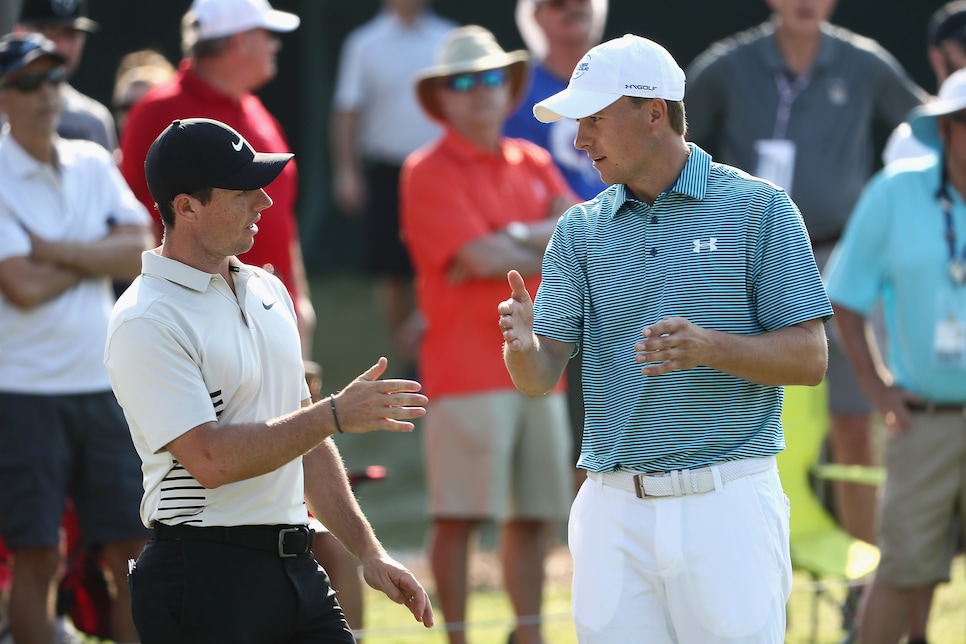
Photo: Jamie Squire
When things settled down, everyone was satisfied (at least outwardly) with the outcome. McIlroy ended up dropping further back than he wanted, but let’s play the “what if” game for a moment. What if McIlroy didn’t consult his playing partners and went ahead and dropped where he wanted? And what if some form of evidence came to light that showed his ball crossed the margin of the penalty area much further back than where he dropped?
RELATED: Can you get free relief from a sprinkler head on your line of play? Maybe (we’ll explain)
This is where Rule 14 comes into play – and you find out what should happen to that guy you saw attempt to take a penalty drop but didn’t get it exactly right. Granted, it might be a casual round, and you might be tempted to let it slide, but what if you’re playing for $20 a side? Or if it’s the third day of your annual trip away? No one wants to be that golfer who calls out an illegal procedure, but here’s what you should do according to the Rules of Golf.
Rule 14.7a says that, after taking a penalty and dropping the ball incorrectly, a second penalty applies if that golfer doesn’t correct the mistake before hitting his or her next shot. It’s the general penalty (two strokes or loss of hole in matchplay). If you call out the player before he or she hits, then that golfer has a chance to correct the mistake before incurring the additional penalty. So perhaps think of your “call out” as a humanitarian effort. You’re just trying to help whomever save a couple of shots.
Interestingly, if you drop in the wrong place in strokeplay and finish the round not knowing you made a mistake, it’s not grounds for disqualification even though you signed for an incorrect score. Rule 3.3 lets you fix the error, provided the competition hasn’t been completed, by adding the penalty strokes for that hole and adjusting the total score. In matchplay, once a round is over, the status of the match stands without the loss-of-hole penalty adjustment as long as the player committing the penalty had no idea he or she reported the wrong number of strokes taken.
It’s also interesting to note that a drop that begins incorrectly is still considered as playing from the wrong place even if it ends up in the correct spot. It’s like solving a maths problem without showing your working. An example: if you are supposed to drop using the back-on-the-line relief, but you don’t drop in the right spot, it doesn’t matter if the ball winds up on the actual line. You didn’t do it right. So the penalty for 14.7 still applies.

Photo: John W. McDonough
Tiger Woods famously took an improper drop at the 2013 Masters that could have led to his disqualification after signing an incorrect scorecard. Amazingly (or perhaps not), the Masters tournament committee took pity on him and levied only a two-stroke penalty on him for playing from the wrong place.